A residential community of more than 2,500 people in Taman Gemilang Peringkat 4, located in Bandar Cheneh Baharu near Chukai, experienced a frightening overnight visitation when a herd of wild elephants descended upon the housing estate on July 24. The incursion marks an escalating pattern of human-wildlife conflict in the area, raising serious concerns among residents about their safety and the future security of their homes and livelihoods in the region.
Wan Nordin Wan Omar, 63, who chairs the Federal Village Development and Security Committee for Kampung Peringkat Empat, emphasised the gravity of the situation by noting that this represents the second elephant invasion within a single calendar year, following an earlier encounter in May. The recurrence within such a short timeframe signals a troubling trajectory in wildlife behaviour, suggesting that the animals are becoming habituated to human settlements rather than maintaining a natural distance from populated areas.
Community leaders have drawn a direct line between the escalating elephant incursions and intensive extraction industries operating in the region. Uncontrolled logging operations and mining activities are fingered as primary drivers pushing the elephant herds out of their natural habitat and into areas where human families, schools, and businesses now stand. By destroying the forest environment that traditionally sustained these large mammals, industrial activities have fundamentally altered the elephant population's relationship with land and forced them to seek sustenance in gardens, orchards, and residential compounds where humans reside.
The elephant herd's behaviour during the July 24 incident demonstrated the boldness that now characterises their approach to human settlements. Rather than passing through quickly or maintaining distance from occupied structures, the animals moved deliberately through the residential area in apparent search of food sources. Residents watched helplessly as the herd targeted cultivated plants and crops, treating the housing estate as an extension of their foraging territory rather than an environment they should naturally avoid.
Johazly Mat Zin, a 53-year-old resident, recounted his harrowing experience when he awoke to loud disturbances originating from behind his home at approximately 1:30 in the morning. Upon investigating by opening his bedroom window, he discovered several wild elephants actively feeding on banana trees planted in his yard. The encounter left him confined within his own home, unable to venture outside to protect his property or drive away the animals due to legitimate fears for his family's physical safety. Only after the herd had satisfied its appetite did the animals eventually depart from the residential area.
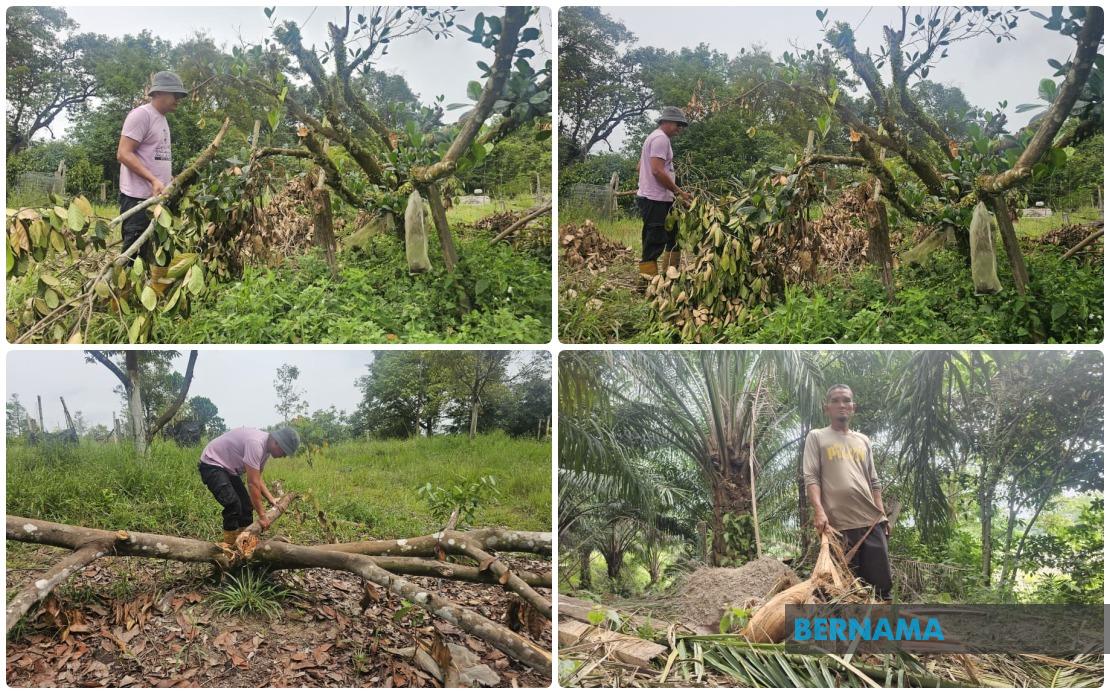
The economic toll on the community extends beyond the frightening nocturnal encounters themselves. Mohd Fazli Mat Yusof, aged 36, documented significant agricultural losses sustained by local farming families when the elephant herd damaged multiple fruit and plantation trees across properties. Five farmers reported combined losses exceeding RM30,000 as the animals destroyed durian, rambutan, cempedak, and jackfruit trees, alongside coconut palms and protective fencing. These losses represent not merely destroyed crops but damaged livelihoods for families who depend on agriculture as a primary income source in a region where economic opportunities remain limited.
The scale of property damage and the agricultural losses underscore how wildlife intrusion extends far beyond momentary panic. For farmers in Terengganu, losing fruit trees represents a setback measured not in weeks but in years, as mature trees require considerable time to regrow and produce commercially viable yields. The destroyed fencing also leaves properties vulnerable to further incursions, creating a cascading effect of vulnerability and financial strain that accumulates across affected households.
Authorities have acknowledged the situation and initiated response measures, though the effectiveness remains uncertain. Dennis Ten Choon Yung, the director of Terengganu's Department of Wildlife and National Parks (Perhilitan), confirmed that his department has launched investigations and begun monitoring the movement patterns of the elephant herd. The stated objective involves preventing future encroachment into residential zones, though the approach appears reactive rather than proactive, focused on managing symptoms rather than addressing underlying causes of habitat destruction.
The community's plea for intervention reflects a deeper regional problem affecting multiple parts of Malaysia, particularly in Peninsular states where wildlife habitat continues to shrink while human settlements expand into previously forested areas. The situation in Bandar Cheneh Baharu exemplifies the collision between industrial development priorities and wildlife conservation, a tension that shows few signs of resolution without significant policy shifts. Residents are demanding that authorities address not merely the elephant movements themselves but the root cause of forest destruction that has displaced the animals in the first place.
For Malaysian policymakers and environmental officials, the recurring incidents in Terengganu serve as an uncomfortable reminder that habitat loss creates compound problems extending far beyond ecological considerations. When forests vanish, the animals occupying them do not simply vanish themselves but increasingly appear in populated areas, creating public safety hazards, damaging property, destroying agricultural livelihoods, and generating the very human-wildlife conflicts that authorities now struggle to manage. The question facing Terengganu's leadership is whether they will continue firefighting individual elephant incidents or confront the extraction industries fundamentally altering the state's natural landscape.

