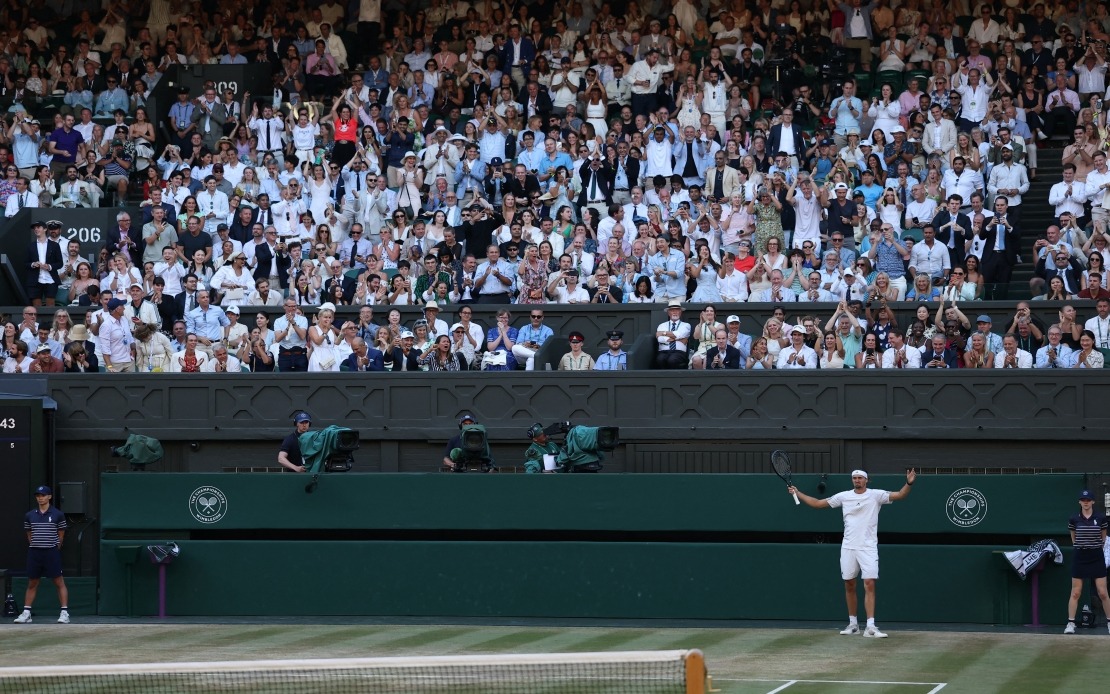
Jannik Sinner's commanding four-set victory over Alexander Zverev in the men's singles final capped off an enthralling fortnight at the All England Club, delivering the kind of compelling conclusion that Wimbledon's devoted following had anticipated. The Italian's triumph represented not merely a tournament victory but a statement of intent from a player increasingly establishing himself among tennis's elite, cementing his status as a major force in men's tennis and validating the expectations that have surrounded his career arc.
The women's singles final provided an emotional rollercoaster that will endure as one of the tournament's most dramatic encounters in recent memory. First-time grand slam finalist Marketa Noskova appeared destined for heartbreak when she squandered five championship points during a stunning second-set collapse, watching her commanding position unravel in ways that seemed to echo the ghosts of Wimbledon past. The 21-year-old Czech player's struggle recalled the tragic final of Jana Novotna, the legendary Czech champion whose tears on the Duchess of Kent's shoulder after losing to Steffi Graf in 1993 remains one of sport's most poignant images. Yet where Novotna had endured years of anguish before claiming her own Wimbledon triumph in 1998, Noskova demonstrated remarkable mental fortitude. During a bathroom break, she walked past the tournament trophies and made a vow that would prove prophetic: "I'm taking the big one!" Her ability to recover from that psychological precipice and ultimately prevail in the final set demonstrated the resilience increasingly demanded of modern champions.
British wild card Jack Fery emerged as the tournament's most improbable and beloved success story, transforming from a modest world ranking of 114 into a semi-final contender and reinvigorating British tennis sentiment during what had otherwise been a disappointing championships for the host nation. The 23-year-old from Wimbledon itself etched his name into the record books as only the fifth British man this century to reach the tournament's second week, a distinction that carried particular weight given the absence of stronger domestic competitors in earlier rounds. His performances captured the public imagination in ways that transcended mere athletic achievement, tapping into the romantic notion of sporting fairytales that the sport cherishes.
Fery's quarter-final triumph exemplified his tournament narrative. Trailing 4-1 in both the fourth and fifth sets against Zizou Bergs on a scorching Court 18, Fery displayed the kind of resilience that separates champions from contenders. The match unfolded under grueling conditions, with the British player enduring three nosebleeds whilst mounting his comeback against an opponent ranked 77 places higher in the world. After levelling the match through a tie-break, Fery maintained his composure as Bergs visibly lost his equilibrium, ultimately prevailing in the tense 10-point decider that sent him through to the semi-finals and into the consciousness of British sporting fans.
Novak Djokovic's quarter-final marathon against Felix Auger-Aliassime provided yet another demonstration of the Serbian legend's seemingly inexhaustible reserves of competitive fire, though the match ultimately proved a pyrrhic victory that hastened his departure from the tournament. The clash consumed five hours and fifteen minutes, establishing itself as the longest quarter-final in Wimbledon history and concluding a mere eight minutes before the championship's 11pm curfew. The 39-year-old 24-time grand slam champion faced multiple obstacles beyond his opponent's racket, including a calf problem requiring treatment at the end of the opening set and a heated confrontation with tournament referee Denise Parnell regarding the roof closure before the third set. Despite navigating these challenges to overcome the third seed, Djokovic's evident exhaustion contributed to his semi-final elimination to Sinner, suggesting that even his legendary stamina possesses finite limits.
The women's semi-final between Coco Gauff and Karolina Muchova distilled the entire tournament's drama into a single climactic tie-break that stretched eighteen pulsating minutes and featured multiple match points for both competitors. At 8-8, Muchova incurred a time violation before sending her serve beyond the baseline, presenting Gauff with her first match point opportunity. Yet the American somehow squandered this opening, dumping what should have been a relatively straightforward drop-shot winner directly into the net in a moment of stunning lapse. Muchova appeared poised to seize her own match point but dramatically lost her footing whilst approaching the net, allowing Gauff's cross-court forehand to pass her with the precision that comes from superior conditioning and mental clarity. When Muchova's next match point opportunity arrived, she executed a masterclass in movement and shot placement, engineering a winning position before Gauff's exhausted forehand find the net, delivering the Czech ninth seed her place in the final.
Serena Williams's return to competitive tennis at age 44, nearly four years after publicly stepping away from the sport, commanded the opening week's narrative and attention in ways that transcended conventional tournament coverage. The American icon's wild card invitation and subsequent appearance on Centre Court generated a standing ovation that underscored her status as sport's most transformative figure of the modern era. Against Australian opponent Tamara Joint, a player twenty-four years her junior, Williams demonstrated glimpses of the formidable competitor who had dominated women's tennis for two decades, even securing an early break in the deciding set that suggested an improbable victory might materialize. However, Williams's physical condition ultimately limited her capacity to sustain the intensity required at tennis's highest level, as Joint managed the pressure and the occasion with impressive maturity whilst Williams's performance declined in the match's closing phases.
Williams's physical struggles during the match later proved more significant than her on-court performance suggested, as a knee injury sustained during the first set's closing stages forced her withdrawal from a planned doubles partnership with her sister Venus. The setback underscored the precarious nature of athletic comeback attempts at advanced ages and hinted at the physical toll that even brief returns to professional competition exact upon aging athletes. Yet Williams's appearance nonetheless succeeded in its broader purpose, reminding the sport of her enduring significance and captivating global audiences with the narrative of an athlete refusing complete retirement despite the physical and temporal distance separating her from her competitive peak.

