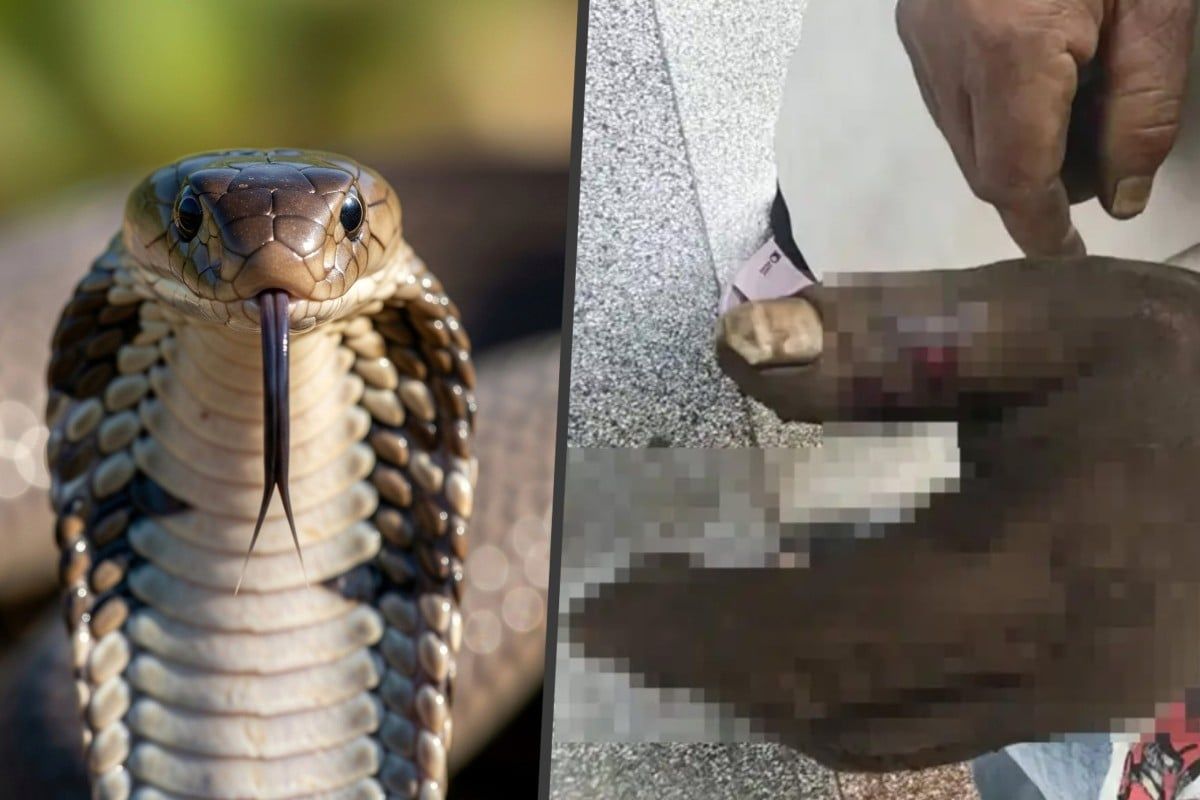
A dramatic medical incident in southwestern China has highlighted the dangers of treating snake bites using methods popularised by television dramas and films. When a farmer in Yunnan province's Yuanyang county was bitten by a cobra whilst working in his field, his wife's well-intentioned but misguided rescue attempt ended with both of them requiring emergency hospital treatment.
The husband's condition deteriorated rapidly after the cobra struck his finger. As his hand swelled dramatically and he experienced dizziness and weakness, his wife took action based on what she had observed in televised emergency scenarios. Without any protective equipment or precautions, she placed her mouth directly on the wound and attempted to extract the venom through suction. This traditional-sounding approach, which has captured public imagination for generations, would prove disastrous.
The farmer was quickly transported to hospital for professional medical care. Yet within hours of the incident, his wife began displaying alarming symptoms of her own—numbness spreading across her mouth, tongue, face and limbs. The following day, as overwhelming fatigue set in, her family recognised the severity of her condition and rushed her to Honghe Prefecture No 3 People's Hospital. Medical staff diagnosed both patients with cobra poisoning and administered antivenom serum alongside supportive treatments. Fortunately, within several days both had stabilised sufficiently for discharge.
Medical professionals at the Yunnan facility used the case as an opportunity to dispel widespread misconceptions about snakebite management. The human mouth, they explained, contains a particularly rich network of tiny blood vessels in its mucous membrane. When venom contacts this delicate tissue, it requires mere seconds to enter the bloodstream, triggering systemic poisoning in the rescuer. This physiological reality makes the suction method catastrophically dangerous for the person attempting rescue, not merely ineffective.
Doctors also stressed that the very structure of snakebite wounds makes venom extraction virtually impossible through suction alone. Cobra fangs typically create puncture wounds barely larger than pinholes. Once the venom enters the tissue beneath the skin or the bloodstream, it distributes far too rapidly and widely to be mechanically removed. The window of opportunity, if one existed, closes within seconds of the bite. Television dramatisations, whilst visually compelling, bear little resemblance to the actual timeline and mechanics of envenomation.
Equally dangerous is another persistent myth: the notion that cutting open a snakebite wound and allowing it to bleed will help remove venom. Such intervention carries serious risks of excessive blood loss and infection for the already-wounded victim. Similarly, exposing the bite to extreme temperatures—either through burning or ice application—causes tissue damage without any therapeutic benefit. These interventions transform a serious injury into a compounded medical emergency.
Instead, medical authorities recommend a fundamentally different approach centred on minimising venom circulation and ensuring rapid professional treatment. The moment a snakebite is suspected, the victim should immediately contact emergency medical services. Movement should be kept to an absolute minimum, as physical activity accelerates the spread of venom through the lymphatic system. When possible, observers should carefully note the snake's identifying characteristics—coloration, scale patterns, head shape—and even capture photographic evidence if safely feasible. This information proves invaluable for medical teams determining the correct antivenom and monitoring for specific systemic effects.
Snakebite incidents continue to generate significant online discussion in China, with the Yunnan case resonating particularly strongly across social media platforms. A notable case from May underscored how critical rapid intervention remains. A fourteen-year-old student in Guangdong province suffered a snakebite on his school campus but initially minimised the incident, feeling no immediate pain and unsure of what had bitten him. Only hours later, as numbness invaded his limbs and his vision blurred, did he report the incident to school authorities. The medical team that treated him made a sobering assessment: had treatment been delayed by just one to two hours, the boy would have experienced respiratory failure, potentially proving fatal.
This clinical reality—that envenomation effects can be catastrophically delayed and that window of effective treatment is genuinely narrow—explains why public education on proper snakebite response remains crucial, particularly in rural and agricultural regions where contact with venomous snakes is more frequent. The Yunnan couple's experience, whilst fortunate in its outcome, powerfully illustrates why intuitive or dramatised responses to snakebites can transform a manageable emergency into a multi-victim crisis. Online commentators reflected on the incident with recognition that popular entertainment has normalised dangerously inaccurate emergency procedures. One observer noted that the case demonstrated how unreliable television drama protocols could be in genuine medical emergencies, whilst another remarked, with some poignancy, that the wife's actions nonetheless reflected the depth of her commitment to her husband—even as those actions placed her in serious peril.

