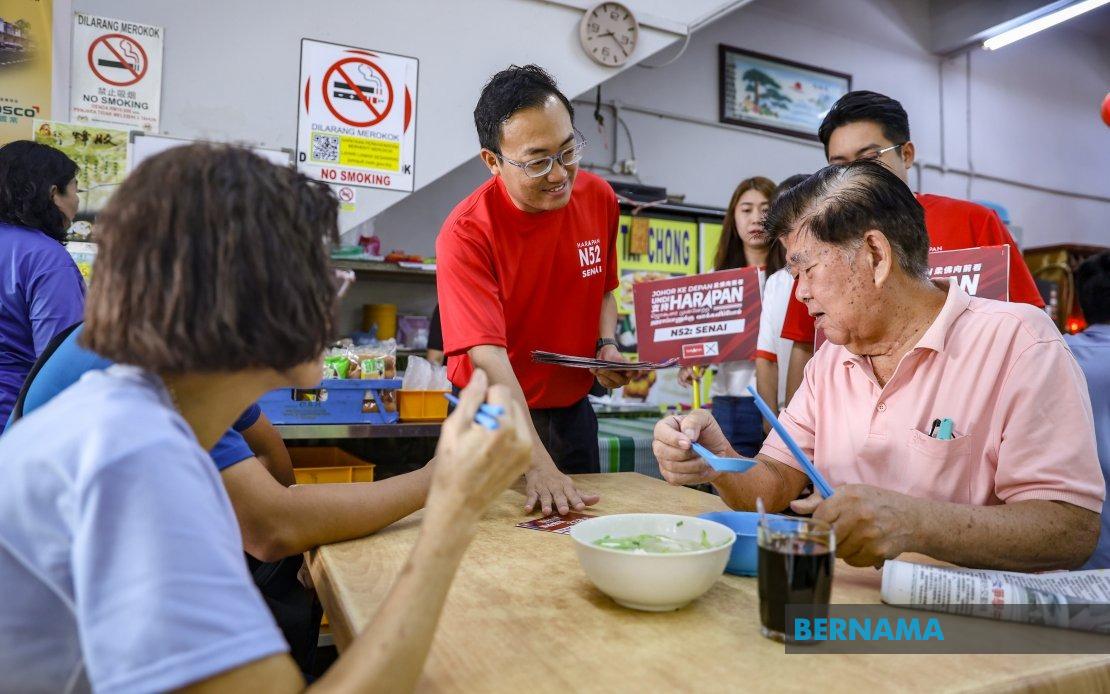
Wong Bor Yang, the incumbent assemblyman for Senai, is approaching the 16th Johor state election with confidence in his ability to retain the seat for Pakatan Harapan (PH). Speaking in Kulai, Wong presented his previous term as evidence of sustained commitment to constituency welfare, particularly through initiatives addressing flooding and upgrading public amenities—a messaging strategy that seeks to position him as a candidate of substance rather than rhetoric in a competitive three-cornered race.
The Senai state seat, which encompasses 66,635 registered voters, will see Wong contest against Barisan Nasional (BN) candidate Tai Chee Chee and independent Bersama candidate Tew Chien How when Johor goes to the polls on July 11, with early voting scheduled for July 7. His candidacy represents continuity within the coalition that currently holds the state, while his opponents will attempt to break PH's grip on what has become a politically significant constituency in southern Johor's more urbanised landscape.
Wong's political trajectory reflects the shifting alignments that have characterised Malaysian politics over the past decade. Since 2014, he has occupied various roles—initially as a special officer within the office of Kulai Member of Parliament Teo Nie Ching, then transitioning through local council positions beginning in 2018, before eventually securing the state assembly mandate. This progression, he argues, has equipped him with practical understanding of constituent needs across different levels of governance and political configurations, a distinction he emphasizes to voters who may be evaluating competing visions for the constituency's future development.
Flood management emerged as a signature achievement in Wong's campaign narrative. His administration secured RM1 million from the state government to upgrade drainage infrastructure in Taman Aman and channel water toward Sungai Skudai, while an additional RM3 million—mobilised through collaboration with Kulai MP Teo Nie Ching—addressed chronic flooding in Peladang Kulai Besar and Saleng. These areas have been removed from the district's list of flash flood hotspots, a material improvement that Wong presents as evidence that persistence within the legislative framework yields tangible results for residents.
Beyond infrastructure, Wong has oriented himself toward cultural preservation and community amenities. He championed the transformation of a former cinema into a community operations centre and refurbished a two-decade-old badminton court into a recreational facility branded as Tiny Lake under the Sejati MADANI programme. These initiatives, while modest in scale, reflect an attempt to position development as encompassing both practical problem-solving and quality-of-life enhancement—a positioning that may resonate with voters in increasingly cosmopolitan suburban constituencies like Senai.
Healthcare represents the anchor of Wong's proposed agenda for a second term. With a journalism degree from Shih Hsin University in Taiwan, Wong brings an outsider's perspective to state-level politics, having previously worked in media before transitioning to public service. He contends that Kulai Hospital's current 93-bed capacity inadequately serves a district whose population is projected to reach 500,000 by 2030, a demographic reality that raises legitimate questions about healthcare infrastructure planning across southern Johor's rapidly developing zones.
A specific grievance Wong highlighted involves the stalled construction of a new health clinic in Taman Mewah, Senai. Land-related bureaucratic impediments at the state level have delayed the project, preventing the Ministry of Health from commencing construction despite apparent readiness to proceed. This technocratic obstruction—seemingly resolvable through administrative coordination—illustrates how infrastructure projects frequently become entangled in state-level processes, an issue that Wong positions himself as capable of unblocking through connections and legislative leverage.
Wong's approach to campaigning reflects confidence in what he terms the political maturity of the Johor electorate, particularly among voters in constituencies like Senai where rapid urbanisation has created populations accustomed to comparing candidate performance against measurable outcomes. His emphasis on proven track record rather than aspirational promises targets constituencies where previous dissatisfaction with underperformance has accelerated political volatility. This positioning becomes particularly relevant in light of Johor's historical role as a politically significant state where shifts in support can portend broader national trends.
The constellation of challenges facing Senai—flooding, healthcare capacity, infrastructure modernisation—reflects broader development pressures affecting Johor's metropolitan fringe. Wong's record on these issues will likely dominate local campaigning, though broader state and national political currents will inevitably influence voting patterns. The presence of a Bersama candidate suggests that dissatisfaction with conventional political alignments persists even in constituencies where sitting assemblyman have compiled credible records.
Wong's confidence in PH's ability to retain Senai rests fundamentally on the notion that voters will prioritise demonstrated competence over alternative propositions. This thesis will face its test during the campaign period and ultimately on election day, when Senai's 66,635 registered voters will render judgment on whether continuity or change better serves their constituency's evolving needs in an increasingly complex metropolitan landscape.

