The 2026 FIFA World Cup has scattered itself across North America's most dynamic urban centres, and the scale of the tournament's presence varies dramatically from city to city. Reuters photographers stationed at training camps and matches throughout the competition have documented not merely the football itself, but the deeper cultural transformations taking place in each location. Their accounts paint a picture of how international sport functions as a unifying force, bringing together communities that often remain isolated within sprawling metropolitan areas.
In Mexico City, photographer Raquel Cunha discovered that football's influence extends far beyond Estadio Azteca's historic walls. The capital's passion for the game permeates everyday neighbourhoods, where residents have reshaped their local geography to carve out space for soccer pitches. This grassroots enthusiasm contrasts with the international spotlight on the Azteca, which has housed some of the tournament's most pivotal moments, including two World Cup finals. The observation suggests that for Mexicans, the tournament merely amplifies an existing cultural reality rather than introducing something novel.
Westward in Guadalajara, nostalgia intertwines with present celebration. Older residents still vividly remember Pelé's 1970 appearance in their city, and the unveiling of a statue honouring the Brazilian legend has deepened that connection to football history. Photographer Ivan Arias witnessed something equally compelling: a spontaneous friendship emerging between Mexican and Colombian supporters. What began as encounters between rival fans evolved into genuine camaraderie, with attendees crossing traditional boundaries to celebrate at each other's gatherings and matches. This phenomenon reveals how football transcends national allegiance in ways that political and economic relationships often cannot achieve.
Monterrey exemplifies how deeply embedded football is in Mexican social fabric. Rather than confining the sport to professional stadiums, locals integrate matches into domestic leisure—backyard gatherings accompanied by barbecue and beer, or casual bar conversations. This integration suggests that for many Mexicans, the World Cup amplifies existing social practices rather than disrupting them.
Miami presents a distinctly different narrative. Amanda Perobelli observed that the city's substantial Latin American population has transformed the World Cup experience into something akin to an extension of ordinary urban life rather than a transformative event. The overwhelming heat and humidity pose physical challenges for photographers spending extended hours outdoors, yet visiting fans appear largely unbothered. This suggests that Miami's multicultural character already accommodates global sporting celebration, requiring less dramatic social reconfiguration than cities with smaller international populations.
Texas's sprawling character—evident in its vast barbecue portions, six-lane highways, and enormous stadiums—has shaped a distinctly expansive World Cup experience. Phil Noble documented Mexican-shirted fans flooding the streets, many of whom enthusiastically supported non-Mexican teams during their own matches. Hannah McKay was present when Lionel Messi set the record for most goals at a men's World Cup, describing the stadium atmosphere as extraordinary. The Texas cities hosting matches have demonstrated that scale itself—whether of venue, distance between locations, or merchandise variety—influences how populations experience global sporting events.
Atlanta's unconventional stadium design, featuring a retractable roof and set-back seating, initially seemed misaligned with traditional football aesthetics. Yet photographer Claudia Greco observed that the atmosphere remained vibrant, with crowded fan zones and television-equipped restaurants generating substantial business. This suggests that architectural and operational details matter less than the collective energy fans bring to an occasion.
Los Angeles and San Francisco offered insights into how the World Cup activates immigrant communities. Daniel Cole noted that the city's characteristic car-dependent culture yielded temporarily to communal street presence, with various diaspora communities—Iranian, South Korean, Mexican—visibly celebrating their ancestral nations. Carlos Barria, based in San Francisco, observed that immigrant flags, languages, and culinary traditions emerged prominently during the tournament. He contrasted this openness with the anxiety many immigrant communities experience under recent U.S. migration policy shifts. The World Cup thus functioned as a counternarrative, introducing Americans to global cultures while simultaneously offering immigrants a legitimate platform for public cultural expression.
Kansas City, straddling the Kansas-Missouri border, demonstrated that football enthusiasm coexists comfortably alongside deeply rooted baseball and American football traditions. Kai Pfaffenbach found an overwhelmingly positive atmosphere, with residents prioritizing collective enjoyment and celebration over competitive sporting tribalism. Philadelphia offered the inverse observation: photographer Siphiwe Sibeko, accustomed to South African football culture where tournaments dominate public conversation, found the World Cup's presence remarkably contained, visible primarily near the stadium on match days.
New York's simultaneous hosting of World Cup celebrations and the Knicks' first NBA championship in over fifty years exemplified the city's capacity for managing competing entertainment spectacles. Dylan Martinez documented Norwegian fans performing their Viking chant tradition and Latin American supporters flooding Times Square for pre-match festivities. This convergence reinforces New York's identity as a city operating continuously at full cultural capacity.
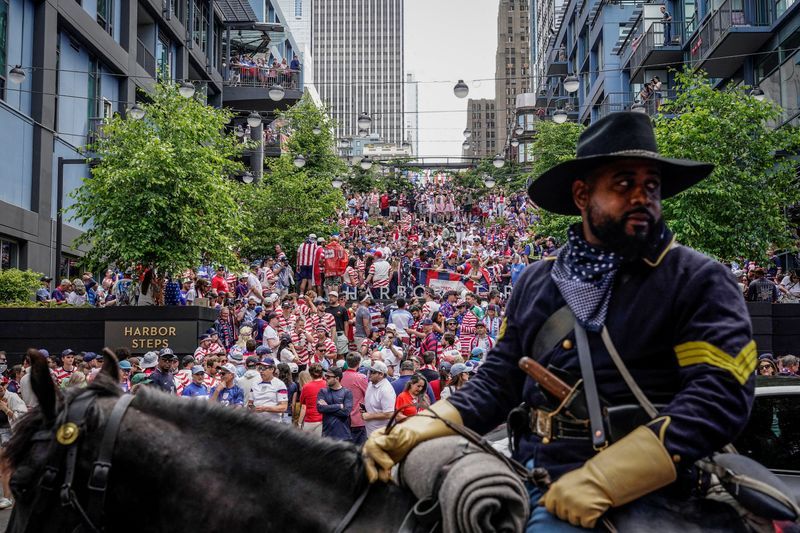
Boston's experience proved particularly revealing when contextualized against the 1994 World Cup, which the United States previously hosted. Brian Snyder, who documented that earlier tournament from Boston and has returned to his hometown for 2026, observed dramatically increased fan participation compared to three decades ago. Beyond the well-publicized embrace of Scotland's Tartan Army, Haitian, Moroccan, and Cape Verdean communities mobilized to support their national teams, suggesting growing comfort with public expression of sporting identity.
Toronto offered an entirely unexpected narrative when photographer Bernadett Szabo encountered a falcon family residing at the stadium—an encounter that underscored how major sporting events sometimes create surprising collisions with local ecosystems. Vancouver, by contrast, displayed comparatively subdued engagement, with photographer Agustin Marcarian, typically based in Buenos Aires, finding the tournament's atmospheric impact less pronounced than in other host cities.
Seattle completed the geographic arc with festive stadium surroundings where crowds dressed patriotically and abundant concession infrastructure supported large gatherings. Photographer Albert Gea interpreted this as reflecting an American sporting philosophy that treats major events as comprehensive entertainment experiences rather than narrowly focused athletic competitions. Across all sixteen locations, the World Cup functioned less as a disruption to urban life than as a temporary intensification of existing cultural patterns—a global sporting event that ultimately reveals how differently cities integrate football into their identities.

