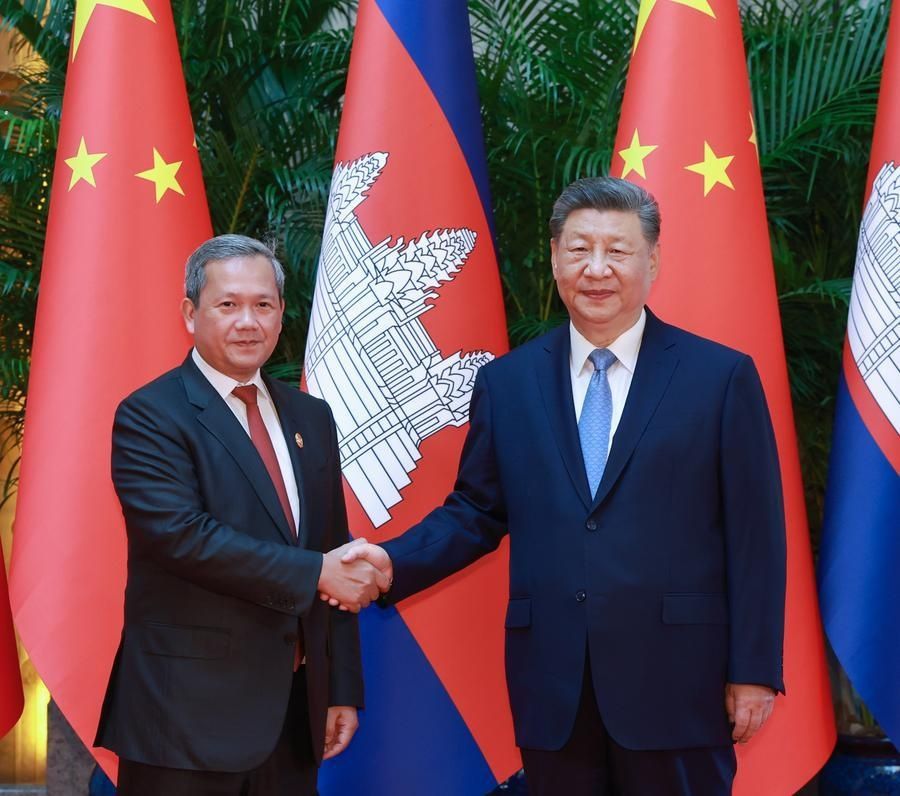
Chinese President Xi Jinping used a Friday meeting with Cambodian Prime Minister Hun Manet in Shanghai to reaffirm Beijing's commitment to what both nations describe as an unbreakable partnership, signalling the enduring centrality of Cambodia within China's Southeast Asian strategy. The encounter took place as Hun Manet attended the 2026 World Artificial Intelligence Conference and High-Level Meeting on Global AI Governance, a dual engagement that underscores how economic forums increasingly serve as venues for high-level bilateral diplomacy in the region.
Xi's emphasis on carrying forward the "ironclad friendship" established by preceding generations of leaders represents standard diplomatic language, yet it carries particular weight given the historically volatile nature of Cambodia-China relations and the current geopolitical turbulence affecting the broader Indo-Pacific. By invoking historical continuity, Xi appears to be reassuring Hun Manet of Beijing's long-term commitment even as China navigates intensifying great-power competition with Western nations and manages its complex relationship with Southeast Asian neighbours.
The "Diamond Hexagon" cooperation framework mentioned by Xi encompasses a structured approach to bilateral engagement across multiple domains. Rather than operating as isolated initiatives, these interconnected partnerships are designed to create overlapping dependencies and mutual benefits that reinforce political alignment. The framework's multifaceted nature suggests China is building Cambodia into a comprehensive strategic asset rather than treating it as merely a valuable geographic location or diplomatic ally.
Among the most significant practical initiatives discussed were the Industrial Development Corridor and the Fish and Rice Corridor, both representing substantial infrastructure investments designed to integrate Cambodia more deeply into Chinese economic networks. The Fish and Rice Corridor, in particular, reflects recognition of Cambodia's agricultural comparative advantages and the potential to create supply chains linking Cambodian production to Chinese consumption. These projects generate employment within Cambodia whilst simultaneously creating economic interdependencies that subtly reinforce political alignment without overt coercion.
Xi's call to modernise traditional sectors such as electricity and agriculture whilst simultaneously nurturing emerging industries like artificial intelligence and the digital economy reveals a calculated strategy to position Cambodia within next-generation economic structures. Rather than allowing Cambodia to remain primarily an exporter of raw materials and agricultural products, China is encouraging technological upgrading that would bind Cambodia's future prosperity to continued Chinese partnership and investment. This developmental approach contrasts sharply with extractive models sometimes associated with Chinese investment across the developing world.
The emphasis on combating cross-border crimes including counterfeiting, smuggling, online gambling, and telecom fraud reflects legitimate security concerns shared across Southeast Asia, yet also demonstrates how China frames security cooperation as mutually beneficial rather than imposing. Telecom fraud rings operated from Cambodian territory have become a particularly acute problem affecting Southeast Asian countries including Malaysia, making this cooperation genuinely valuable to regional stability and not merely rhetorical.
Xi's remarks regarding the Cambodia-Thailand ceasefire and border disputes reveal China's nuanced approach to regional conflicts. Rather than simply backing one party, Beijing positions itself as a neutral facilitator encouraging dialogue, thereby maintaining relationships with both nations whilst appearing as a stabilising force. This diplomatic positioning allows China to retain influence across multiple Southeast Asian relationships without the costs of overt partisanship, a delicate balance that has generally served Chinese interests well throughout the region.
Hun Manet's response emphasised Cambodia's unwavering commitment to the one-China policy and pledged to resist any shifts in international circumstances that might otherwise strain bilateral relations. This explicit reassurance addresses potential Chinese concerns about external pressure to reorient Cambodia's foreign policy, suggesting that Hun Manet understands maintaining Beijing's confidence as crucial to his government's stability and economic prospects. Such statements reflect the fundamental asymmetry in the Cambodia-China relationship, with Cambodia's dependence on Chinese support significantly exceeding China's dependence on Cambodia.
The Cambodian Prime Minister's commitment to expanding bilateral trade and advancing cooperation on major infrastructure projects acknowledges the economic foundation underpinning political alignment. Chinese investment and market access have become increasingly important to Cambodia's development aspirations, particularly given the country's limited alternative sources of large-scale capital and technological expertise. This economic reality constrains Cambodia's policy flexibility independent of any political pressure Beijing might choose to exert.
The dual focus on both bilateral cooperation and regional stability issues demonstrates how China integrates its relationships with individual Southeast Asian nations into a broader strategy for regional influence. By combining offers of economic benefit with diplomatic support on local disputes, Beijing creates a package of inducements that makes alignment with Chinese preferences attractive even when such alignment might not always serve narrower national interests.
For Malaysia and other Southeast Asian nations, the Shanghai meeting illustrates the depth of Chinese engagement with Cambodia and the effectiveness of Beijing's strategy of combining economic investment with diplomatic support. Understanding these dynamics becomes essential as regional powers calibrate their own Southeast Asian strategies and consider how to maintain influence when facing competitors offering similarly comprehensive packages of benefits.
The timing of this meeting during an artificial intelligence conference also signals China's determination to position itself and cooperative partners like Cambodia at the forefront of technological development. As AI increasingly shapes economic competitiveness and geopolitical influence, Cambodia's alignment with Chinese technology initiatives could have long-term ramifications for regional technological ecosystems and the distribution of capabilities across Southeast Asia.

