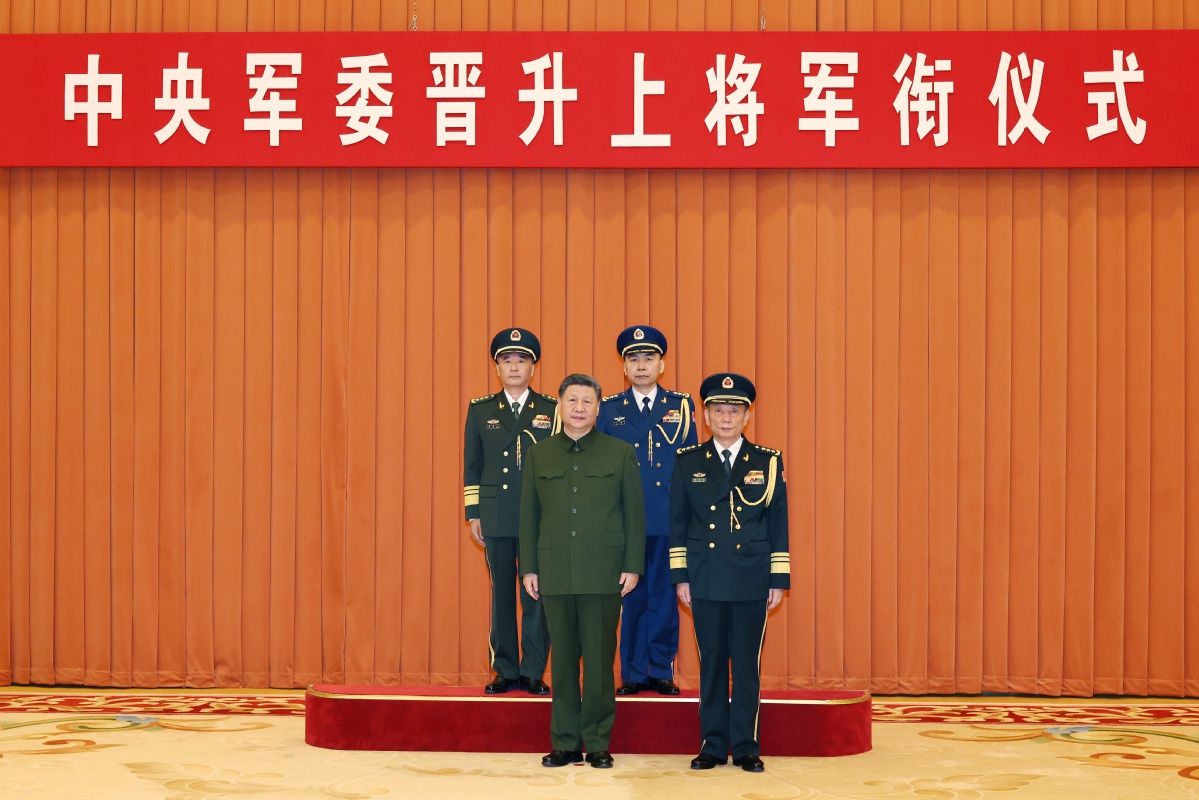
President Xi Jinping has intensified his grip on China's military hierarchy with a major leadership reshuffle at the heart of the People's Liberation Army's anti-corruption apparatus. The appointment of Zhang Shuguang as secretary of the Central Military Commission's discipline inspection commission, announced at a state ceremony in Beijing on Friday, represents another pivotal move in what observers describe as the most ambitious restructuring of China's armed forces in five decades. The shifts signal Xi's continued determination to reshape the military establishment according to his strategic vision, even as regional security tensions mount across East Asia and Southeast Asia.
Zhang's elevation to this critical post underscores the centrality of anti-corruption work to Xi's broader military agenda. The discipline inspection commission wields substantial power over personnel decisions and internal accountability within the PLA, making the role a strategic linchpin in consolidating institutional authority. By installing a trusted lieutenant in this position, Xi ensures direct oversight of investigations and disciplinary actions involving military personnel at all levels. Wang Gang's concurrent promotion to commander of the People's Liberation Army Air Force represents a complementary move, placing another Xi-aligned figure in command of one of China's most technologically advanced military branches. Both men received promotions to the rank of general, the apex of active-service military rank in China.
The personnel changes reflect the broader turbulence within Chinese military leadership since Xi launched his sweeping anti-graft campaign in mid-2023. This initiative commenced several months after Xi secured an unprecedented third term as party chief, a political victory that liberated him from traditional term-limit constraints and provided the political capital necessary for such ambitious military restructuring. The scale of purges has been remarkable: Xi's administration has removed two vice chairs of the Central Military Commission, three other CMC members, a former defence minister, and at least a dozen senior generals commanding major military regions and specialized commands. For Malaysian observers and Southeast Asian security analysts, these removals carry significant implications, as they reshape the decision-making structures governing military operations and strategic planning in a region where Chinese military assertiveness has been a persistent concern.
Perhaps most striking among recent developments was Xi's move to investigate Zhang Youxia, his longtime ally and one of the PLA's most senior figures, in circumstances that stunned observers familiar with Chinese military politics. This action demonstrates that even Xi's closest associates face scrutiny if perceived organisational vulnerabilities emerge, reinforcing the message that no one is beyond accountability within his restructured military apparatus. The investigation into Zhang Youxia sent shockwaves through military and diplomatic circles, signalling that Xi's anti-corruption campaign extends to the highest echelons of command regardless of personal relationships.
Zhang Shengmin, who previously occupied the role now held by Zhang Shuguang, has been reassigned to serve as vice chairman of the Central Military Commission—a lateral move that nonetheless removes him from daily management of anti-corruption operations. This transition ensures continuity of institutional knowledge whilst shifting operational control to fresh personnel aligned with Xi's priorities. The move reflects sophisticated political management: rather than purging trusted but potentially obstructive figures entirely, Xi has repositioned them in ways that preserve their status while extracting them from sensitive operational positions.
For Malaysia and other Southeast Asian nations navigating their relationships with China, these military reshuffles warrant careful attention. The composition of China's military leadership directly influences defence policy-making, foreign military engagement, and strategic calculations in regional hotspots including the South China Sea. When Xi removes senior commanders and installs his preferred lieutenants, he is effectively engineering the military apparatus that will execute his strategic directives in coming years. This restructuring typically results in more cohesive military-civilian coordination around Xi's preferred policy directions, potentially leading to more assertive military postures if Xi determines such assertiveness advances national interests as he defines them.
The removal of six military lawmakers from their seats in the national parliament last week further indicates Xi's determination to cleanse political institutions of figures potentially resistant to his authority. These parliamentary removals typically precede formal corruption charges or signify preliminary steps in ongoing investigations. The pattern suggests a coordinated campaign extending beyond purely military domains into the civil-military interface where political and military authority converge.
The fate of former Air Force Commander Chang Dingqiu remains unclear following Wang Gang's appointment to his previous position. Such uncertainty regarding the next postings of displaced senior officials is characteristic of Xi's operating style—maintaining ambiguity about transitions preserves control and prevents the formation of coherent opposition blocs. Officials awaiting reassignment operate in a state of professional limbo, discouraging them from building independent power bases or organising resistance to Xi's initiatives.
From an institutional perspective, Xi's approach to military reform represents a deliberate effort to subordinate military autonomy to Communist Party control, with Xi himself serving as the apex of party authority. This represents a recalibration of civil-military relations towards greater centralisation and tighter party control over military decision-making. For neighbours concerned about China's military trajectory, this concentration of decision-making authority could either moderate military adventurism through more cautious civilian oversight or amplify it if Xi's strategic calculations favour confrontational approaches.
These developments occur against a backdrop of heightened regional tensions, including maritime disputes, military modernisation competition, and great-power rivalry between Washington and Beijing. China's military structure and leadership composition will substantially influence how these competitive dynamics unfold. The appointment of officers amenable to Xi's vision across key command positions suggests a military institution increasingly responsive to centralised strategic direction, which could prove consequential for regional security architecture. For ASEAN nations maintaining careful balances between engagement with Beijing and alignment with other powers, monitoring these internal Chinese military dynamics remains essential for understanding potential shifts in behaviour or policy orientation.

