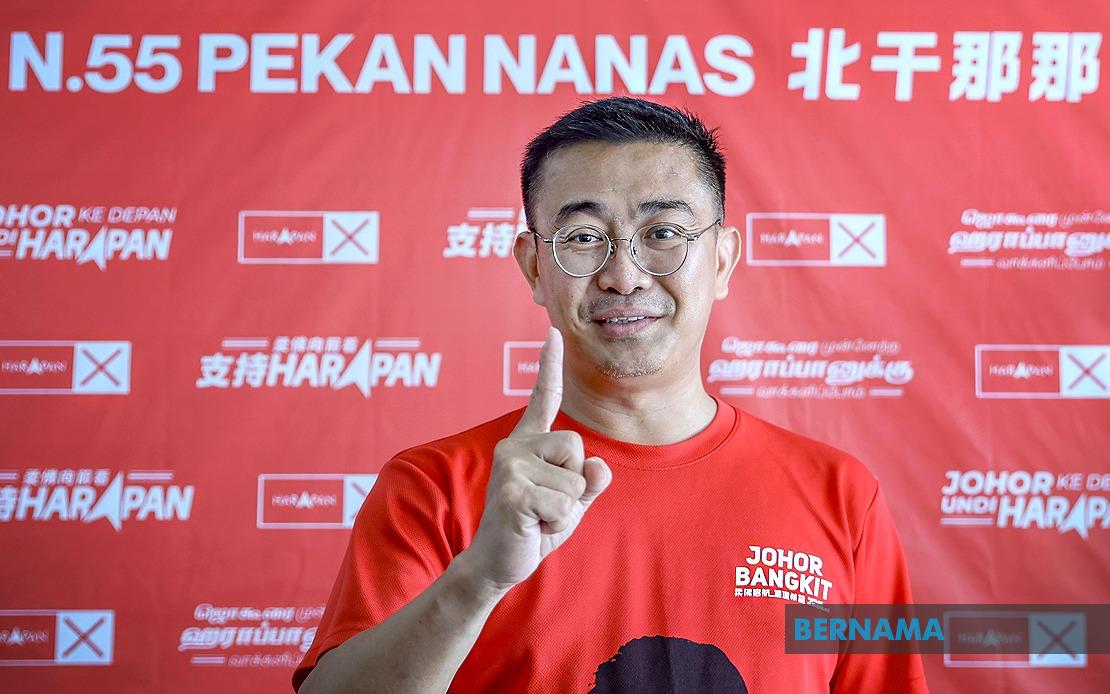
Yeo Tung Siong, the Pakatan Harapan candidate contesting the Pekan Nanas state constituency in Johor's latest state election, believes his decade-long tenure as the area's representative positions him well to win back the seat from the incumbent Barisan Nasional assemblyman. Having served two consecutive terms between 2013 and 2022, the former educator and administrator is betting that voters will reward his prior service and responsiveness to constituent concerns.
Campaigning across the Pontian area, Yeo has struck an optimistic tone about his electoral prospects, citing the grassroots reception he has encountered during the campaign trail. He estimates that through sustained on-the-ground engagement—including doorstep visits, community forums, market interactions, and neighbourhood dialogues—he has already connected with approximately 60 per cent of the constituency's voters. The feedback from these encounters, he maintains, has been consistently positive, suggesting substantial support for his political comeback.
Yeo's pitch to voters rests primarily on demonstrating his record as a public representative. During his earlier tenure as assemblyman, he secured a RM500,000 allocation to address one of Pekan Nanas's most persistent infrastructure challenges: the Pulai River flooding problem, which had plagued residents for years. Beyond this high-profile initiative, he collaborated with private-sector partners to implement drainage works along the periphery of Kampung Melayu Raya, further testament to his ability to broker solutions across public and private spheres. These concrete deliverables form the cornerstone of his appeal to voters evaluating his performance in office.
The former vice-principal and discipline teacher emphasises his accessibility as a key attribute distinguishing his approach to representation. He stresses that he has never been a politician preoccupied with ceremonial standing or protocol, instead prioritising direct availability to constituents facing difficulties. This informal, citizen-centric stance appears designed to resonate with voters frustrated by distant or unresponsive leadership. He invites residents to contact him directly with their problems, pledging personal intervention rather than bureaucratic deflection.
In mapping his future priorities should he regain the mandate, Yeo identifies two interconnected transportation projects as major planks of his agenda. The first involves establishing a shortcut linking Ulu Pulai to Pekan Nanas, while the second would create a direct route between Pulai and the Sri Bunian junction. Together, these infrastructure interventions would substantially compress travel times between Pekan Nanas and Johor Bahru, addressing complaints about traffic congestion and commute times that have surfaced repeatedly throughout his campaign conversations with residents.
Beyond roads and drainage, Yeo recognises that employment remains a critical concern among constituents in this semi-rural constituency. He has pledged to revive the career fair initiative he previously organised as assemblyman, bringing together major employers operating in and around Pekan Nanas to generate job placements and skills-matching opportunities for local workers. This targeted approach to job creation—leveraging existing business networks rather than relying solely on government hiring—reflects an understanding of private enterprise's role in regional economic development.
Social welfare represents another dimension of Yeo's platform. He intends to expand access to statutory assistance programmes administered by the Social Welfare Department and the Social Security Organisation, ensuring that vulnerable residents navigate the bureaucracy effectively and receive the support to which they are entitled. This emphasis on welfare administration suggests recognition that government schemes often fail the neediest populations through poor awareness or administrative barriers rather than insufficient funding.
The straight contest between Yeo and Tan Eng Meng, the sitting Barisan Nasional assemblyman, will serve as a key bellwether in assessing how Johor voters have shifted since 2022. The direct one-on-one nature of the contest means little room for fence-sitters, making ground-level campaign intensity and voter mobilisation particularly consequential. For Pakatan Harapan, recapturing Pekan Nanas would represent meaningful progress in a state where the coalition has struggled to consistently gain traction, particularly in more rural or semi-rural constituencies.
Yeo's candidacy also reflects broader Pakatan Harapan strategy in Johor, where the coalition aims to rehabilitate its image following previous electoral disappointments by fielding incumbents with verifiable constituency records. Unlike newcomers or parachuted candidates, Yeo carries the advantage of name recognition and documented service achievements that can be scrutinised by voters. This choice to run a known quantity rather than introduce fresh faces suggests the coalition is prioritising electability and defensive retention of previous strongholds over renewal.
For Southeast Asian political observers, the Pekan Nanas contest exemplifies recurring patterns in Malaysian state elections: the tension between continuity and change, the persistent salience of local infrastructure and employment concerns, and voters' pragmatic assessment of representatives' capacity to deliver tangible benefits. Yeo's campaign narrative—grounded in past accomplishments, accessible representation, and concrete infrastructure priorities—represents the tried-and-true formula that has won votes in Malaysian constituencies across multiple election cycles, irrespective of which coalition deploys it.

