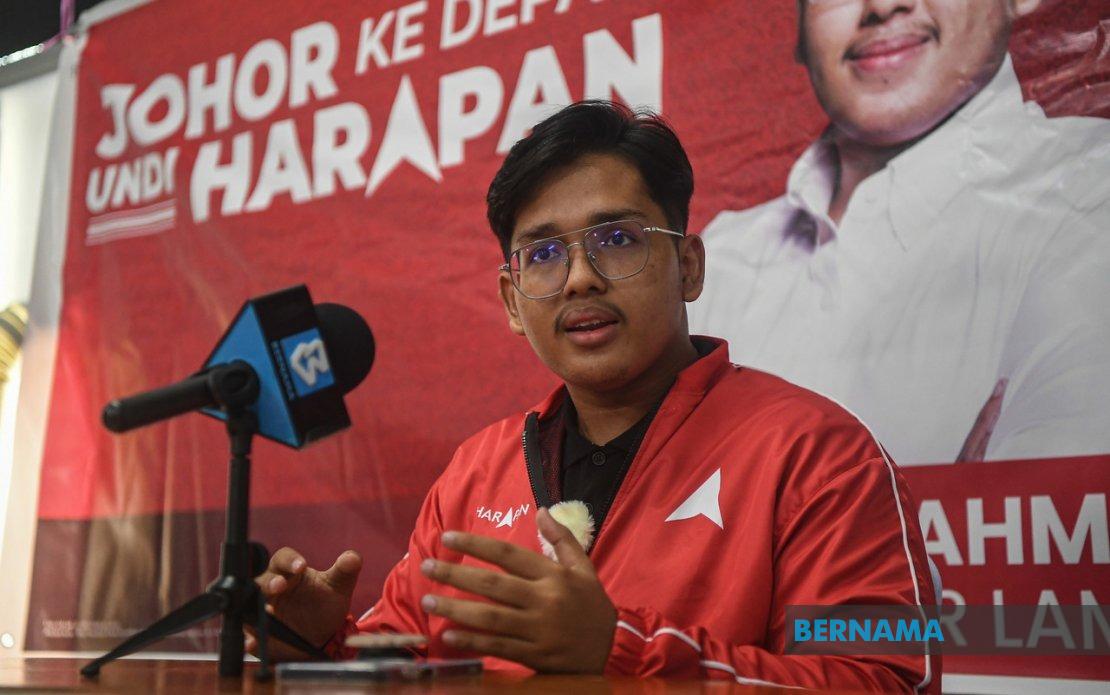
At just 23 years old, Danish Hossman Abd Rahman has become a focal point in the Johor Lama state constituency race, representing Pakatan Harapan in what shapes up as a closely watched three-cornered contest. The Information Technology postgraduate student from Universiti Tun Hussein Onn Malaysia is banking on what he describes as an energising reception from constituents and a groundswell of support to mount a credible challenge against the incumbent Norlizah Noh of Barisan Nasional and Aisah Esa from Perikatan Nasional. His campaign reflects a broader generational shift taking place across Malaysian politics, where younger candidates are attempting to reframe age not as a liability but as an operational advantage in addressing persistent governance challenges.
The extensive fieldwork that has defined Hossman's campaign strategy appears to be resonating particularly strongly among older voters and veterans, a demographic group traditionally considered conservative in their electoral preferences. Rather than view his youth with scepticism, these constituents seem to view it as a symbol of fresh commitment and genuine engagement. Hossman attributes this acceptance to his consistent physical presence in communities—a quality he suggests has become increasingly rare among established politicians. He has observed that veterans in Johor Lama express frustration with long-serving representatives who have become disconnected from constituent concerns, spending minimal time in the field despite years in office and presiding over unresolved local problems.
Hostman's positioning as a "strategic bridge" between institutional experience and generational aspirations represents a deliberate rhetorical and political strategy designed to address concerns about his relative inexperience. Rather than dismissing the value of seasoned leadership, he frames his candidacy as complementary to established knowledge, suggesting that his role would be to translate the practical wisdom of previous office-holders into policies that align with contemporary social expectations. This bridging narrative attempts to neutralise what could otherwise be presented as a significant disadvantage—namely, his limited track record compared to rival candidates with longer political histories.
Across the 56 seats contested in the 16th Johor state election, a total of 172 candidates are competing for representation, underscoring the competitive intensity of Malaysia's second-largest state by population. Within this broader electoral environment, Hossman's campaign in Johor Lama has adopted an inclusive approach focused on multiple constituency segments. His strategy encompasses targeted engagement with youth, women, and small business operators—demographic groups often overlooked in conventional political outreach but increasingly influential in electoral outcomes. This segmented approach reflects awareness that electoral success now requires coalition-building among diverse voter interests rather than reliance on traditional bloc voting patterns.
The core policy platform Hossman articulates centres on economic revitalisation through strategic investment and local industry development. He has identified housing affordability and employment scarcity as the fundamental challenges driving youth migration away from Johor Lama, a pattern that mirrors demographic trends across rural and semi-rural Malaysia. His proposed solutions involve attracting external capital for downstream industrial development that leverages the constituency's existing economic foundations, particularly in agricultural production and livestock operations. The underlying logic is that job creation and economic opportunity retention are prerequisites for reversing outmigration and enabling younger residents to envision sustainable futures within their home communities.
Hostman's emphasis on repeated voter contact and personal visibility reflects contemporary campaign theory emphasising intimate engagement over mass communication. He notes deliberately visiting communities multiple times to ensure constituent familiarity and to establish relationship depth that transcends typical electoral cycles. This intensity of ground presence contrasts with what he characterises as the electoral malpractice of opponents, who he suggests rely on divisive rhetoric and personal attacks rather than substantive policy differentiation. His explicit call for voters to assess candidates on capability rather than "politics of hatred" attempts to elevate campaign discourse while implicitly questioning the legitimacy of his opponents' approaches.
The intergenerational dimension of Hossman's campaign gains particular significance within Malaysia's broader political context. The last decade has witnessed growing electoral volatility, with younger voters increasingly willing to abandon traditional party loyalties in favour of candidates perceived as more responsive and authentic. Hossman's candidacy tests whether authenticity, accessibility, and policy focus can override age-related concerns about administrative capacity. His success or failure in Johor Lama will offer valuable data about voter willingness to support youth candidates even when experienced alternatives exist, particularly in state-level contests where constituency-level governance directly affects daily citizen experiences.
The timing of his emergence as a significant candidacy, heading into the final campaign week before Saturday's polling, suggests momentum-building effectiveness. His extensive outreach across towns, villages, and Felda settlements has apparently generated grassroots enthusiasm that institutional party machinery alone might struggle to replicate. The visible support from veteran constituents, who might have been expected to favour more established candidates, indicates that Hossman has successfully navigated a significant political challenge—overcoming age-based scepticism through demonstrated commitment and policy specificity.
For regional observers, Hossman's campaign exemplifies evolving patterns in Southeast Asian electoral politics where demographic shifts are producing younger candidacies across multiple countries. Malaysia's experience with youth candidates like Hossman will likely inform approaches in other systems grappling with questions about how to incorporate younger voices while maintaining governance stability. Should Hossman win, he would represent an unusually young entry point into state assembly ranks, potentially influencing how future recruitment and nomination processes operate within Pakatan Harapan and competing coalitions.

