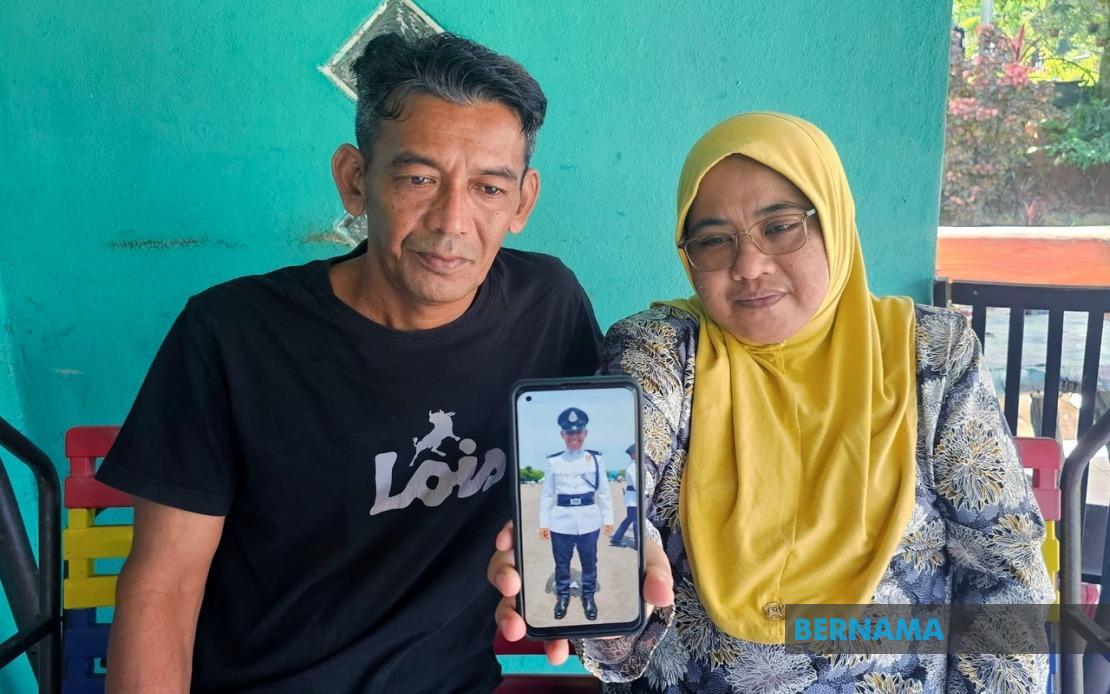
The joyful anticipation that filled the home of Ismarubee Ismail and Nor Azila Zakaria transformed into devastating grief when they learned their son, Constable Muhammad Raimi Ismarubee, had died in a workplace accident in Sabah. The young policeman, aged 26 and stationed at Weston Police Station in Beaufort, had been planning to return to his family in Felda Kerteh in Terengganu for a much-awaited holiday later this month. Instead, his parents received the devastating news that he had been fatally electrocuted while on duty, joining two of his colleagues in a tragic incident that has raised fresh questions about workplace safety in police facilities across the country.
The electrocution occurred on the afternoon of August 6 outside the Weston Police Station, near Sekolah Kebangsaan Weston, when three officers attempted to move a metal pole typically used for harvesting coconuts. Besides Muhammad Raimi, Corporal Chiu Teck Siong, aged 40, and Lance Corporal Mohamad Nur Hafiz Ibrahim, aged 29, also perished in the incident. The three men were engaged in what appeared to be routine work when contact with the metal pole proved fatal, highlighting the potential hazards that officers may face in circumstances extending beyond conventional law enforcement operations.
Ismarubee, who labours for his living, recalled the shock of that day with raw emotion. Just hours before receiving the devastating phone call from his son's friend at 6 pm, Muhammad Raimi had messaged the family on WhatsApp at 2 pm, sharing word of a successful drug arrest operation. The abrupt shift from professional accomplishment to sudden death underscores the unpredictability of occupational risks facing frontline personnel. For a parent in a modest economic position, losing a son who had become the family's principal breadwinner represents not merely emotional devastation but also material hardship.
Muhammad Raimi had only recently begun his career in the police force, having joined Weston Police Station in September 2024. Despite the brevity of his service, he had already demonstrated commitment to his work and deep responsibility towards his family. His last visit home occurred in January, roughly seven months before his death. The extended separation, coupled with his difficulty in securing affordable airline tickets to make the journey, had frustrated both him and his parents, who yearned for his company during the school holidays.
His mother, Nor Azila, painted a portrait of a devoted son whose priorities reflected traditional family values and concern for his siblings' futures. Muhammad Raimi had been planning an engagement to a woman from Sabah in the coming year, yet he had determined to postpone marriage celebrations until his youngest sibling completed the Sijil Pelajaran Malaysia examinations. This decision revealed both maturity and a commitment to supporting his family's educational aspirations. Beyond these major life decisions, he had quietly invested in his siblings' academic needs, purchasing essential items such as laptops and sending monthly allowances, the kind of consistent financial support that younger family members had come to depend upon.
The loss extends beyond the immediate family to affect broader systems of interdependence common across Malaysian households where older siblings shoulder responsibility for younger ones' welfare and education. Muhammad Raimi's regular monetary contributions had evidently become woven into his family's monthly budget, providing stability and opportunity. The removal of this income stream will force the family to reassess educational plans and financial commitments, particularly as one sibling approaches critical examination periods. For many Malaysian families in similar economic circumstances, such losses represent ruptures in carefully balanced household economies.
The incident also invites scrutiny regarding workplace safety protocols at police installations and whether officers receive adequate training when engaging in tasks beyond their primary law enforcement functions. The use of a metal pole for coconut harvesting outside a police station raises questions about whether appropriate electrical safety measures had been implemented and whether personnel understood the risks associated with handling such equipment near potential power sources. These three deaths represent not merely individual tragedies but potentially systemic lapses in occupational health and safety that warrant investigation and remedial action.
Police authorities and relevant government agencies face pressure to establish whether the electrocution resulted from faulty equipment, inadequate safety barriers around electrical sources, lack of proper training, or some combination thereof. The Royal Malaysia Police must conduct thorough inquiries to determine whether similar hazards exist at other stations and whether protocols require updating. Such incidents carry implications for force recruitment and retention, particularly among young officers and their families who consider the genuine risks accompanying police service.
Muhammad Raimi's remains were returned to his family and buried at the Felda Kerteh 2 Muslim Cemetery on August 7, allowing him to rest finally in the community where he had grown up and where his parents and siblings would attempt to navigate the profound disruption his absence creates. The loss of three trained police officers in a single preventable incident also represents depletion of the force's operational capacity at a station level, amplifying the incident's institutional consequences. For the small community of Felda Kerteh and the broader Malaysian public observing these events, the tragedy serves as a stark reminder that the risks facing those in service extend beyond the dangers most commonly associated with police work.

