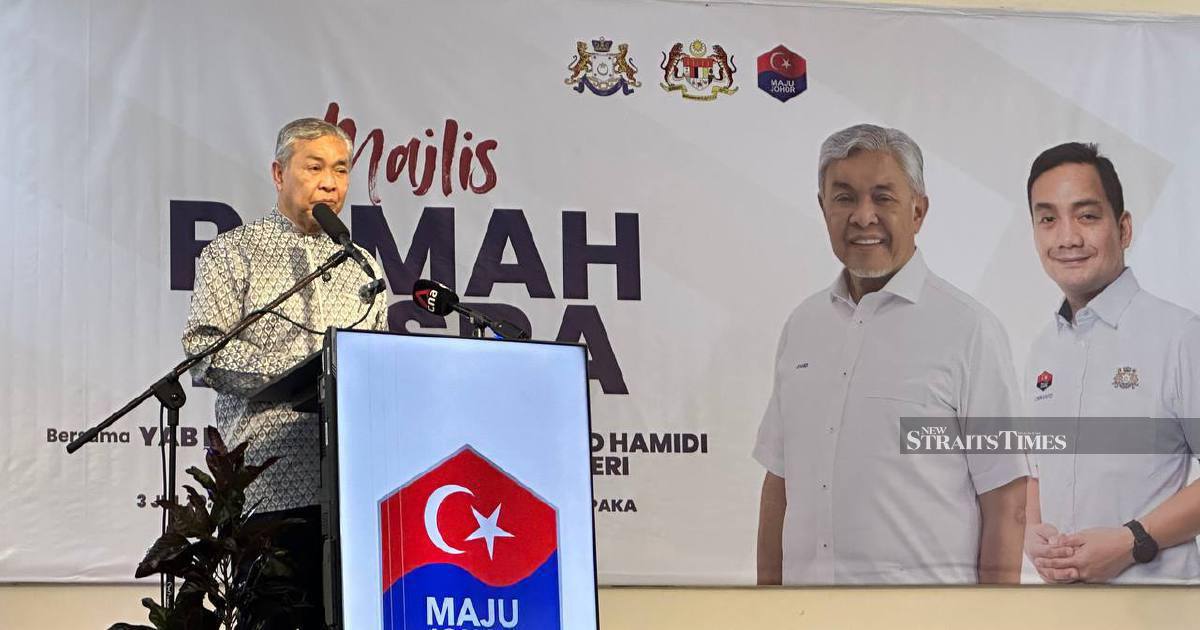
Barisan Nasional chairman Datuk Seri Dr Ahmad Zahid Hamidi has made a pointed appeal to his coalition partners in the unity government, requesting that they cease raising historical controversies targeting Umno and the broader BN alliance during their joint campaign efforts in the Johor state elections. The request underscores mounting tensions within Malaysia's governing coalition, where partners from different political traditions have been uneasy partners since the formation of the unity government.
Zahid's comments reflect a delicate balancing act that BN leadership must undertake to maintain cohesion amongst coalition members with divergent political histories and agendas. The unity government arrangement, which brings together traditionally rival political factions, has always been vulnerable to internal friction, particularly when campaigns heat up and parties compete aggressively for electoral advantage. Johor represents a crucial test of whether these partnerships can survive the pressures of state-level electoral competition without fracturing along historical fault lines.
The appeal carries particular significance given Umno's complicated recent history. The party has faced numerous scandals and legal challenges that have provided ammunition for opposition forces and, occasionally, for coalition partners seeking to distance themselves from controversial Umno-linked issues. By requesting that allies avoid dredging up past matters, Zahid is attempting to prevent a scenario where the unity government essentially campaigns against itself, which would undermine the entire rationale for the coalition's existence.
For Malaysian political observers, this development highlights a fundamental challenge facing the unity government model. When parties with fundamentally different electoral bases and historical animosities are forced to work together, the pressure cooker of electoral campaigns inevitably triggers disputes about how to present the coalition to voters. Coalition partners must simultaneously defend shared government policies while maintaining their individual political identities—a difficult proposition that often leads to finger-pointing about past grievances.
The Johor election campaign provides a particularly sensitive stage for these tensions. Johor has long been a Umno stronghold, and the party's performance there carries significant implications for its national standing. Any suggestion that BN's coalition partners are undermining Umno during the campaign could be interpreted as betrayal, while conversely, rehashing past issues could drive wedges between parties that need to present a united front to voters. Zahid's intervention signals that BN leadership recognizes these dynamics and is taking proactive steps to manage them.
Such appeals are not unprecedented in Malaysian coalition politics, yet their frequent necessity suggests that unity government arrangements remain fundamentally unstable without constant management from senior leaders. The underlying tensions—between parties that previously battled each other, between leaders with personal animosities, and between organizations with different visions for Malaysia's direction—never truly disappear simply because formal coalition agreements are signed.
The timing of Zahid's statement also merits attention. As campaign intensity increases, there is typically a corresponding escalation in the volume and severity of political attacks. By issuing this appeal now, Zahid appears to be attempting to establish ground rules before the campaign spirals into acrimony. However, the effectiveness of such appeals often depends on whether all coalition partners are equally motivated to maintain coalition discipline, a condition that is rarely guaranteed in Malaysian politics.
For ordinary Malaysians, particularly Johor voters, this internal coalition dynamics represent a complication in their electoral choices. Voters might wonder whether they can trust coalition partners to work together effectively if they cannot avoid attacking each other even during joint campaigns. The credibility of the unity government itself depends partly on demonstrating that parties can transcend historical grievances sufficiently to govern coherently.
The broader regional context should not be overlooked either. Throughout Southeast Asia, multi-party coalitions have proven notoriously difficult to sustain, particularly when they bring together ideologically diverse partners. Malaysia's experience with its unity government is closely watched by political observers across the region, as it tests whether countries can successfully employ grand coalition strategies to manage highly competitive and fractious democratic politics. The extent to which Zahid's appeal succeeds in maintaining coalition discipline in Johor will provide important signals about whether the unity government model has genuine staying power or whether Malaysian politics will revert to a more traditional two-bloc confrontation.
Ultimately, Zahid's request reflects a recognition that the coalition's electoral prospects depend on projecting stability and unity, even when internal disagreements exist. Whether coalition partners will heed this call and resist the temptation to attack Umno using historical controversies remains to be seen as the Johor campaign enters its critical phase. The answer will provide important insights into the maturity and resilience of Malaysia's current governing arrangements.

