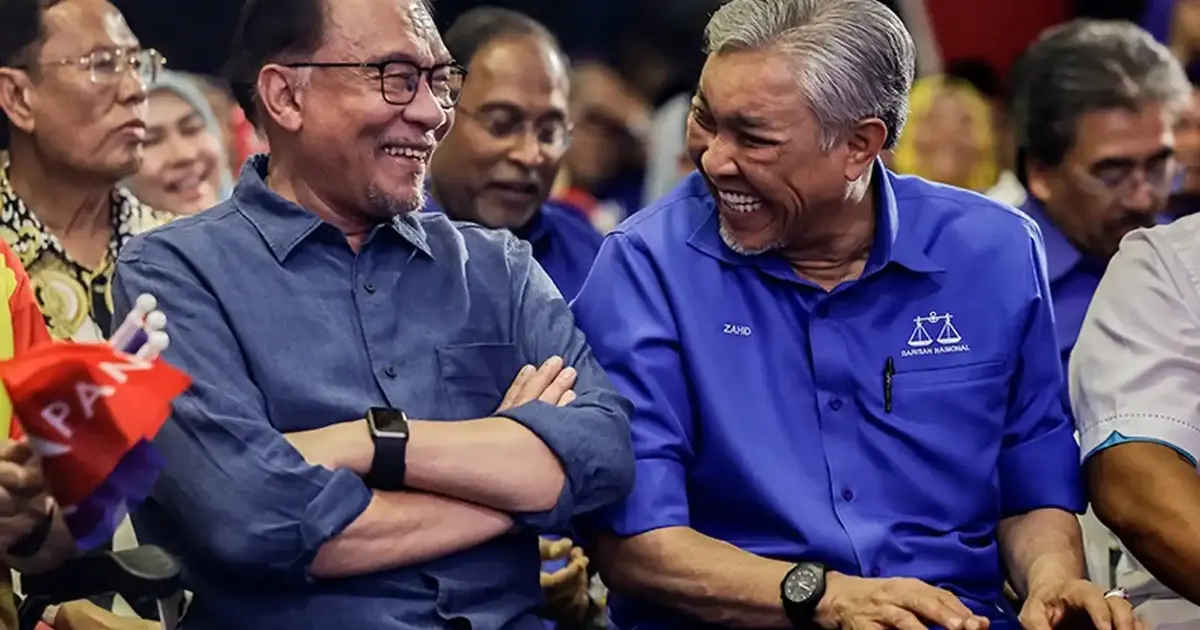
Deputy Prime Minister Zahid Hamidi has turned to poetry as his medium for responding to a recent verse from Prime Minister Anwar Ibrahim, in what appears to be an unusual diplomatic exchange between two of Malaysia's most senior political figures. The Barisan Nasional chairman's decision to craft his own poem signals an unconventional approach to political messaging at the highest levels of government, reflecting the creative yet somewhat theatrical dimensions that occasionally emerge from Malaysia's leadership circles.
Zahid's poetic response carries particular significance given the historical tension between the two leaders and their respective political coalitions. Before the formation of the unity government following the 2022 general election, Barisan Nasional and Anwar's Pakatan Harapan had been entrenched adversaries across multiple election cycles. The shift toward cooperation represents one of the most significant political realignments in recent Malaysian history, and the exchange through poetry suggests an attempt to soften the narrative around this transformation.
The verse-for-verse exchange, while seemingly lighthearted on the surface, carries deeper implications for the stability of Malaysia's current political architecture. The unity government, which brings together historically opposing blocs under a single administration, remains contingent upon maintaining sufficient goodwill and cooperation between the component parties. Any public deterioration in the relationship between Anwar and Zahid could potentially undermine the delicate balance that holds this coalition together, making even symbolic gestures like poetic responses worthy of political analysis.
Zahid's accompanying statement emphasising Barisan Nasional's continued commitment to the unity government represents the more substantive element of his message. This affirmation appears designed to counter any speculation about the coalition's durability or potential fractures that might emerge before the next general election. By publicly reiterating BN's dedication to seeing the government through to the end of its constitutional term, Zahid aims to project stability and predictability to both coalition partners and the broader electorate.
The timing of this exchange warrants consideration within the context of Malaysia's recent political developments. Various political factions have periodically tested the unity government's resilience through public statements and positioning that hinted at diverging interests. Both the governing coalition and its critics have closely watched for signs of weakness or the emergence of internal divisions. A fresh, if unconventional, affirmation of commitment from the BN chairman helps to inoculate the government against suggestions of instability emanating from either opposition quarters or ambitious politicians within the coalition itself.
Understanding Zahid's role as both deputy prime minister and Barisan Nasional chairman is essential to appreciating the significance of his statement. These dual positions place him at the nexus of coalition management and national governance. As BN chairman, he bears responsibility for maintaining party discipline and ensuring that his coalition remains an effective partner within the broader unity government framework. The explicit reaffirmation of commitment therefore represents both a personal stance and an official position on behalf of one of Malaysia's oldest and historically dominant political coalitions.
For Malaysian observers accustomed to more conventional political discourse, the resort to poetry by both leaders might seem unusual, yet it reflects international precedents where political figures have occasionally adopted creative forms of communication. The approach potentially allows for expressing sentiments that might otherwise come across as overly stiff or formal through traditional political statements. It also injects an element of human personality into what could otherwise remain purely transactional political relationships.
The continuation of the unity government remains consequential for Malaysia's immediate political and economic trajectory. Major policy initiatives, legislative priorities, and the government's ability to pursue its agenda all depend on maintaining adequate parliamentary support and internal coalition cohesion. Any significant fracturing of the alliance could trigger early elections or a government transition, outcomes that would carry substantial implications for investor confidence, ongoing development projects, and the country's regional standing.
Barisan Nasional's specific commitment matters because the coalition, whilst significantly diminished from its decades-long dominance before 2018, still commands substantial parliamentary seats and political resources. The party's cooperation remains integral to maintaining the current government's legislative majority. Zahid's public reaffirmation serves to bind BN to this commitment, making any subsequent deviation more politically costly and thus less likely.
Regionally, Malaysia's political stability carries significance beyond its borders. Southeast Asia benefits from predictable governance in one of the region's larger and more economically developed nations. The unity government, whatever its internal tensions, has provided a degree of continuity that facilitates regional cooperation on trade, security, and diplomatic matters. Public affirmations of commitment help sustain this stability.
Looking forward, the true test of BN's commitment will emerge through sustained cooperation on policy matters rather than through poetic expressions or public statements. How effectively the coalition manages competing interests, resolves disagreements, and presents a united front on major issues will determine whether the unity government endures as intended or succumbs to internal pressures. The exchange between Zahid and Anwar, whilst symbolic, represents only one data point in a much longer narrative of coalition management and political navigation.

