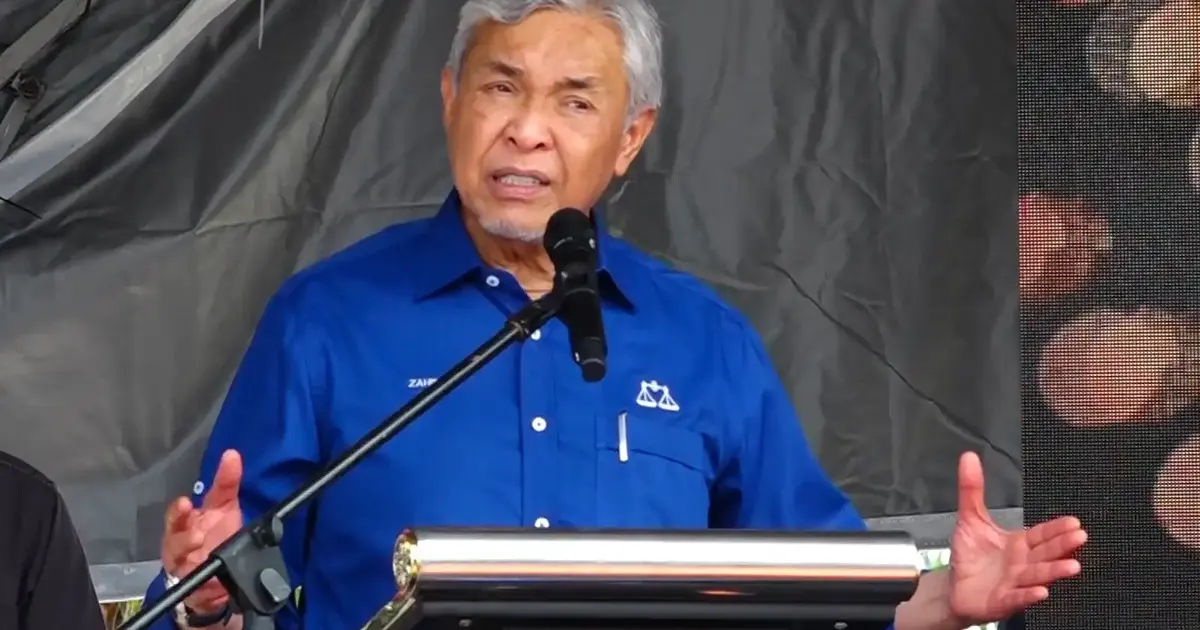
Umno President Ahmad Zahid Hamidi has directed the party's electoral machinery to sideline remarks from former party leader Puad Zarkashi, particularly those concerning Barisan Nasional's candidate selections for the Johor state elections. The directive reflects mounting tensions within Malaysia's oldest political party as internal voices challenge decisions made by the current leadership regarding candidate distribution and electoral strategy in the crucial southern state.
Zahid's instruction to disregard Puad's commentary signals an attempt to enforce party discipline and prevent divergent views from disrupting campaign momentum. Rather than engage with the criticism directly, the Umno president has opted for a containment strategy, essentially instructing party officials and grassroots operatives to treat such commentary as noise rather than substantive input requiring response. This approach mirrors similar instances in Malaysian politics where party leaders seek to maintain unified public positioning during critical electoral periods.
Puad Zarkashi, who previously held prominent positions within Umno's hierarchy, represents a segment of the party that retains considerable influence among grassroots members and state-level operatives. His willingness to comment on candidate selections suggests disagreement with how Barisan Nasional's leadership has allocated tickets in Johor, a state that remains a traditional stronghold for the ruling coalition but where opposition parties have made inroads in recent electoral cycles. The former leader's interventions carry weight precisely because of his background and continued connections within party structures.
The Johor state elections represent a significant battleground in Malaysia's ongoing political realignment. As one of the most economically developed states and traditionally a Barisan Nasional stronghold, any perceived weakness in Umno's performance there would carry implications beyond state-level politics, affecting the coalition's national standing and internal dynamics. Zahid's insistence on candidate unity therefore reflects broader calculations about maintaining party cohesion during what is effectively a test of Umno's electoral viability and internal stability.
Intra-party criticism over candidate selections is hardly uncommon in Malaysian politics, but its intensity and public nature can indicate deeper organisational tensions. When senior figures like Puad voice concerns about who receives tickets, they often articulate grievances held by significant party constituencies—whether state-level operatives feeling sidelined, ambitious politicians denied nomination, or factions unhappy with strategic direction. Zahid's response suggests the leadership believes suppressing public airing of such concerns serves party interests better than addressing underlying disagreements.
The instruction to ignore Puad's commentary also reflects the challenge of maintaining party discipline in an era where senior leaders retain communication channels to media and the broader public. Unlike earlier periods when party hierarchies could more effectively control information flows, contemporary Malaysian politics sees former and current leaders able to broadcast views directly through press statements and social media. Zahid's directive thus represents less a silencing strategy than a message to party machinery about which voices merit attention when crafting electoral narratives.
For Barisan Nasional's broader electoral prospects, managing internal dissent while projecting unity remains a perpetual balancing act. The coalition's strength historically derived partly from Umno's ability to maintain internal discipline despite competing interests. Yet that same discipline, when perceived as overly centralised or dismissive of legitimate concerns, can breed resentment that festers beneath public facades. Zahid's handling of Puad's criticism will likely become a test case for how successfully current leadership navigates these tensions.
The timing of such internal friction adds another dimension to electoral calculations. Elections demand focused campaign operations, and leadership messaging that constantly battles internal critics dilutes the coherent positioning necessary to persuade swing voters. By instructing the party machinery to ignore Puad's commentary, Zahid attempts to prevent coverage of intra-party disputes from dominating campaign narratives and distracting from Barisan Nasional's messaging to Johor voters. Whether such an approach proves effective depends largely on whether other party voices honour the directive.
Regionally, Umno's internal management mirrors challenges facing ruling parties across Southeast Asia. Political organisations balancing factional interests, representing diverse constituencies, and maintaining electoral competitiveness must constantly negotiate tensions between enforcing unity and accommodating legitimate input from senior figures. Malaysia's particular context—with its history of strong party leadership but also sophisticated political operators capable of leveraging public platforms—makes such negotiations especially delicate. Zahid's instruction reflects calculations about which internal voices can be safely marginalised without triggering broader organisational fracture.

