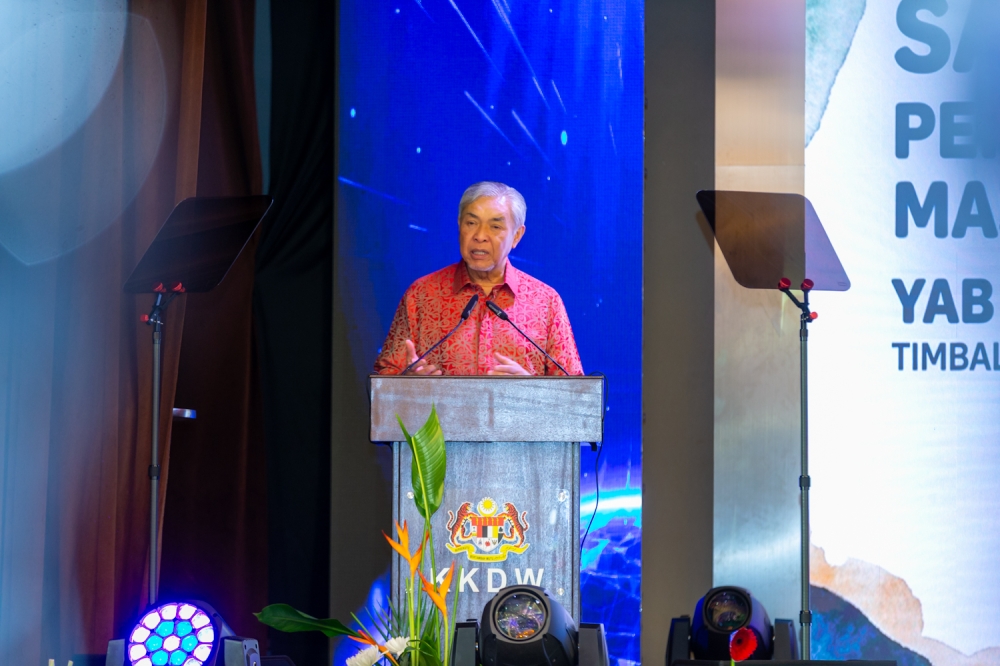
Deputy Prime Minister Datuk Seri Ahmad Zahid Hamidi has firmly denied claims that senior leaders from Barisan Nasional, Perikatan Nasional, GPS and GRS recently convened in a high-level political gathering, labelling such suggestions as speculative rumours circulating on social media. His categorical rejection, issued from Putrajaya on July 21, represents a significant reassurance to coalition partners amid persistent speculation about political realignments in Malaysian politics.
The denial carries particular weight given the sensitivity surrounding coalition dynamics in Malaysia's current political landscape. Reports of such a meeting between the country's major political blocs would have signalled potential fractures in the unity government arrangement that has defined Malaysian politics since 2022. The government coalition, comprising Barisan Nasional, Pakatan Harapan, and other smaller parties, has maintained relative stability despite underlying tensions that periodically surface in public discourse and social media chatter.
Zahid's forceful rebuttal underscores the importance Malaysian leadership places on messaging clarity at a time when political speculation can quickly undermine investor confidence and public perception of governmental stability. The Deputy Prime Minister's intervention reflects a broader pattern among government figures of proactively addressing coalition-related narratives before they gain traction among opposition figures or international observers monitoring Malaysia's political trajectory.
The Umno leader reiterated his personal commitment to supporting the unity government framework, a position consistent with Barisan Nasional's overarching strategy since the 2022 general election. This reaffirmation serves multiple purposes: it reassures coalition partners that Umno remains steadfast, it sends a signal to potential dissidents within the broader government alliance that the party line remains unchanged, and it attempts to establish a counter-narrative to speculation about alternative political arrangements.
Political observers in Southeast Asia have noted that Malaysia's unity government represents a significant departure from the polarised two-coalition system that dominated electoral politics in the preceding decade. This framework, while sometimes unwieldy, has provided stability that stakeholders credit with enabling economic policy continuity and investor confidence. Any credible threat to this arrangement would carry implications extending beyond domestic Malaysian politics to regional investment flows and diplomatic relationships.
The circulation of such rumours reflects the endemic speculation characteristic of Malaysian politics, where coalition mathematics constantly occupy the analytical attention of political commentators and opposition strategists. Opposition parties, particularly those on the sidelines of government, have motivation to explore potential realignments that could restore their political leverage. Such exploration occasionally leaks into the public sphere as rumour, creating the very type of viral claims that Zahid was addressing.
The timing of Zahid's denial is noteworthy, coming amid broader discussions about Malaysia's economic challenges and the government's reform agenda. Political instability, whether real or merely perceived, can distract from substantive policy debates and complicate executive function. By definitively ruling out coalition reconfiguration discussions, the Deputy Prime Minister attempts to keep the political conversation focused on governance rather than coalition building.
For smaller coalition partners like GPS and GRS, clear statements about unity government commitment provide reassurance about their continued relevance and access to governmental appointments and resources. These parties, which derive significant value from coalition membership, benefit from senior government figures publicly affirming that no backdoor negotiations are underway that might sideline them in favour of alternative arrangements. Zahid's statement thus serves to stabilise relationships across the entire government alliance.
The Deputy Prime Minister's statement also addresses a broader Malaysian audience concerned about political stability. Investors, both foreign and domestic, international credit rating agencies, and ordinary citizens monitoring government effectiveness all benefit from clarity about political arrangements. Uncertainty about coalition stability can translate into tangible economic costs through delayed investment decisions, higher borrowing costs for government, and reduced consumer and business confidence.
Zahid's role as Deputy Prime Minister gives his statements particular authority and credibility compared to other party leaders. As the second-highest executive official, his endorsement of unity government stability carries greater weight than similar statements from coalition partner leaders. This positioning explains why he was the natural figure to address such rumours despite their relevance to multiple parties.
Looking forward, such denials likely represent a recurring feature of Malaysian politics under the unity government framework. The very plurality of coalitional partners creates mathematical possibilities for alternative arrangements that opposition strategists and media commentators will periodically explore through speculation and rumour. Government figures like Zahid will necessarily continue to preemptively address such narratives to prevent their accumulation and potential evolution into more serious coalition challenges.
The incident illustrates how Malaysian politics has shifted from the era when single-party dominance or clear two-coalition competition defined the system. In the current context, coalition stability requires active management, regular reaffirmation of commitment, and swift response to any suggestion of internal discussions about alternative arrangements. These are the maintenance costs of coalition government that Malaysia's leaders must now routinely undertake.

