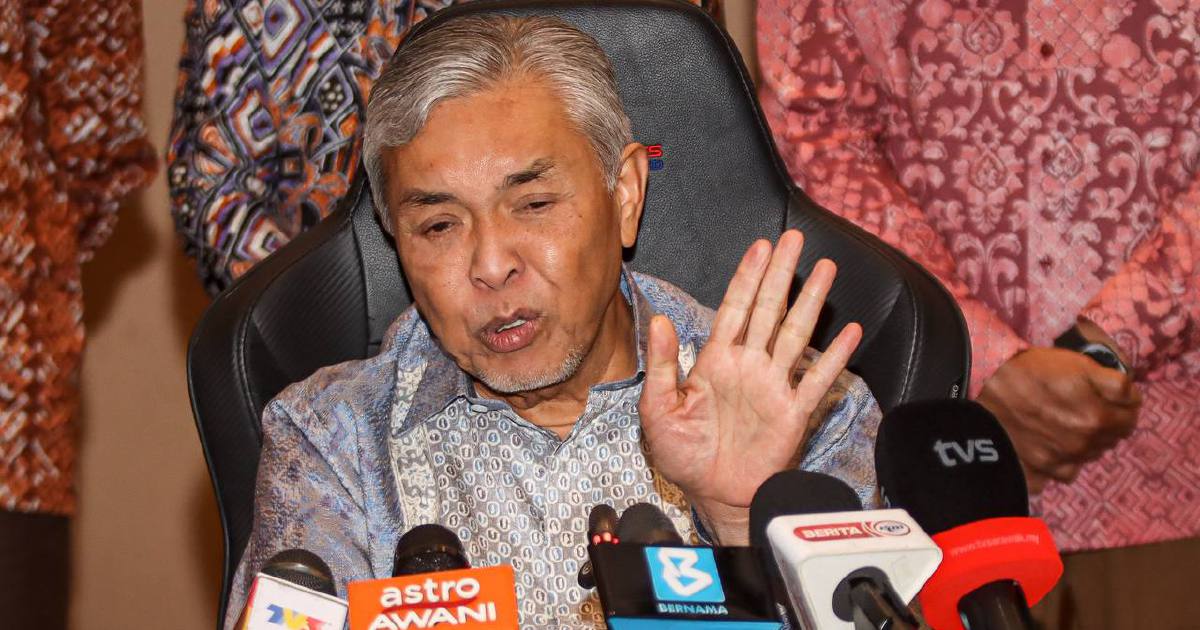
Datuk Seri Dr Ahmad Zahid Hamidi has categorically dismissed recent speculation surrounding potential moves to destabilise the current administration, declaring that Barisan Nasional remains steadfast in its commitment to upholding the unity government framework. Speaking in George Town, the BN chairman made clear that any rumours of attempts to topple Prime Minister Datuk Seri Anwar Ibrahim should be disregarded, sending what observers interpret as a significant reassurance signal to the investing public and Malaysia's international partners regarding the continuity of the administration.
The statement arrives at a moment when questions about political stability have periodically surfaced in Malaysian media and political circles, though Zahid's intervention appears designed to quash speculation at its source. By choosing to address the matter directly rather than allowing innuendo to persist unchallenged, the veteran politician signalled the depth of BN's commitment to the broader coalition arrangement that has defined Malaysian politics since the 2022 general election. His declaration effectively placed the weight of the coalition's leadership behind a unified narrative regarding the administration's future.
Barisan Nasional's role within Malaysia's current political architecture remains pivotal. As the senior partner in the larger unity government coalition that includes Pakatan Harapan, DAP, and other component parties, BN's continued support constitutes a foundational pillar of governmental stability. Any wavering in BN's commitment to the administration could theoretically create leverage points that smaller parties or independent lawmakers might exploit. Zahid's reinforcement of BN's position therefore addresses both internal coalition mechanics and external perceptions of governmental durability.
The timeline referenced by Zahid—extending through the end of the 15th Parliament—represents a substantial commitment spanning several years. This parliamentary session is not expected to conclude before 2027 or 2028, depending on the timing of the next general election. By binding BN to this extended timeframe, Zahid has essentially removed any ambiguity regarding whether the coalition might alter its stance during the current electoral cycle. This represents a constraint on BN's tactical flexibility should political calculations shift, but simultaneously provides certainty to markets, civil society organisations, and other stakeholders who value institutional continuity.
The political context underlying Zahid's statement deserves examination. Since the unity government's formation, periodic tensions have emerged between UMNO-led BN and PKR-dominated Pakatan Harapan over policy direction, cabinet allocations, and the distribution of developmental projects. In states governed by BN, occasional friction has surfaced regarding the allocation of federal resources and decision-making authority. These frictions, though generally managed, occasionally generate speculation about whether the coalition might fracture. Zahid's emphatic restatement of BN's commitment therefore attempts to foreclose such conversations before they gain traction.
For Malaysian investors and international observers, clarity regarding governmental stability carries substantial weight. The Malaysian economy, while diverse and resilient, benefits from political certainty that enables long-term infrastructure planning and investment strategy. Zahid's reassurance operates partly at this level, aimed at business confidence and Malaysia's credit ratings. When political stability comes into question, capital flows can be disrupted, currency markets may experience volatility, and business investment decisions can be deferred. By explicitly dismissing destabilisation rumours, BN's leadership reduces these economic friction points.
Regional considerations also subtly underpin these declarations. Southeast Asia's political landscape has experienced considerable turbulence in recent years, with democratic backsliding, military interventions, and coalition instability affecting several neighbouring jurisdictions. Malaysia's continued adherence to constitutional processes and orderly governance represents a relative bright spot within the region's broader political context. Zahid's statement therefore carries implications extending beyond Malaysia's borders, as it reinforces the country's reputation for institutional stability that distinguishes it from less settled neighbours.
The mechanism through which such political reassurance operates deserves consideration. By positioning himself as BN's authoritative voice on this matter, Zahid has effectively claimed the prerogative to determine the coalition's strategic direction. This consolidates his standing within UMNO and signals to potential challengers that the party remains aligned on major strategic questions. Within Malaysia's quasi-presidential system, where party politics heavily influences governmental stability, such internal positioning matters substantially for the durability of administrations.
Opposition groups have periodically questioned the unity government's coherence, with some suggesting that fundamental policy disagreements between BN and Pakatan Harapan make sustained collaboration difficult. Zahid's reaffirmation implicitly addresses these critiques by asserting that whatever tensions exist remain manageable within the coalition framework. This framing—emphasising commitment despite differences—provides a narrative in which the coalition's durability appears assured rather than contingent on perfect agreement on all matters.
Looking forward, the stability Zahid has affirmed faces various tests. State and local elections scheduled across different Malaysian states during the parliamentary term could alter political calculations if component parties experience significant losses or gains. Policy disagreements on contentious matters such as subsidy rationalisation or civil service reform could create pressure points. Economic performance, particularly if growth slows significantly, might generate political currents that strain coalition cohesion. Nevertheless, Zahid's explicit statement creates political costs for any party or leader contemplating deviation from the stated commitment, thereby strengthening the incentive structure favoring continued cooperation.
The dismissal of destabilisation rumours also reflects the realities of parliamentary mathematics. No obvious alternative coalition commands a majority of seats in the Dewan Rakyat, making the unity government the only viable configuration under Malaysia's current electoral composition. This underlying reality provides structural support for Zahid's affirmation, as the alternative would likely involve either a fresh general election—costly and uncertain—or the installation of a government without democratic legitimacy. These unappealing alternatives reinforce the rationality of maintaining the existing arrangement.
In the broader context of Malaysian political discourse, Zahid's measured yet emphatic statement represents the reassurance that stakeholders routinely require from leadership when stability becomes subject to speculation. By placing BN's authority behind continued governmental support, he has reduced uncertainty regarding a matter that, while perhaps unlikely to result in immediate government collapse, nevertheless warrants clear and authoritative clarification. This approach reflects both the responsibilities of senior leadership in democratic systems and the particular dynamics of Malaysia's coalition-dependent political arrangements.

