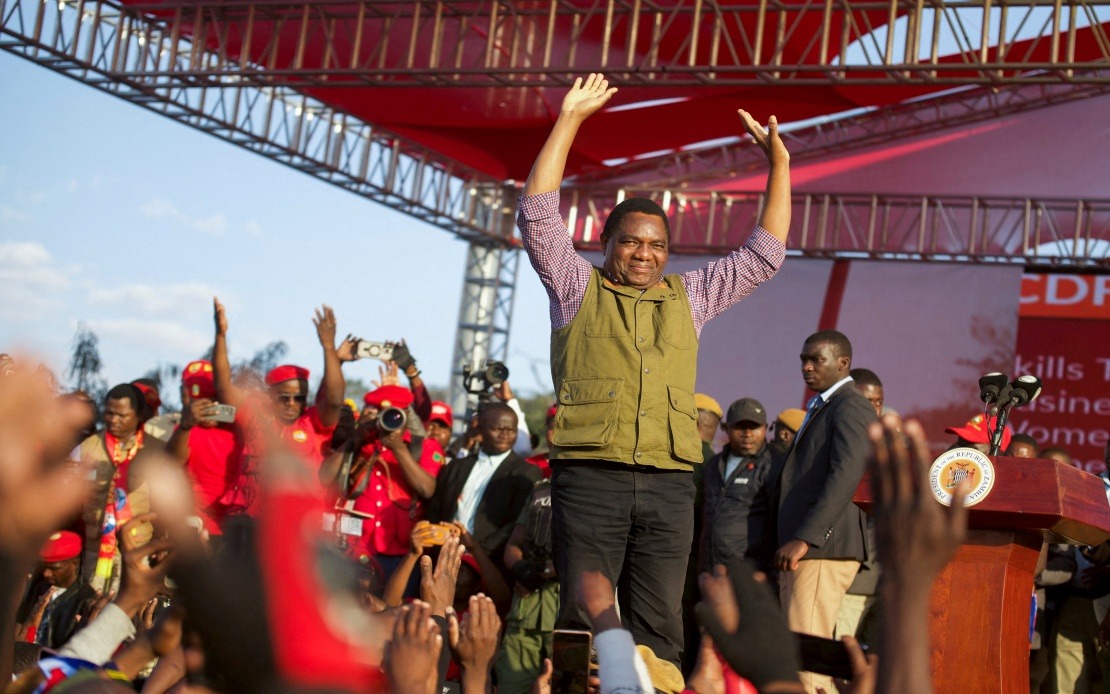
Zambian President Hakainde Hichilema has secured a fresh mandate to lead the Southern African nation, winning re-election with a commanding majority that underscores sustained public confidence in his stewardship. The Electoral Commission of Zambia confirmed early on Tuesday that the 64-year-old incumbent accumulated more than 2.9 million votes in last Thursday's presidential contest, eclipsing the constitutional requirement of 50 per cent plus one vote needed to claim outright victory.
The scale of Hichilema's triumph became apparent when commission chairperson Mwanagala Zaloumis declared him president-elect at the national election centre in Lusaka, the capital. Zaloumis notably observed that the margin had been so substantial that remaining results from selected polling stations across five of Zambia's 226 constituencies would prove inconsequential to the overall outcome. This assessment reflected the decisive nature of the endorsement, leaving no realistic possibility that trailing challengers could overtake the frontrunner.
Hichilema's main opposition came from Brian Mundubile, representing the National Restoration Party for Unity and Progress, who accumulated 1.8 million votes. The gap of approximately 1.1 million votes between the two frontrunners represented a commanding margin in the context of electoral competition, signalling a fundamental realignment of voter preference rather than a marginal victory requiring recounts or legal challenges. This clarity proved significant given Zambia's recent political history, which has occasionally involved contested election results and constitutional disputes over presidential succession.
Emotions ran high across Lusaka as election results trickled in, with jubilant supporters of the ruling United Party for National Development gathering in streets and public spaces. The early-morning cold could not dampen the enthusiasm of residents from all social strata who ventured out to celebrate what many perceived as validation of their nation's chosen path forward. The energy persisted long after the official announcement, suggesting the victory resonated beyond the immediate partisan base.
Hichilema's response to victory struck a tone of humility and recommitment to public service. Through a Facebook statement issued shortly after Zaloumis's declaration, the president-elect thanked Zambians for reposing their trust in him and pledged to continue serving the nation's interests. His language emphasised stewardship and accountability rather than triumphalism, framing the electoral outcome as an opportunity to deepen his administration's agenda rather than as a personal vindication of power.
Collins Maoma, national chairperson of the United Party for National Development, reinforced this narrative when addressing media representatives. Maoma emphasised that the Zambian electorate had once again demonstrated confidence in Hichilema's leadership qualities, suggesting that continuity rather than dramatic policy shifts would characterise the incoming term. The party chairman's commentary reflected an interpretation of voter intentions as endorsement of current trajectory, implying that major institutional or economic changes were unlikely to dominate the next administration's opening months.
The election outcome carries implications for regional stability and economic direction across Southern Africa. Zambia, the continent's second-largest copper producer and a nation grappling with substantial external debt, requires consistent leadership to navigate ongoing fiscal challenges and investment negotiations. Hichilema's return to office provides continuity for international creditors and development partners assessing the country's reform commitments and macroeconomic management.
For Malaysian observers and policymakers, Zambia's successful election cycle—marked by relatively peaceful conduct and orderly power transition—offers perspective on democratic consolidation within African nations. While election disputes have characterised some recent African contests, Zambia's clear result and accepted outcome demonstrate institutional capacity to manage contested political succession, an achievement worth noting as regional comparative governance continues evolving.
The re-election also underscores broader patterns within Zambian politics, where leadership personalities and particular individuals often command voter loyalty that transcends traditional party allegiances. Hichilema's personal popularity, developed through his trajectory as a businessman and opposition leader before assuming the presidency, appears to constitute a significant electoral asset extending beyond programmatic appeals or ideological differentiation.
Looking forward, Hichilema faces the task of translating electoral endorsement into tangible improvements in living standards for ordinary Zambians. Rising inflation, employment challenges, and service delivery pressures have characterised recent years, and voter expectations for visible progress will likely shape assessments of his second term's success. The forthcoming five-year period will test whether the confidence demonstrated through ballots translates into durable improvements in institutional effectiveness and economic performance.

