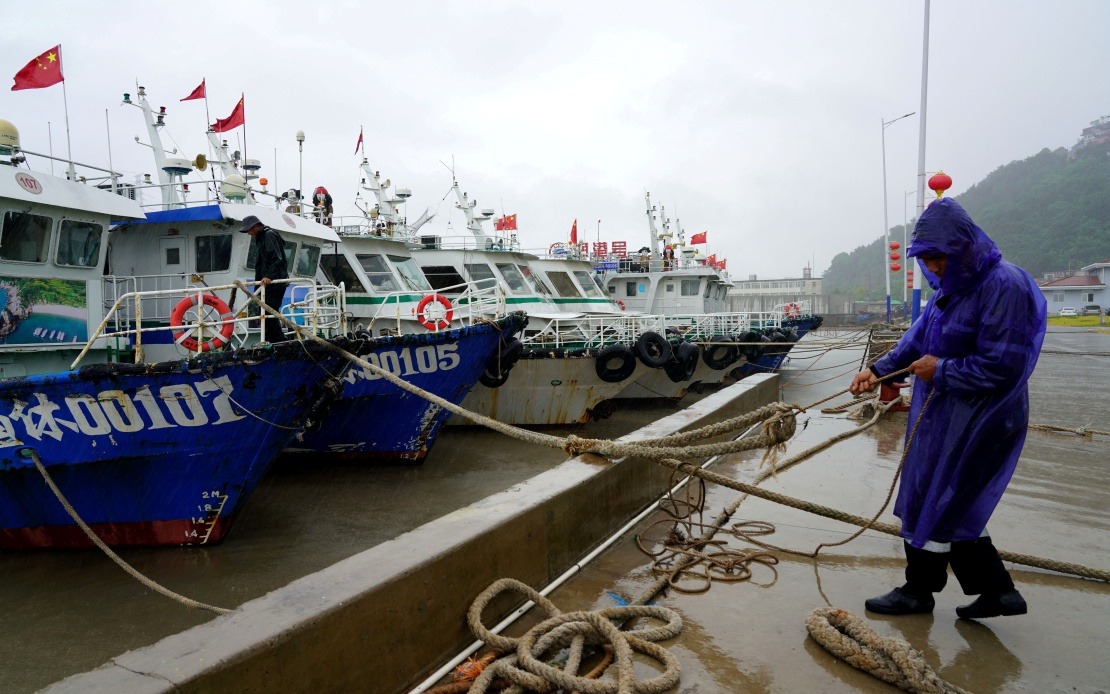
Zhejiang Province in eastern China has escalated its emergency protocols for Typhoon Dolphin, jumping from Level IV to Level III alert status as the system bears down on the country's coastal regions. The elevation came at midday Friday as meteorological officials tracked the 13th typhoon to form during the 2026 season. The move reflects growing concern about the storm's trajectory and intensifying threat to one of China's most economically developed provinces, a region that hosts critical manufacturing and commercial infrastructure serving regional and global supply chains.
At the time of the alert upgrade, Typhoon Dolphin sat approximately 763 kilometres east of Wenling in Zhejiang, according to readings from the Zhejiang Meteorological Observatory. The storm's current positioning places it directly in line for a westward progression that could bring it directly into the province. Forecasters projected the system would advance toward the Chinese mainland at a velocity of 15 to 20 kilometres per hour, maintaining or slightly intensifying its current strength as it moves across the warm waters of the East China Sea. This steady approach pattern has given authorities a relatively clear window to prepare protective measures.
China's National Meteorological Centre issued a yellow-level alert on Thursday evening, establishing a landfall window between Sunday and Monday along a stretch of coast extending from Shanghai through Fuqing in Fujian Province. This geographical range encompasses some of China's most populated and economically significant urban centres, underscoring the scale of potential disruption. Lou Xiaofen, the chief forecaster at Zhejiang's meteorological service, emphasised the heightened risk profile for the province, noting that Typhoon Dolphin has demonstrated a substantial probability of striking Zhejiang directly rather than glancing off peripheral areas. Such a direct hit would expose the region's 100 million residents and vast industrial base to the full force of the system as it transitions from typhoon strength toward severe typhoon classification.
The precautionary actions initiated by Zhejiang authorities reveal the scale of preparation underway across the province. Maritime services have been comprehensively curtailed, with all 162 passenger ferry routes suspended to prevent vessels from being caught at sea during dangerous conditions. Simultaneously, work operations at all 193 offshore industrial and construction projects have ground to a halt, eliminating hazards posed by partially constructed installations exposed to extreme winds and waves. A total of 474 construction vessels have been ordered to seek protected harbour, ensuring these crucial maritime assets are secured against storm surge and rough seas.
Provincial maritime authorities have activated an extensive early warning distribution network, transmitting 86,000 advance notification messages to ship operators, port facilities, and coastal communities. Inspections have been conducted on 24,000 individual vessels to ensure compliance with storm preparations and to verify seaworthiness standards. Beyond these administrative measures, high-powered tugboats have been positioned in strategic locations along the coast, positioned for rapid deployment to render emergency assistance should any maritime vessel find itself in distress during the typhoon's passage. This layered approach to marine safety reflects lessons learned from previous typhoon events that inflicted casualties among fishing fleets and merchant shipping caught unprepared.
Under the Level III response framework, local government agencies across Zhejiang have been mobilised to undertake continuous surveillance of the typhoon's development, refining forecasts as the system approaches. Public warning systems must remain in constant operation, disseminating updates through every available communications channel—television, radio, mobile telephone networks, and social media platforms. The protocols demand the systematic evacuation of populations from areas deemed most vulnerable to storm surge, flooding, and wind damage, with authorities establishing temporary shelters to accommodate those relocated from high-risk zones. Comprehensive guidance must be provided to the general public regarding shelter-in-place procedures, emergency supplies, and appropriate responses to various typhoon-related hazards.
For Malaysia and other Southeast Asian nations, the activity of Typhoon Dolphin and the response mechanisms deployed across Zhejiang offer important comparative lessons. The region shares similar typhoon climatology and faces comparable challenges in protecting dense coastal populations and critical economic infrastructure from tropical cyclone impacts. The coordination between meteorological services, maritime authorities, and civilian emergency management agencies demonstrated by Chinese authorities reflects best practices applicable across the region. Malaysian emergency management organisations can draw insights from Zhejiang's vessel inspection protocols, early warning message distribution systems, and the strategic positioning of rescue assets before typhoon arrival.
The economic ramifications of a direct Typhoon Dolphin impact on Zhejiang extend well beyond the province's borders. The region serves as a manufacturing and logistics hub integrated deeply into regional and global supply chains. Disruptions to port operations, interruptions to industrial production, and damage to transportation infrastructure could reverberate across Southeast Asia, affecting business operations dependent on Chinese suppliers or components. Maritime shipping that transits through the East China Sea and toward Southeast Asian ports could experience routing delays or cancellations. Supply chain managers across Malaysia, Singapore, Thailand, and Vietnam have begun monitoring Typhoon Dolphin's development, adjusting logistics schedules in anticipation of potential disruptions to regional trade flows.
The decision to maintain or slightly increase the storm's intensity as it approaches the coast adds another variable to the forecast uncertainty. Warm sea surface temperatures in the East China Sea could provide additional energy to the system, potentially allowing Typhoon Dolphin to maintain severe typhoon strength all the way to landfall rather than weakening as it encounters cooler waters or increased friction from land masses. Such persistence of intensity would magnify rainfall totals, expand the wind damage footprint, and increase vulnerability to storm surge and flooding in low-lying coastal areas. Forecasters will continue refining intensity predictions as new satellite imagery and aircraft reconnaissance data become available in the days preceding landfall.
For international observers and Southeast Asian governments, the escalation of Zhejiang's alert level serves as a signal that the situation warrants serious attention. The transition from Level IV to Level III alert represents more than bureaucratic procedure—it indicates that official channels now assess the threat severity to justify comprehensive economic disruption and large-scale resource mobilisation. Maritime shipping authorities throughout the region have begun issuing navigational warnings and encouraging vessel operators to avoid the anticipated typhoon track. Insurance and logistics companies are reviewing coverage and adjusting exposure to potential claims arising from typhoon-related losses.
The extensive preparatory measures undertaken by Zhejiang authorities—from ferry suspensions to vessel inspections to early warning broadcasts—demonstrate the institutional capacity developed across China for managing typhoon threats at scale. The sheer magnitude of coordination required to manage 162 ferry routes, 193 offshore projects, and 24,000 vessels reflects decades of experience managing multiple typhoon seasons annually. As climate patterns potentially intensify tropical cyclone activity, this capacity for rapid mobilisation and comprehensive protective action offers a model that other nations in the region continue to study and adapt to their own institutional contexts and geographical circumstances.

