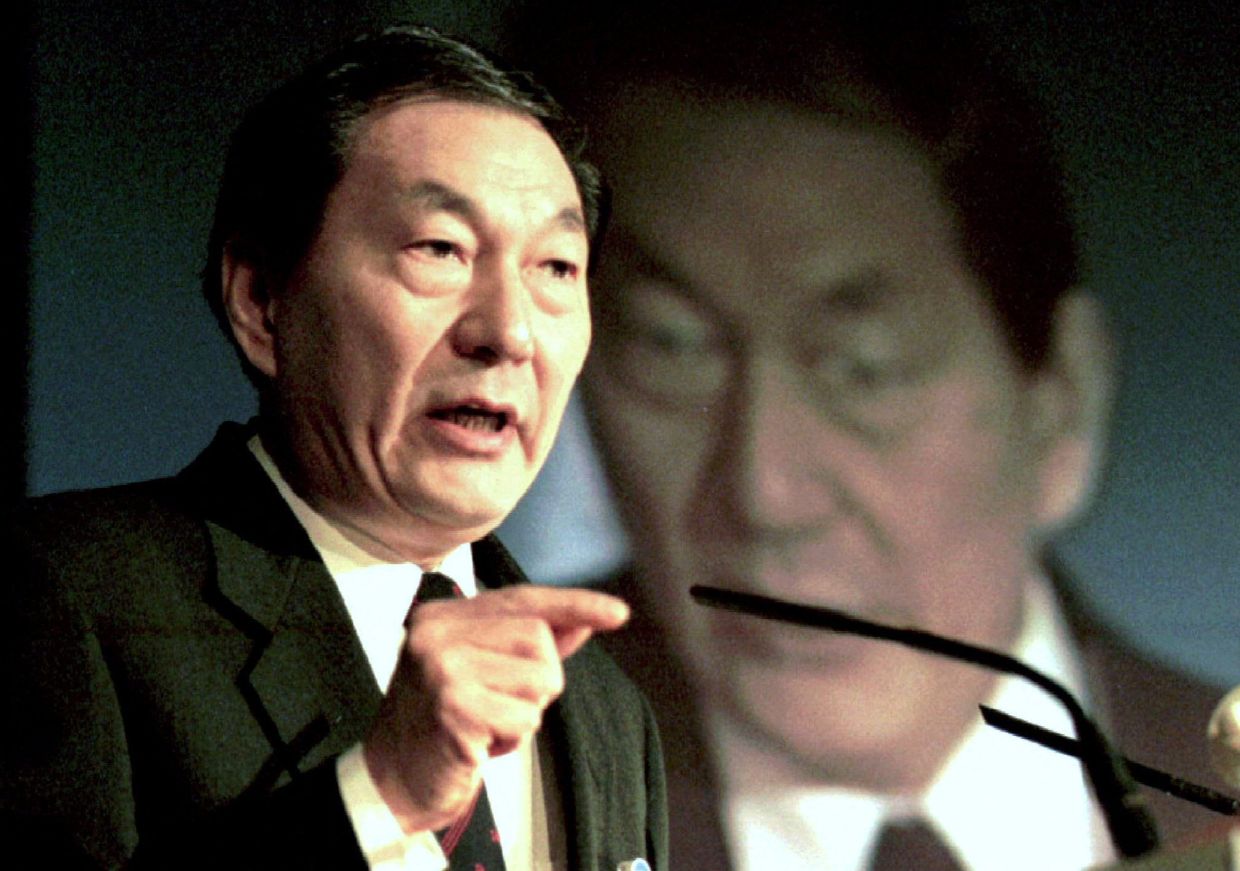
Zhu Rongji, the influential Chinese premier who fundamentally transformed the country's economic landscape through aggressive restructuring and guided China into the World Trade Organization, has passed away at the age of 98. The former senior statesman died on Wednesday (August 12) in Beijing after medical treatment for an undisclosed condition proved unsuccessful, according to reports from the official Xinhua News Agency.
During his tenure as premier from 1998 to 2003, Zhu implemented sweeping reforms that reshaped China's relationship with state ownership and market forces. His administration closed tens of thousands of inefficient state-owned enterprises across sectors including telecommunications, banking, and oil production. These decisions displaced tens of millions of workers but were intended to address mounting debt and catalyse growth through private sector development. Prior to his premiership, Zhu had already established himself as China's chief economic strategist, navigating the country through the turbulent 1997 Asian financial crisis and periods of double-digit inflation.
The strategic vision that animated Zhu's reforms stands in stark contrast to the approach pursued by subsequent Chinese administrations. Under President Xi Jinping's leadership, the government has championed a "stronger, better, and bigger" state-controlled economy, positioning public ownership as essential to advancing national strategic priorities. This philosophical divergence reflects broader debates within China's leadership about the optimal balance between market mechanisms and state direction, a tension that remains unresolved.
John Thornton, formerly co-president of Goldman Sachs, recalled meeting Zhu in the mid-1990s and was struck by the premier's command of detail and willingness to engage substantively with complex business matters. When coordinating the October 1997 Hong Kong share offering that launched China Mobile Ltd, Thornton assembled Chinese executives on Hainan island alongside Deutsche Telekom experts to discuss operational structures. Zhu monitored proceedings closely and posed searching questions that demonstrated his grasp of corporate finance and organisational design. "We'd answered these questions many times before, but usually you don't get these questions from the premier of a country," Thornton reflected, noting that such inquiries typically emanated from corporate chief financial officers rather than heads of government.
Before ascending to the premiership, Zhu served as governor of the People's Bank of China from 1993 to 1995, where he accelerated the country's financial opening. He introduced pilot programmes inviting foreign financial institutions into Chinese markets and oversaw the nation's inaugural worldwide bond issuance. These initiatives signalled China's determination to integrate with global capital markets while maintaining domestic oversight. In 1999, Zhu orchestrated the creation of asset-management companies tasked with purchasing 1.4 trillion yuan (US$220 billion) in non-performing loans from China's four largest banks. This mechanism proved crucial in allowing financial institutions to rehabilitate their balance sheets and eventually proceed to public listings beginning in 2005, fundamentally modernising China's banking sector.
Zhu's pivotal role in China's accession to the World Trade Organization underscored his commitment to globalisation. In 2000, he convened discussions with then-European Union Trade Commissioner Pascal Lamy in Beijing to break through negotiating impasses. China's subsequent WTO entry in 2001 unleashed rapid economic expansion; the nation's gross domestic product has since grown roughly elevenfold to rank as the world's second-largest economy. Nevertheless, trading partners have increasingly contested Beijing's adherence to WTO rules, pointing to state subsidies, informal import barriers, and intellectual property violations as persistent irritants in commerce relationships.
Beyond his role as economic architect, Zhu earned recognition for anti-corruption initiatives and bureaucratic streamlining. His drive to eliminate unnecessary administrative approvals and reduce government intermediaries spawned the epithet "one-chop Zhu," referencing the official seals, or chops, required to authorise documents in China. He commanded respect internationally through his fluent English and sharp wit. During a joint press appearance with United States President Bill Clinton in 1999, when questioned about alleged Chinese campaign donations to the Democratic Party, Zhu responded with characteristic irony: "This shows that some Americans really have underestimated us. If political contributions could really be effective, and I have $146 billion of foreign-exchange reserves, I could take out at least $10 billion for this purpose. Why just $300,000? That would be too foolish!" The candid rejoinder drew laughter and applause.
Zhu's early life traced the turbulent trajectory of modern China. Born in October 1928 in Hunan province in southern China, he studied electrical engineering at Tsinghua University from 1947 to 1951 and joined the Communist Party in October 1949, the very month Mao Zedong declared the People's Republic. Working in the state planning apparatus from 1952, Zhu later criticised Mao's economic policies during the Hundred Flowers Campaign, when limited speech was permitted, arguing that they produced irrational growth. This candour cost him dearly; he was branded a "rightist" and demoted, subsequently spending five years labouring on a farm during the Cultural Revolution, raising pigs and planting rice.
Following his rehabilitation in 1978 after the Cultural Revolution's conclusion, Zhu's ascent through the governmental hierarchy was methodical. He became Shanghai's mayor in 1987 and vice premier in 1991, before joining the Politburo Standing Committee, the apex of Chinese power, in 1992. After relinquishing the premiership to Wen Jiabao in 2003, Zhu devoted himself to enhancing the international standing of Tsinghua University, his alma mater, and channelled royalties from published books toward rural schools, emphasising education as a vehicle for societal advancement.
In a 2000 statement before the National People's Congress, Zhu articulated his aspirations for legacy. "I only hope that after I leave office, the Chinese people will say that he was a clean official, not a corrupt one. I would be very satisfied," he remarked. "If they are more generous and say that Zhu Rongji got some real things done, then I'd thank heaven and Earth." By most accounts, his wish has been largely granted. Deng Xiaoping, the paramount leader who set China on its reform trajectory, had designated Zhu a "rare talent" with economic understanding and willingness to confront difficulties. Zhu is survived by his wife, Lao An, and two children: his son Levin Zhu, who led China International Capital Corp investment bank in Beijing from the early 2000s to 2014, and his daughter Zhu Yanlai, who occupied senior management roles at Bank of China (Hong Kong).

