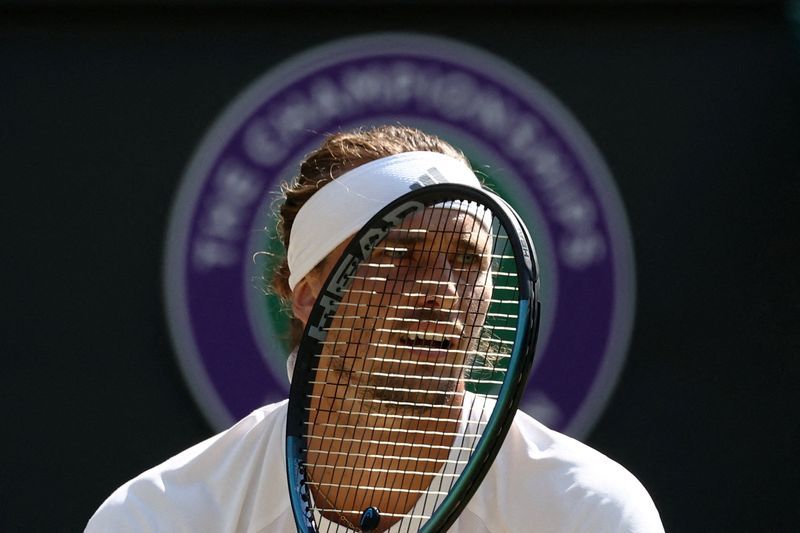
Alexander Zverev has conquered one of the most significant obstacles standing between him and a second consecutive Grand Slam title, dismantling Taylor Fritz 6-4 6-4 6-2 to secure his place in the Wimbledon semi-finals. The German second seed's commanding performance on Court One in southwest London represents a watershed moment in their head-to-head rivalry, as Zverev had struggled considerably against the American, failing to win in their previous seven meetings, including a loss at the All England Club just twelve months earlier. With this victory, the French Open champion from earlier this summer remains firmly on course to capture back-to-back major championships, a feat that would underline his credentials as one of the sport's elite competitors.
Zverev's breakthrough against Fritz comes at a crucial juncture in his career trajectory. The 29-year-old German has reached his maiden Wimbledon semi-final, an achievement that places him in the company of four fellow men from his nation who have reached the penultimate round at the grass-court championship during the professional era that commenced in 1968. Boris Becker, Michael Stich, Rainer Schuettler and Tommy Haas form an illustrious list of German male players to have previously achieved this milestone, demonstrating both the depth of tennis talent that Germany has historically produced and the rarity of individual players reaching this stage at Wimbledon. Zverev's inclusion among these names reflects the quality of his performance across all four major tournaments and his growing ability to compete consistently at the highest level.
The manner of Zverev's victory underscored his tactical precision and mental resilience throughout the match. Breaking serve early in the opening set established the foundation for his dominance, as he built a commanding 5-4 lead before having to dig deep to fend off a spirited rally from Fritz in the tenth game. The German's composure under pressure proved decisive as he ultimately claimed the opening set beneath the intense afternoon sun on Court One. This early success set the psychological tone for the remainder of the encounter, as Zverev appeared increasingly confident in his strokeplay and court positioning.
The second set witnessed Zverev intensify his attacking approach following a medical timeout Fritz required after just three games to address a persistent right knee issue. The American's physical discomfort appeared to provide Zverev with an opening to seize control of the match more emphatically. Breaking serve at a crucial moment, Zverev celebrated with visible relief and intensity, understanding that he had effectively placed his opponent in a position from which recovery would prove extremely difficult. The German's ability to capitalize on such opportunities reflected his superior conditioning and mental focus throughout the afternoon.
The crowd's response to news filtering through from Centre Court that British hope Arthur Fery had secured a two-set advantage against his opponent provided an interesting dynamic within the stadium. Zverev's own surge to further clarity shortly thereafter represented a sympathetic competitive momentum, with the German holding serve comfortably as Fritz's prospects of mounting a meaningful comeback progressively diminished. The American's hopes had essentially evaporated by this juncture, as Zverev's superior positioning and shot selection had rendered Fritz increasingly ineffective in rallies.
Zverev's third-set performance demonstrated the level of execution required to compete at the highest echelon of professional tennis. A scintillating backhand winner enabled him to secure a double break at 4-1, effectively sealing the match's outcome well before the final service games. The German completed the rout with minimum drama, closing out the set with the same assured efficiency that had characterized his approach throughout. This victory extended his Grand Slam semi-final appearances to twelve across his career, reinforcing his status among the sport's established championship contenders.
The psychological significance of ending the two-year losing streak cannot be overstated. During his post-match reflections, Zverev acknowledged the mental burden of facing an opponent against whom he had previously struggled repeatedly. The knowledge that he had failed to defeat Fritz in their most recent seven encounters had clearly weighed upon him before the match commenced. He recognized that overcoming this negative history had required an elevated level of performance, describing his display as approaching near-perfection. Such self-awareness and the ability to execute under the pressure of psychological disadvantage speaks to the maturity Zverev has developed as a competitor.
Zverev's forthcoming semi-final against Arthur Fery presents an intriguing encounter between two players who are reaching the penultimate round of Wimbledon for the first time. The German appeared magnanimous in acknowledging that home sentiment at the All England Club would naturally favour the British player, joking with the crowd about their likely allegiances while maintaining a lighthearted tone. Nevertheless, Zverev expressed quiet confidence in his ability to execute his game plan effectively, recognizing that his recent victory over Fritz should provide considerable psychological momentum heading into the semi-final.
For Malaysian and Southeast Asian tennis enthusiasts, Zverev's progression represents the continued dominance of European players at the major championships, a trend that has persisted for several years. The German's pursuit of consecutive Grand Slam titles would constitute a remarkable achievement in the modern era of tennis, where the demands of competition across multiple surfaces and extended calendar schedules make such feats exceptionally demanding. His performance against Fritz demonstrated the technical and mental qualities necessary to sustain excellence over the duration of a two-week major championship, offering insights into what distinguishes elite competitors from the broader field of professional players.
The contrast between Zverev's assured execution and Fritz's struggles with both his right knee issue and his opponent's rising confidence became increasingly apparent as the match progressed. The American's inability to generate pressure through his customary serving prowess and aggressive baseline play meant that he remained largely reactive throughout the encounter. Zverev's dominance in rallies and his improved decision-making regarding when to attack and when to construct points systematically demonstrated the evolution in his gameplay. These attributes will prove essential should he advance further in the tournament, as subsequent opponents will present progressively greater challenges across different tactical contexts.
Zverev's pathway to contention for the Wimbledon title has been clarified through his victory over Fritz, but the work remains far from complete. The semi-final against Fery will present a different stylistic challenge, as will potentially a final against another strong competitor. Nevertheless, the psychological breakthrough represented by ending the losing streak against Fritz provides legitimate grounds for optimism regarding his prospects of capturing a second major championship within a calendar year, an accomplishment that would meaningfully enhance his overall legacy within professional tennis.

