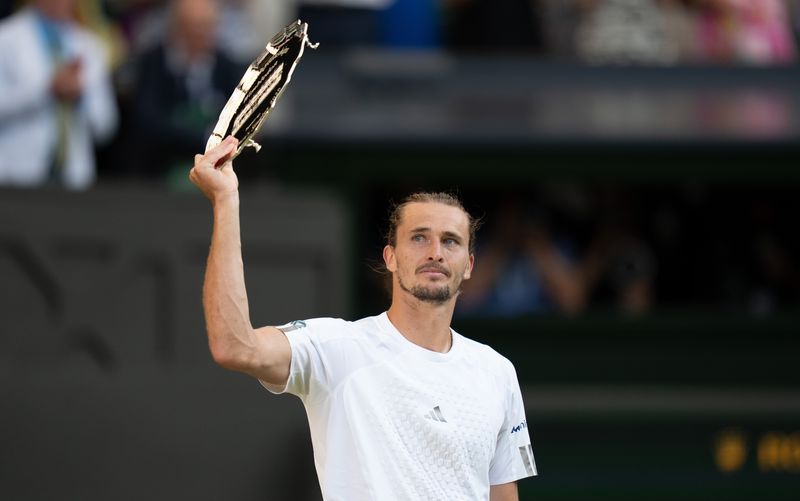
Alexander Zverev's ascent to the number two position in the ATP rankings beginning Monday marks a significant milestone for the German competitor, yet it comes tempered by the reality of men's tennis dominance currently exercised by Jannik Sinner and Carlos Alcaraz. Despite this competitive reality, Zverev has articulated a clear conviction that his recently refined attacking approach—characterised by a more aggressive deployment of his forehand and consistent serve execution—can eventually bridge the performance chasm separating him from the sport's current elite.
The 29-year-old's Wimbledon final on Sunday against world number one Sinner represented far more than another defeat in an increasingly one-sided rivalry. Zverev faced the Italian across four sets that reflected genuine competitive equilibrium, particularly in the opening moments, rather than the stylistic domination Sinner has exhibited in previous encounters. The final scoreline of 6-7(7), 7-6(2), 6-3, 6-4 in Sinner's favour obscures a match that could have taken an altogether different trajectory. Had Zverev not stumbled at 3-3 in the third set during his sole break-point opportunity, the narrative surrounding a potential German singles champion at the All England Club—the first since Michael Stich's 1991 triumph—might be substantially different today.
Zverev's preceding months have witnessed a decisive transformation in both his approach and results. His French Open victory last month represented a watershed achievement, securing his maiden Grand Slam title at the 41st attempt. Though some observers tempered their enthusiasm by noting that Sinner exited the tournament in the second round whilst Alcaraz sat absent with a lingering wrist condition, the psychological impact of that Paris success proved undeniable. The confidence derived from defeating Flavio Cobolli in the final manifested visibly at Wimbledon, where Zverev executed what many observers recognised as his most expansive grasscourt Slam performance to date.
The architectural foundation of Zverev's revised tennis philosophy rests upon unreserved offensive intent. Throughout the Wimbledon final, his first serve percentage maintained steady occupation around the 80 mark while his forehand—previously criticised for excessive passivity—inflicted considerable punishment upon Sinner's defensive positioning. Zverev has articulated this tactical commitment with unusual clarity, explaining his willingness to strike aggressively whenever opportunities arise, accepting the accompanying variance in execution accuracy as an acceptable consequence of his chosen approach. This represents a deliberate strategic divergence from earlier phases of his career characterised by more cautious shot selection and defensive positioning.
Zverev's determination to maintain this attacking methodology remains unwavering despite the challenges encountered during the year's earlier stages. He acknowledged initial difficulties implementing the strategy consistently, yet he persisted methodically with the approach, drawing confidence from incremental improvements and recent major-tournament achievements. The player emphasised that both his Paris triumph and Wimbledon final appearance constitute evidence that his strategic evolution is generating tangible results, even against tennis's most formidable competitors. Rather than viewing these outcomes as aberrations, Zverev interprets them as validation of his methodological commitment and indications of trajectory improvement.
The statistical landscape between Zverev and his dominant rivals presents a stark contrast. Sinner and Alcaraz possess a combined 12 Grand Slam titles, an accumulated championship portfolio that underscores their current technical and mental superiority across tennis's premier competitions. Yet Zverev resists characterisation as permanently consigned to the third-tier competitor designation that has routinely circulated through tennis commentary. He observes that throughout the current season, he has consistently pressed both rivals toward their competitive limits, even absent victory records against either player. His performance at Melbourne Park against Alcaraz and his Wimbledon final resistance against Sinner both exemplified matches wherein the gap—whilst still decidedly in his opponents' favour—narrowed considerably from their typical separation margins.
Zverev articulated his competitive aspiration with notable candour, acknowledging the persistent media discourse surrounding identification of tennis's next breakthrough challenger. For several years, conversation has revolved around whether Zverev might ascend beyond his current position as the consistent third force trailing Sinner and Alcaraz. The distinction Zverev emphasises involves not merely occupying the third-ranked position but rather achieving genuine competitive proximity to the current dominators, positioning himself within a viable mix capable of winning major championships. Should he successfully narrow the existing gap and establish himself as a genuine contender for tennis's biggest tournaments, he would dramatically alter the current competitive landscape that has been largely binary in character.
A fall during the Wimbledon final's third set provided a complicating factor in Zverev's otherwise encouraging performance narrative. The incident involved an over-extension of his knee comparable in character to an injury sustained two years previously, consequently affecting his service mechanics. Zverev acknowledged that his serve velocity diminished noticeably following the mishap, and his overall performance level dipped temporarily in the third set before recovering during the fourth. The player attributed his inability to finalise the match not to inadequate strategy execution but rather to this physical setback occurring at a moment when competitive momentum had potentially shifted in his direction.
The implications of Zverev's evolving game for Malaysian and Southeast Asian tennis observers extend beyond simple spectator interest. The German's demonstrated willingness to fundamentally restructure his approach at 29 years old—an age when most professional athletes have cemented their tactical frameworks—offers instructive lessons regarding competitive adaptation and psychological flexibility. His insistence that persistent technique refinement, rather than natural talent alone, determines breakthrough achievement resonates across regional markets where tennis development remains in earlier evolutionary stages. Furthermore, Zverev's trajectory suggests that whilst Sinner and Alcaraz currently dominate, the competitive landscape need not remain permanently closed to challengers willing to execute radical strategic evolution.
Looking forward, Zverev's trajectory will likely influence broader competitive dynamics across professional tennis. Should his attacking philosophy prove sustainable and continue generating Grand Slam opportunities, the established dominance exercised by Sinner and Alcaraz may gradually erode as competitive pressure increases and alternative technical approaches challenge their current superiority. Conversely, should Zverev's recent successes represent temporary peaks rather than sustainable elevation, the binary competitive structure will persist. What remains clear from his recent performances is that Zverev has identified a plausible pathway toward sustained championship contention, one fundamentally grounded in aggressive execution and unwavering commitment to his revised strategic vision rather than fundamental limitations in technical capacity.

