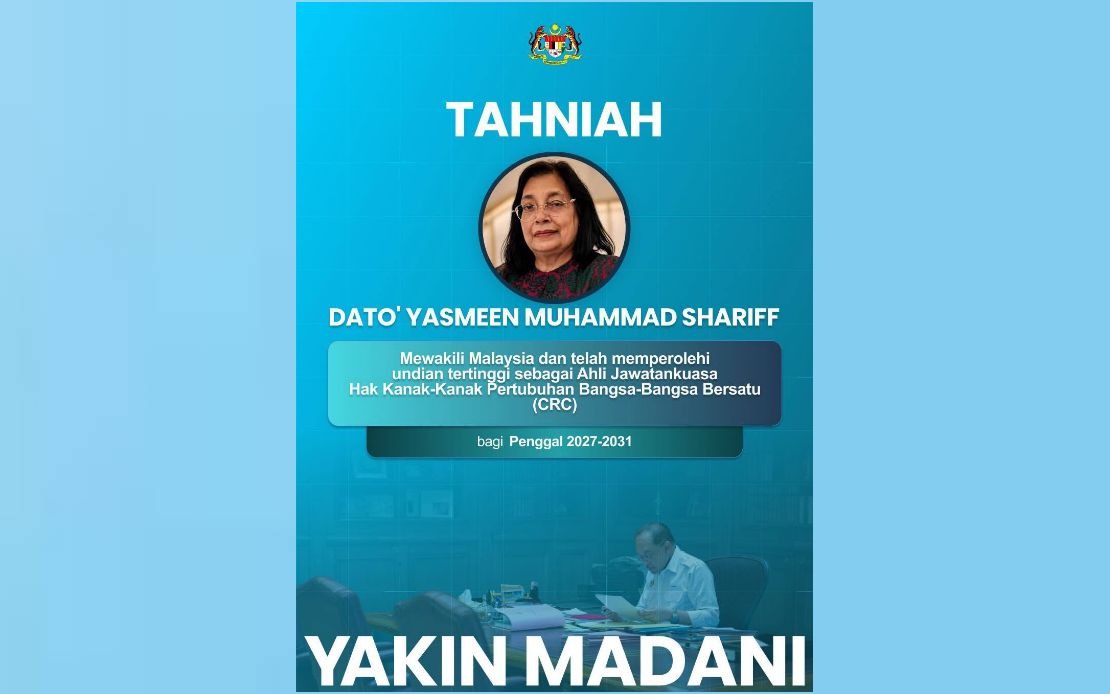
Prime Minister Datuk Seri Anwar Ibrahim has publicly commended Datuk Yasmeen Muhamad Shariff for securing election to the United Nations Committee on the Rights of the Child, a five-year appointment running from 2027 to 2031. The congratulations, extended through a Facebook post on June 25, underscored the Prime Minister's view that the selection represents a significant endorsement of Malaysia's standing within the international community and reflects global recognition of the nation's dedication to advancing children's welfare and rights on the world stage.
Yasmeen's successful candidacy emerged from voting held during the 21st Meeting of States Parties to the Convention on the Rights of the Child, conducted at United Nations headquarters in New York on Tuesday. Among 189 States Parties eligible to vote, she garnered 136 votes—a commanding majority that demonstrates substantial international backing. The Ministry of Women, Family and Community Development, her home ministry, released the results the following day, highlighting the confidence placed in her expertise and Malaysia's commitment to child protection issues.
This appointment marks the second occasion Yasmeen has been selected for membership on the internationally influential committee. Her previous tenure spanned the 2013-2017 term, granting her nearly a decade of intermittent experience with the body's work. The return of a familiar expert to the committee suggests that her prior contributions were valued and that her accumulated knowledge of UN child rights mechanisms would be assets to the committee's functioning during the coming period.
As a committee member, Yasmeen will operate in her personal capacity as an independent expert rather than as an official representative of Malaysia. This distinction is crucial within UN institutional frameworks; it means her positions and votes on committee matters will reflect her professional judgment and the body's collective consensus, not direct Malaysian government instructions. Nonetheless, her presence on such a prominent international body enhances Malaysia's visibility within UN human rights circles and provides informal channels through which Malaysian perspectives on children's issues can influence global policy discussions.
Anwar's public recognition of the achievement carries political significance beyond simple courtesy. By amplifying the news through his social media platform, the Prime Minister signalled that his administration views international human rights engagement as a priority and source of national pride. The statement also credited the Ministry of Women, Family and Community Development alongside Yasmeen, effectively recognising institutional support structures that enabled her selection.
The UN Committee on the Rights of the Child operates as a supervisory mechanism for the Convention on the Rights of the Child, the world's most widely ratified human rights treaty. The committee examines periodic reports submitted by state parties, issues recommendations, and contributes to interpreting the convention's provisions. Committee membership therefore carries substantial intellectual and policy influence over how signatory nations implement child protection standards. Malaysia's participation through Yasmeen positions the country as an active contributor to shaping global child welfare discourse.
For Southeast Asia specifically, Yasmeen's appointment provides a regional voice within a body that might otherwise be dominated by representatives from wealthier, more developed nations. Asian perspectives on family structures, education, child labour remediation, and social protection systems can appear underrepresented in international forums; her presence allows consideration of regional contexts and challenges that differ markedly from those in Europe or North America. This regional representation becomes increasingly important as the UN system grapples with implementing child rights standards across vastly different economic and cultural contexts.
The election also reflects Malaysia's active engagement with multilateral human rights institutions at a time when some nations have adopted more isolationist stances. By positioning experts in international bodies and encouraging their appointment, Malaysia demonstrates commitment to cooperative global governance. This approach yields both tangible benefits—influence over international standards that affect Malaysian citizens and businesses—and intangible ones, including enhanced diplomatic credibility and soft power.
Yasmeen's appointment cycle aligns with Malaysia's broader diplomatic calendar and international human rights commitments. The nation has in recent years undergone Universal Periodic Review processes, engaged with various UN special rapporteurs, and participated actively in regional human rights mechanisms. Populating international bodies with Malaysian experts creates reciprocal relationships and networks that facilitate dialogue on rights issues relevant to the country's development agenda and social policy objectives.
Looking forward, the 2027-2031 term will present distinct global challenges for child welfare monitoring. Anticipated areas of committee focus likely include pandemic recovery effects on education and mental health, digital rights and online safety for children, climate change impacts on youth populations, and persistent issues including child labour, trafficking, and exploitation. Yasmeen's appointment positions her to engage with these evolving priorities and to contribute Malaysian and Southeast Asian insights to the committee's guidance on implementing the Convention on the Rights of the Child during a complex period.

