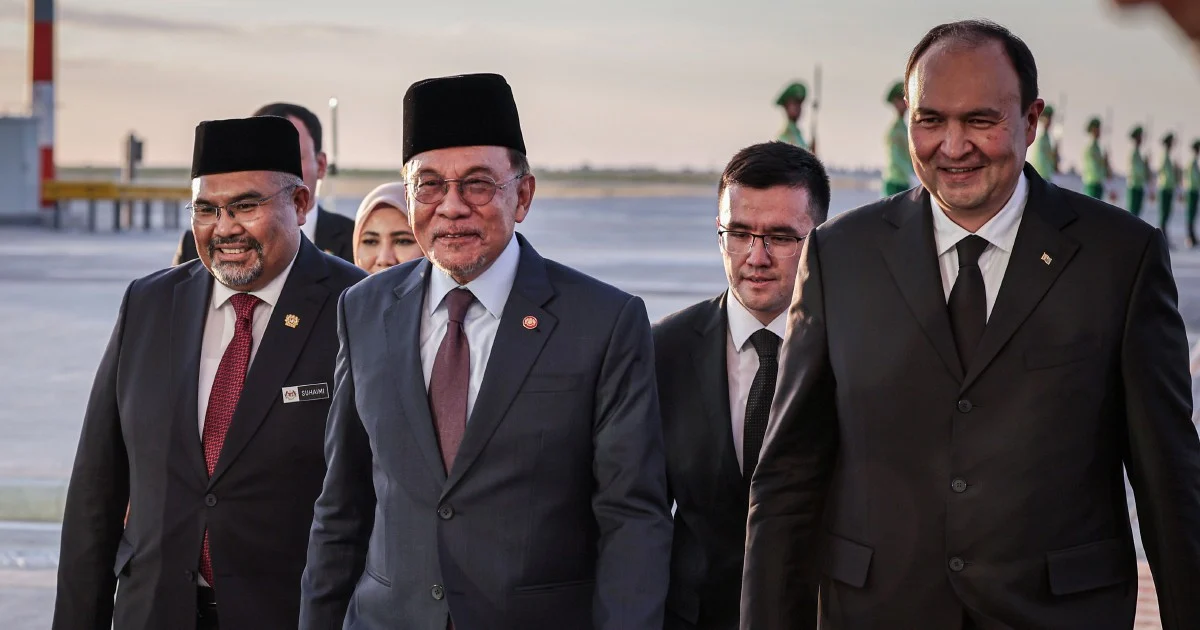
Prime Minister Datuk Seri Anwar Ibrahim has arrived in Ashgabat for a two-day official visit, marking the second destination in an ambitious Central Asian tour that underscores Malaysia's growing interest in strengthening ties with the region's emerging economies. The premier travelled directly from Kazan in Russia's Republic of Tatarstan, where he concluded a two-day working engagement that focused on bilateral cooperation and regional stability.
Turkmenistan's capital, known locally as the "White Marble City" for its distinctive architecture, serves as a critical hub for energy diplomacy and regional connectivity in Central Asia. The choice of venue reflects Malaysia's strategic focus on nations that control significant resources and influence regional geopolitics. Ashgabat has positioned itself as a neutral player in regional affairs, a positioning that aligns with Malaysia's traditional non-aligned foreign policy approach.
Anwar's extended Central Asian tour signals a deliberate pivot toward diversifying Malaysia's international partnerships beyond traditional trading partners and regional neighbours. This diplomatic engagement reflects a broader recognition in Kuala Lumpur that engagement with Central Asia offers multiple advantages, including access to emerging markets, energy security partnerships, and positioning within broader Eurasian infrastructure projects such as the Belt and Road Initiative.
The timing of this visit carries particular significance given the evolving geopolitical landscape in Asia. As Malaysia navigates complex relationships with major powers and regional actors, expanding dialogue with Central Asian republics provides valuable diplomatic space and economic opportunities. Turkmenistan, in particular, offers distinct advantages as a resource-rich nation with significant oil and gas reserves, making it an attractive partner for Malaysian energy companies and investors seeking diversification beyond Middle Eastern and Southeast Asian sources.
Anwar's journey from Kazan to Ashgabat demonstrates Malaysia's commitment to building sustained engagement across the Eurasian continent rather than limiting interactions to isolated high-level meetings. The sequential visits suggest coordination with Russian authorities and Turkmen officials to maximise diplomatic outcomes across both destinations. Such planned tours typically include discussions on bilateral economic cooperation, cultural exchange programmes, and potential investments in infrastructure and energy sectors.
For Malaysian business interests, Turkmenistan represents an opportunity to explore partnerships in sectors ranging from energy to telecommunications and construction services. Malaysian companies have demonstrated capability in managing large-scale infrastructure projects across Asia, and Central Asian nations increasingly seek experienced partners for developing economic zones, transportation networks, and industrial facilities that support regional integration.
The visit also reflects Malaysia's interest in participating in Central Asian regional groupings and dialogue forums. Economic cooperation frameworks and multilateral engagement mechanisms have expanded significantly in recent years, offering platforms for smaller nations like Malaysia to exert influence disproportionate to their size. Through active engagement in these forums, Malaysia can shape discussions on regional security, trade liberalisation, and cultural preservation.
Anwar's diplomatic mission carries implications for Malaysia's approach to great power competition. By maintaining active engagement with Central Asian republics, Malaysia demonstrates independence from major power alignments while keeping multiple diplomatic channels open. This balancing act has long characterised Malaysian foreign policy and remains essential as geopolitical tensions between major powers reshape regional dynamics.
Energy security considerations undoubtedly feature prominently in discussions with Turkmen counterparts. Malaysia's growing energy demands and the importance of securing stable supply sources make Central Asian energy producers valuable partners. Beyond immediate commercial interests, energy cooperation often serves as a foundation for broader political and economic relationships that can evolve over time.
Cultural and people-to-people exchange programmes typically form part of such high-level visits, with both nations exploring opportunities for student exchanges, tourism promotion, and collaborative initiatives in education and research. These softer aspects of diplomacy often prove more durable than transactional commercial agreements, building sustained goodwill and understanding between populations.
The Central Asian segment of Anwar's itinerary demonstrates a sophisticated understanding of regional geography and political dynamics. By visiting both Russian Tatarstan and Turkmenistan sequentially, the Prime Minister signals Malaysia's engagement with the region's diverse political actors and reflects recognition that Central Asia's future will be shaped by multiple powers rather than any single hegemon.
Looking ahead, this visit may establish frameworks for future cooperation that extend beyond immediate commercial transactions. Educational scholarships, investment promotion boards, and cultural heritage conservation initiatives frequently emerge from such official visits, creating lasting institutional connections between governments and societies. For Malaysian policymakers and business leaders, Turkmenistan represents a frontier market with growth potential and strategic importance to broader Asian integration projects.
Anwar's presence in Ashgabat thus represents more than ceremonial diplomacy—it reflects Malaysia's conscious decision to expand its diplomatic footprint across Eurasia and position the nation as a credible, independent actor capable of engaging profitably with diverse global partners while maintaining core principles of non-alignment and mutual respect.