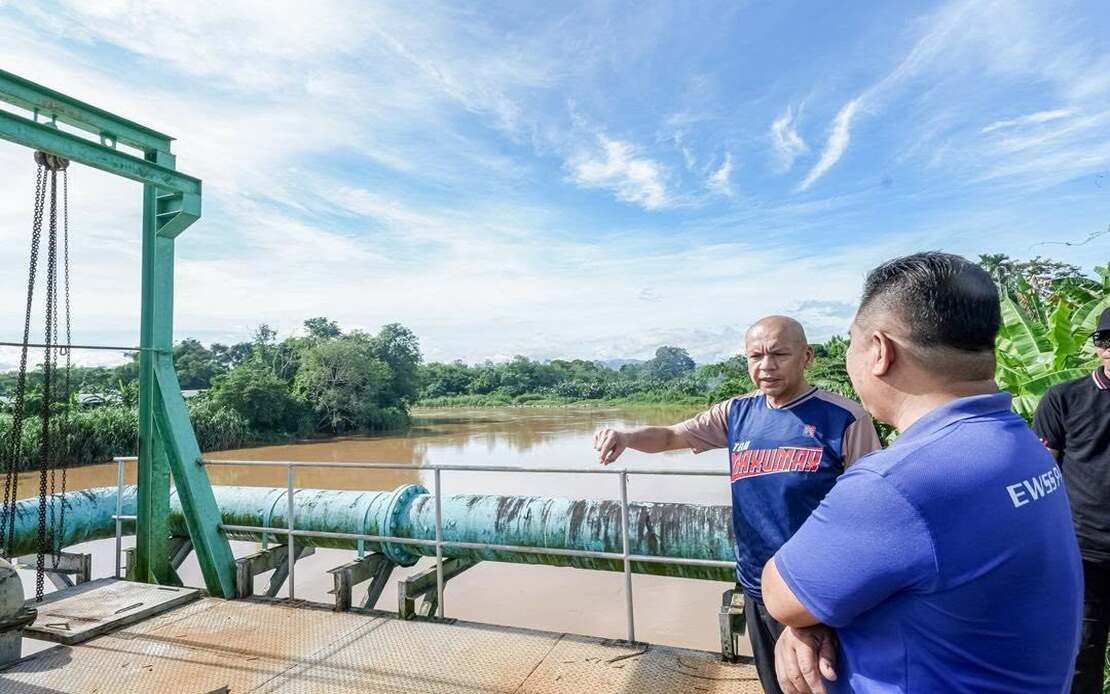
Datuk Armizan Mohd Ali, the Domestic Trade and Cost of Living Minister and MP for Papar, has undertaken a comprehensive inspection of the district's water infrastructure projects to verify their progress and effectiveness in addressing persistent supply challenges faced by residents. The ministerial visit follows a dedicated coordination meeting held on June 15 to assess implementation timelines and operational hurdles at multiple treatment facilities serving the Papar region.
At the heart of the stabilization effort are two concurrent infrastructure initiatives designed to expand the district's water handling capacity. The Kogopon Water Treatment Plant is undergoing substantial expansion to double its daily processing capability from 40 million litres to 80 million litres, while improvements are simultaneously being advanced at the Kampung Kabang intake infrastructure. These complementary projects represent a strategic response to mounting demand pressures in Papar, where population growth and economic activity have progressively strained the existing water distribution network.
The timing of Armizan's field visit proved particularly significant given recent operational disruptions that have constrained water availability across the district. Both the EWSS Plant and the JETAMA Limbahau Plant experienced temporary shutdowns during the week preceding his inspection due to elevated turbidity levels in raw water supplies. Turbidity, measured in nephelometric turbidity units (NTU), directly affects the treatability of water at treatment facilities; when source water quality deteriorates beyond processing thresholds, plants must reduce or halt operations until conditions improve sufficiently for safe treatment resumption.
These recurring water quality fluctuations underscore a fundamental vulnerability in Papar's water supply chain. Rather than representing isolated incidents, the turbidity spikes that forced temporary plant closures reflect seasonal and weather-related variations common to tropical watersheds, where heavy rainfall and upstream land disturbance can substantially degrade raw water conditions. For a region attempting to boost treatment capacity, such constraints highlight the necessity of concurrently improving source water management and intake infrastructure resilience.
Armizan's hands-on assessment of both treatment plants and intake facilities signals the government's commitment to direct operational oversight rather than reliance on secondary reporting. By personally examining conditions at the EWSS and JETAMA Limbahau facilities, the minister sought to identify specific bottlenecks and verify that mitigation strategies being implemented by plant operators align with broader infrastructure expansion targets. This field-level engagement provides decision-makers with granular understanding of technical constraints that routine progress reports may obscure.
The expansion of Kogopon WTP represents the centrepiece of Papar's capacity enhancement strategy. Doubling treatment throughput from 40 to 80 million litres daily would substantially increase the supply margin available to serve the district, theoretically providing buffering capacity during periods when weather or maintenance temporarily reduces operational efficiency at other facilities. However, the plant's expanded capacity will only deliver tangible benefits if intake, transmission, and distribution infrastructure simultaneously receive corresponding upgrades to prevent new bottlenecks from materializing elsewhere in the supply network.
For Malaysian water consumers and regional observers, Papar's infrastructure challenges reflect broader patterns affecting water security across Sabah and Peninsular Malaysia. Aging treatment facilities, aging transmission networks, and rising per-capita demand have created structural imbalances in many districts, prompting state and federal authorities to prioritize rehabilitation and expansion projects. Papar's experience demonstrates both the necessity of such investments and the ongoing vulnerabilities that persist even as construction proceeds.
The Kampung Kabang intake upgrade component merits particular attention, as intake infrastructure quality fundamentally determines the raw water conditions that treatment plants must manage. Improvements at this point in the supply chain—whether through enhanced sediment settling capacity, better source water protection, or upgraded screening systems—directly reduce the turbidity challenges that forced recent plant shutdowns. Strategic investment at the intake stage often yields greater long-term returns than attempting to enhance treatment capacity alone.
Armizan's characterization of direct field monitoring as essential to understanding operational realities reflects a pragmatic administrative philosophy increasingly common among federal ministers overseeing infrastructure portfolios. Remote management through reports and statistics risks missing contextual factors that on-site observation readily reveals. By witnessing conditions at multiple facilities within a single visit, the minister accumulated firsthand knowledge of interconnected systems and constraint points that bureaucratic summaries typically compartmentalize.
Looking forward, Papar's water stabilization programme will require sustained attention to both the timeline and quality of the Kogopon and Kampung Kabang projects. Completion delays could perpetuate the vulnerability to supply disruptions that residents have recently experienced, while quality shortcuts during construction might undermine the operational efficiency that justifies the substantial public investment these projects represent. The minister's commitment to ongoing monitoring suggests that accountability mechanisms will remain engaged throughout implementation phases.
The broader significance of Papar's infrastructure challenge extends beyond the district itself. As Southeast Asian nations confront intensifying water demand driven by urbanization and industrial growth, their experiences managing supply constraints and treatment plant operations provide instructive lessons. Malaysia's approach—combining capacity expansion with direct ministerial oversight and field-level problem-solving—offers a model of engaged governance that other regional governments may examine as they plan their own water security strategies.
For residents in Papar and surrounding areas, the convergence of multiple infrastructure projects and heightened ministerial attention suggests that policymakers recognize the urgency of stabilizing supply reliability. The temporary plant closures that prompted this week's inspection, while disruptive, have evidently crystallized political will to accelerate project implementation and eliminate the systemic vulnerabilities that allow single-point failures to cascade into district-wide supply disruptions.


%22%2F%3E%3C%2Fpattern%3E%3C%2Fdefs%3E%3Crect%20width%3D%22100%25%22%20height%3D%22100%25%22%20fill%3D%22url(%23ph2re9gg)%22%2F%3E%3Crect%20width%3D%22100%25%22%20height%3D%22100%25%22%20fill%3D%22url(%23ph2re9gp)%22%2F%3E%3Ctext%20x%3D%2250%25%22%20y%3D%2250%25%22%20text-anchor%3D%22middle%22%20dominant-baseline%3D%22central%22%20fill%3D%22rgba(255%2C255%2C255%2C0.95)%22%20font-family%3D%22Georgia%2C%20'Times%20New%20Roman'%2C%20serif%22%20font-weight%3D%22700%22%20font-size%3D%22194%22%20letter-spacing%3D%22-0.02em%22%3ETeacher%3C%2Ftext%3E%3C%2Fsvg%3E)