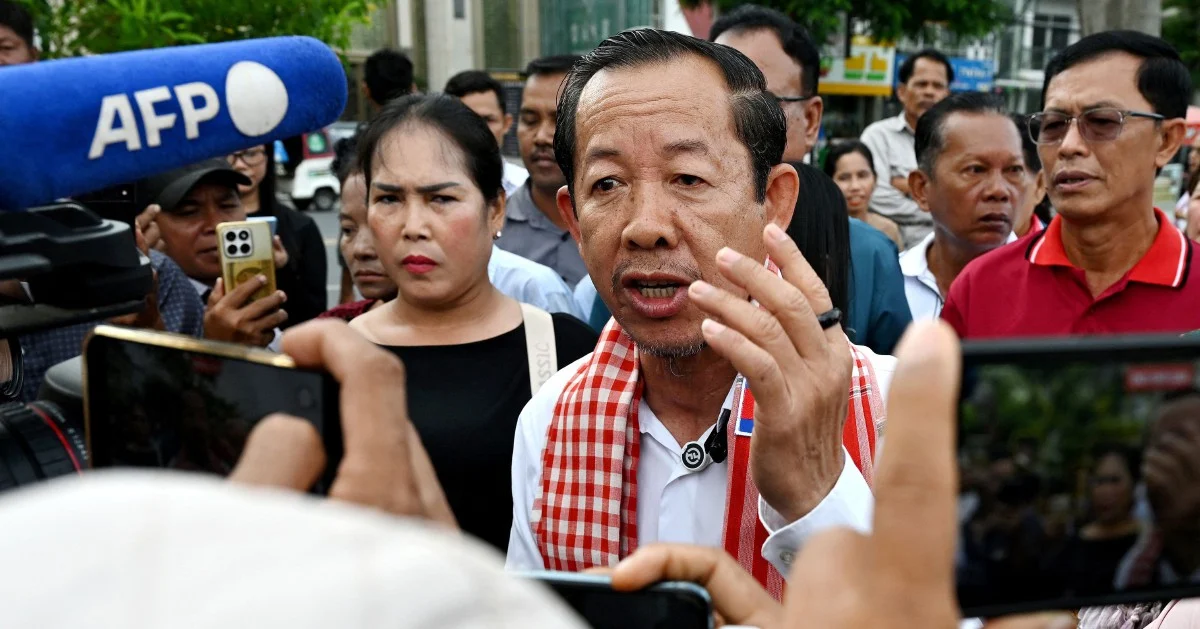
Cambodia's Supreme Court has dealt a decisive blow to opposition politics by upholding an election ban against prominent politician Rong Chhun, even as it moved to suspend his prison sentence. The ruling, delivered on Friday and confirmed by Chhun's legal team, marks a critical juncture in Cambodia's increasingly constrained political landscape, where judicial decisions against opposition figures have become a defining feature of recent years.
The suspension of Chhun's custodial sentence appears on the surface to offer some relief, yet the preservation of his electoral disqualification reveals the court's prioritization of preventing opposition participation in Cambodia's democratic processes. This dual ruling—partial clemency paired with permanent political exclusion—reflects a pattern whereby Cambodian authorities apply legal measures selectively to neutralize opposition threats while maintaining an appearance of procedural regularity.
Rong Chhun, whose political activism has made him a focal point of government pressure, becomes another in a lengthening roster of opposition figures subjected to comprehensive restrictions. His case exemplifies the multifaceted constraints imposed on Cambodia's political opposition, encompassing legal prosecution, imprisonment, and electoral exclusion that collectively function to diminish the viability of organized alternatives to Prime Minister Hun Sen's long-ruling Cambodian People's Party.
The election ban is particularly consequential for Cambodia's future political trajectory. With parliamentary elections expected in coming years, the disqualification of experienced opposition figures removes seasoned voices from electoral competition and creates a playing field weighted decisively toward the governing establishment. For Malaysian observers monitoring Southeast Asian democracy trends, Cambodia's approach contrasts sharply with more pluralistic systems, illustrating how different regional governments employ courts to manage political opposition.
Cambodia's judicial system has faced sustained international criticism for lacking independence from executive authority. The Supreme Court's decision regarding Rong Chhun must be understood within this context of compromised institutional autonomy. When courts consistently deliver rulings that align with government interests—particularly regarding opposition politicians—questions about judicial impartiality become unavoidable, undermining domestic and international confidence in the rule of law.
The suspension of his prison sentence, while presented as leniency, may serve strategic purposes beyond humanitarian considerations. By avoiding Chhun's continued incarceration, Cambodia's authorities potentially mitigate international pressure and accusations of purely vindictive persecution, whilst the election ban accomplishes the substantive goal of removing him from electoral contention. This approach allows the government to claim it has moderated its position whilst maintaining core restrictions on opposition participation.
For Cambodia's broader civil society and opposition movements, the ruling transmits a troubling message about the risks of political engagement. When a ban from contesting elections becomes a permanent consequence of opposition activity, the incentive structure for participation in formal politics fundamentally shifts. Younger activists and potential opposition candidates must calculate whether political involvement is worth potential career-ending disqualifications, potentially driving meaningful dissent underground or toward non-institutional channels.
Regional implications are also significant. As ASEAN member states navigate questions about democratic governance and opposition management, Cambodia's methods offer a case study in how electoral systems can function formally whilst substantively excluding genuine competition. Other governments in Southeast Asia, particularly those facing robust opposition challenges, will observe whether Cambodia's approach generates domestic stability or accumulates political grievances that eventually manifest in unexpected ways.
The international community's response to Cambodia's judicial decisions regarding opposition figures remains mixed and often muted. Some Western governments and international organizations issue statements expressing concern about democratic backsliding, yet such expressions rarely translate into consequential diplomatic pressure or economic sanctions. This gap between rhetorical criticism and substantive action may reinforce Cambodia's calculations that electoral restrictions and opposition suppression carry manageable international costs.
Within Cambodia itself, the ruling affects not only Rong Chhun but also calculates the broader political calculations of other opposition figures and potential challengers to the government. The message conveyed is that legal jeopardy awaits those who contest government authority, whilst electoral participation remains reserved for politically compliant actors. This creates a form of managed pluralism where elections occur, yet meaningful competition remains constrained by prior judicial determinations.
The sustainability of Cambodia's current political model depends partly on whether accumulated restrictions eventually produce counterproductive backlash or whether institutional capacity to manage opposition through legal means proves sufficient for regime continuity. The case of Rong Chhun represents one data point in a longer sequence of judicial actions shaping Cambodia's political future, suggesting that Cambodia's authorities have concluded that aggressive use of legal mechanisms against opposition figures serves their strategic interests more effectively than accommodating genuine political competition.
%22%2F%3E%3C%2Fpattern%3E%3C%2Fdefs%3E%3Crect%20width%3D%22100%25%22%20height%3D%22100%25%22%20fill%3D%22url(%23ph4kmesg)%22%2F%3E%3Crect%20width%3D%22100%25%22%20height%3D%22100%25%22%20fill%3D%22url(%23ph4kmesp)%22%2F%3E%3Ctext%20x%3D%2250%25%22%20y%3D%2250%25%22%20text-anchor%3D%22middle%22%20dominant-baseline%3D%22central%22%20fill%3D%22rgba(255%2C255%2C255%2C0.95)%22%20font-family%3D%22Georgia%2C%20'Times%20New%20Roman'%2C%20serif%22%20font-weight%3D%22700%22%20font-size%3D%22194%22%20letter-spacing%3D%22-0.02em%22%3EHighway%3C%2Ftext%3E%3C%2Fsvg%3E)