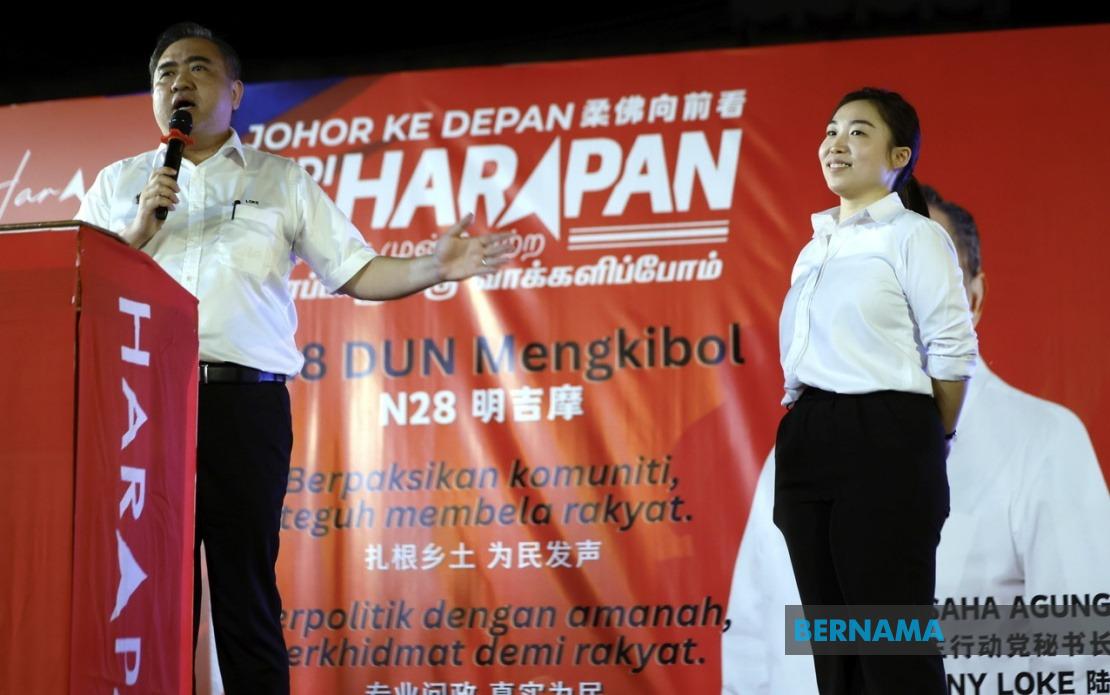
The Democratic Action Party has named Chu Poh Yee, a 33-year-old legal professional, as its standard-bearer for the Mengkibol state assembly seat in the forthcoming Johor state election. The announcement, made in Kluang on June 18, represents the party's first official candidate declaration for the contest and marks a strategic shift in the party's representation for the constituency.
Party secretary-general Anthony Loke disclosed that the nomination follows a deliberate decision to transition the seat's current representative to a higher political office. Chew Chong Sin, who has held the Mengkibol seat for two consecutive terms, will step aside to pursue candidacy for the Labis parliamentary constituency. This repositioning capitalizes on the anticipated vacancy created by incumbent Member of Parliament Pang Hok Liong, who has signaled his intention to retire from federal politics.
Loke framed the transition as part of the party's systematic succession planning, wherein proven state-level performers are elevated to the national stage. The move reflects a common practice within Malaysian political structures, where strong grassroots organizers are identified early for higher electoral contests. By advancing Chew to the parliamentary tier, the DAP positions itself to maintain continuity in Labis while simultaneously introducing fresh leadership at the state level.
Chu's selection underscores the party's commitment to gender representation in electoral politics, a principle that has gained prominence across Malaysian political movements in recent years. The legal professional brings credentials spanning multiple domains relevant to constituency work. Her background in legal aid matters—assisting elected representatives with citizen grievances and administrative legal issues—provides practical experience in the day-to-day demands of representative politics. The party leadership emphasized her fluency in multiple languages and robust educational qualifications as additional assets for engaging a diverse electorate.
The appointment also reflects broader demographic considerations within Mengkibol. Chu maintains established connections within the constituency, a factor party strategists clearly weighed in their evaluation. In Malaysian electoral politics, such local networks often prove decisive, particularly in state contests where personal accessibility and community familiarity carry substantial weight. Her ties to the area suggest the party conducted sufficient groundwork before announcing her candidacy.
The DAP's broader electoral strategy in Johor encompasses seventeen state seats across the southern state. The party composition reveals both continuity and ambition: ten seats represent incumbent-held constituencies, four constitute previously contested seats the party seeks to reclaim, and three represent new territorial expansion. This distribution indicates a mix of defensive and offensive positioning, a typical approach during state elections when changing political dynamics can reshape electoral viability.
The candidate rollout will proceed in tranches over successive announcements. Four additional candidates—for the constituencies of Tiram, Johor Jaya, Senai, and Bukit Permai—would be unveiled on the following Saturday, with remaining nominees disclosed jointly with other Pakatan Harapan coalition partners. The staggered announcement strategy distributes media attention and allows individual candidates focused publicity rather than diluting coverage across multiple simultaneous disclosures.
For Malaysian observers, the Johor state election carries significance extending beyond the state's boundaries. Johor has traditionally functioned as a bellwether for national political trends, given its size, economic importance, and diverse demographic composition. Performance metrics from the state contest frequently influence perception of party momentum entering subsequent national-level contests. A strong DAP showing could strengthen Pakatan Harapan's negotiating position in national coalitions, while disappointing results might prompt recalibration of the alliance's messaging or strategy.
Chu's candidacy also reflects evolving voter expectations regarding professional credentials and specialized expertise at state assembly level. Malaysian state representatives increasingly come from professional backgrounds—law, medicine, business, academia—rather than exclusively from party bureaucratic ranks. This pattern suggests constituencies increasingly demand representatives capable of navigating complex administrative and legal frameworks affecting residents' daily lives. The emphasis on Chu's legal background and assistance with administrative matters aligns with this expectation.
For women in Malaysian politics, the nomination represents incremental progress toward greater representation in electoral contests, though numerical parity remains distant. While DAP and other coalition partners have pledged commitments to female candidacy, implementation across all electoral contests remains uneven. Chu's selection demonstrates willingness to field women in competitive seats rather than relegating them exclusively to symbolic or unwinnable positions—a distinction carrying practical implications for meaningful representation.
The timing of the announcement, roughly concurrent with preparations for national-level candidate selection by Pakatan Harapan, suggests the Johor state contest functions as both distinct political competition and preliminary skirmish within broader coalition positioning. The party's public confidence in announcing candidates sequentially suggests internal party structures have functioned effectively, with selection committees reaching consensus relatively quickly. This contrasts with previous election cycles when candidate selection sometimes generated internal friction and public disagreement.
Chew's anticipated transition to parliamentary politics also reflects demographic realities within Malaysia's political system. Opportunities for advancement from state to federal level remain limited, with competition intense among aspiring national representatives. The DAP's willingness to facilitate such progression, particularly when incumbent representatives have demonstrated effectiveness, indicates confidence in both Chew's capabilities and the party's capacity to retain state-level seats despite leadership transitions.