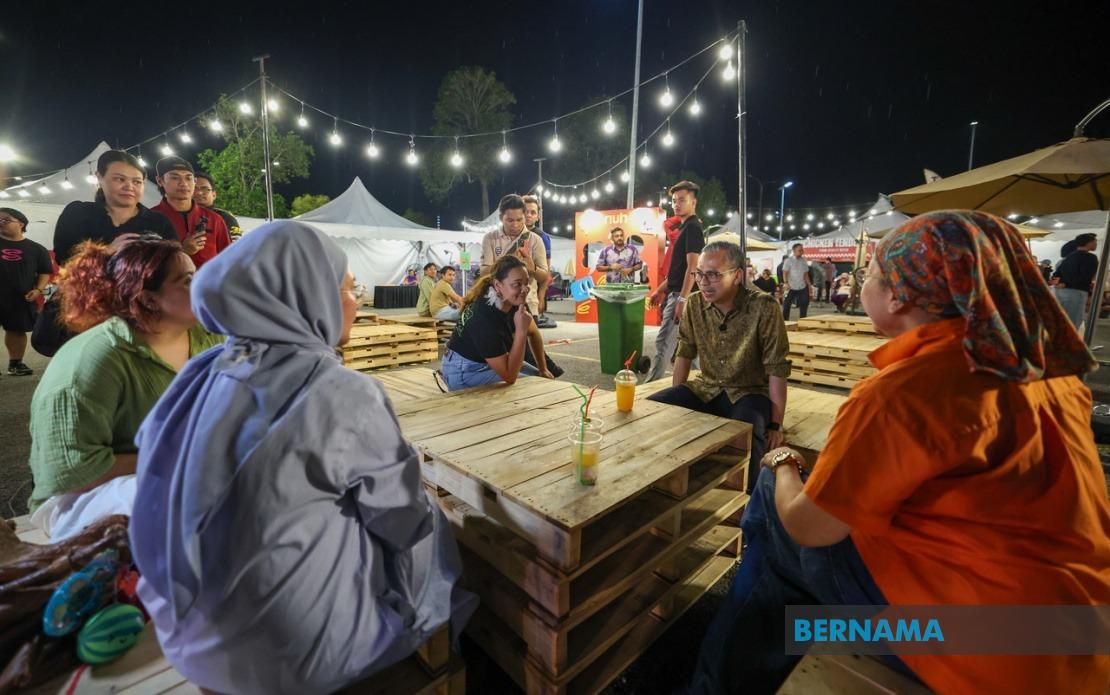
Communications Minister Datuk Fahmi Fadzil has voiced his approval of the RIUH Pi HAWANA carnival, a vibrant cultural showcase currently underway at the PICCA Convention Centre @ Butterworth Arena in Penang. Speaking to reporters at the event, Fahmi expressed genuine satisfaction with how the programme has unfolded, highlighting its effectiveness as a dedicated platform for Malaysia's creative economy. The minister's endorsement reflects the broader government commitment to nurturing local talent across multiple artistic disciplines and entrepreneurial ventures.
The carnival, which runs in tandem with the 2026 National Journalists' Day observance, represents a carefully curated fusion of entertainment, commerce, and cultural celebration. According to Fahmi, the execution has been seamless, with organisers demonstrating strong logistical capability in managing what amounts to a multi-faceted creative marketplace. This smooth delivery matters significantly, as poorly managed events can undermine public confidence in government-sponsored initiatives and deter repeat attendance. The successful rollout suggests that future iterations of similar programmes could be scaled up or replicated in other states, a prospect that appeals to policymakers seeking to decentralise creative opportunity beyond major urban centres.
One of the carnival's most compelling features is its intergenerational appeal. The event has deliberately assembled both veteran performers and emerging artists, creating rare moments where Malaysian audiences encounter established acts and fresh talent within a single venue. Fahmi specifically referenced acts including Exists, Bunkface, Masdo, Sakura Band, Fugo, Budak Nakal Hujung Simpang and Chelsia Ng across its 18 live performances. This programming strategy serves a dual purpose: it maintains audience interest through recognisable names whilst simultaneously introducing younger performers to potential fans. For emerging artists in particular, exposure through a government-endorsed platform carries legitimacy and can accelerate their pathway to sustainability.
The creative economy dimension extends well beyond the musical performances dominating the event schedule. MyCreative Ventures, the organising entity, has assembled more than 24 local creative brands and 20 food and beverage vendors under a single roof. This aggregation reduces friction in the market by collecting disparate suppliers in one convenient location, dramatically improving consumer access to artisanal and independent products. For small-scale entrepreneurs operating outside major shopping districts, such opportunities prove invaluable. The carnival becomes not merely entertainment but a revenue driver for microenterprises that might otherwise struggle to reach critical mass of paying customers.
Interactive workshops comprise another dimension of the carnival's value proposition. Rather than confining visitors to passive roles as audience members or spectators, the event encourages active participation through hands-on creative activities. These workshops allow attendees to sample various creative disciplines, potentially sparking new interests or revealing latent talent. For communities in Penang, this democratisation of access to creative learning represents meaningful cultural infrastructure. Malaysia's economy increasingly depends on knowledge workers and creative professionals, making early exposure to such disciplines strategically important from a workforce development perspective.
Fahmi has explicitly encouraged Penang residents to take advantage of the carnival before it concludes on Sunday. This public call carries weight when delivered by a federal minister, potentially amplifying media coverage and social media discussion. For events operating on tight timeframes, such ministerial endorsements function as authentic marketing that money cannot easily purchase. The appeal also signals that government officials view the venture as sufficiently successful to warrant their political capital, suggesting confidence in its continuation.
Looking forward, Fahmi articulated hope that RIUH Pi HAWANA becomes a recurring fixture within the National Journalists' Day calendar. Institutionalising the carnival would provide predictability for participating vendors, performers and entrepreneurs, enabling them to plan accordingly. An annual event also builds community anticipation and tradition, factors that drive sustained attendance growth. From a government perspective, regular programming demonstrates consistent investment in the creative sector, signalling longer-term commitment beyond one-off initiatives.
The HAWANA observance itself, first introduced in 2018, represents the Communications Ministry's formal recognition of journalism's role in Malaysian society. By anchoring the carnival to this occasion, organisers have connected creative enterprise with media infrastructure, an implicit acknowledgment that both sectors depend on healthy information ecosystems. The Malaysian National News Agency (Bernama) serves as implementing agency, lending institutional weight and logistical experience to the event.
For Southeast Asian observers, Malaysia's approach to supporting creative industries through government-endorsed platforms offers instructive lessons. Many regional economies struggle to translate cultural assets into sustainable economic activity. By creating physical spaces where supply and demand converge, and by deliberately mixing performers and vendors of varying scales and experience levels, Malaysia demonstrates a practical methodology for creative sector development. The Butterworth location is particularly significant, as secondary cities in the region often feel neglected by creative economy initiatives concentrated in capital areas.
The broader implications for Malaysia's service economy warrant consideration. As manufacturing competitiveness faces sustained pressure from lower-cost regional competitors, diversification into high-value creative services becomes increasingly critical. Events like RIUH Pi HAWANA serve multiple strategic purposes simultaneously: they provide genuine cultural value to communities, generate taxable economic activity, create employment pathways particularly for younger demographics, and position Malaysia as a nation where creative talent can flourish. Minister Fahmi's endorsement reflects official recognition that this diversification strategy is not merely cultural embellishment but economic necessity.
Public response metrics, though not specified in the minister's remarks, appear encouraging enough to justify his satisfaction. Attendance numbers and vendor revenue figures would provide clearer economic impact assessment, yet the visible presence of satisfied participants clearly impressed the communications chief. This positive reception creates momentum for scaling similar initiatives, whether through expanded programming at future carnivals or through franchising the concept to other Malaysian states seeking to build their own creative infrastructure. The success in Butterworth may yet become a template for nationwide cultural entrepreneurship development.
%22%2F%3E%3C%2Fpattern%3E%3C%2Fdefs%3E%3Crect%20width%3D%22100%25%22%20height%3D%22100%25%22%20fill%3D%22url(%23ph3cmotg)%22%2F%3E%3Crect%20width%3D%22100%25%22%20height%3D%22100%25%22%20fill%3D%22url(%23ph3cmotp)%22%2F%3E%3Ctext%20x%3D%2250%25%22%20y%3D%2250%25%22%20text-anchor%3D%22middle%22%20dominant-baseline%3D%22central%22%20fill%3D%22rgba(255%2C255%2C255%2C0.95)%22%20font-family%3D%22Georgia%2C%20'Times%20New%20Roman'%2C%20serif%22%20font-weight%3D%22700%22%20font-size%3D%22151%22%20letter-spacing%3D%22-0.02em%22%3EMalaysian%3C%2Ftext%3E%3C%2Fsvg%3E)