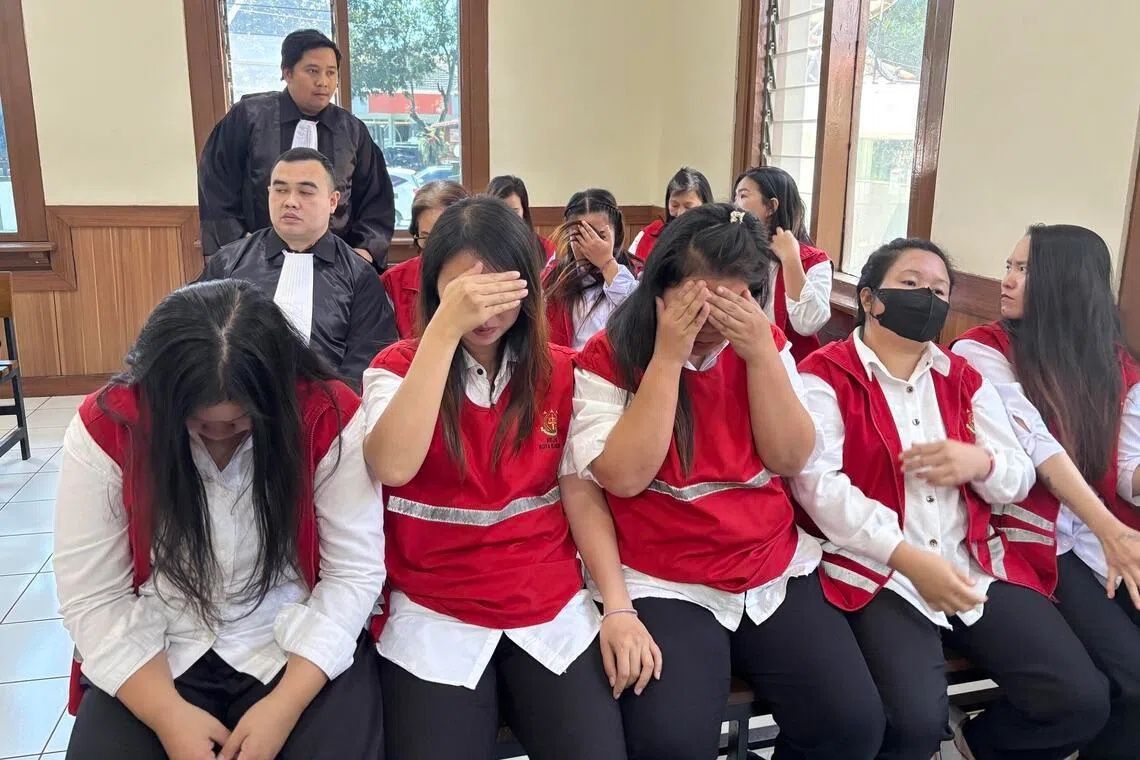
Prosecutors in Indonesia have demanded prison sentences of up to a decade for members of an alleged baby trafficking ring, marking one of the most significant cross-border human trafficking operations uncovered in the region in recent memory. The case involves 19 suspects—18 women and one man—who have faced trial since April on accusations of unlawfully trafficking at least 34 infants over a two-year span. At a hearing in Bandung District Court on June 30, prosecutors outlined their case against the syndicate, which they allege operated with chilling efficiency across multiple countries, with at least 12 of the babies sent to Singapore at prices ranging from 200 to 250 million rupiah, equivalent to approximately S$18,110 per child.
The investigation has identified 70-year-old Lie Siu Luan, known informally as Lily or Popo, as the orchestrator of the entire operation. According to investigators' findings, Lie wielded significant control over recruitment efforts, coordinated the creation of fraudulent documentation to facilitate adoptions, and oversaw the logistics of moving infants across borders. Her role as the alleged mastermind places her at the apex of a sophisticated criminal enterprise that exploited vulnerable infants and prospective adoptive parents. During the June 30 proceedings, both Lie and co-defendant Astri Fitrinika, identified as one of the syndicate's primary recruiters, wept as prosecutors detailed their alleged involvement and demanded appropriate custodial sentences.
Prosecutor Cucu Gantina formally requested that the court declare Lie legally culpable of "recruiting, harbouring, sending, transferring, or receiving a person for the purpose of exploiting said person within the territory of the Unitary State of the Republic of Indonesia." This formulation reflects the serious nature of the charges under Indonesian human trafficking legislation. Beyond Lie, the prosecution sought the maximum ten-year sentence for Astri Fitrinika and fellow recruiters Djaka Hamdani and Elin, alongside Lai Su Hua, who allegedly fabricated official documentation required for adoption procedures. The remaining fourteen defendants, who allegedly functioned as childcare providers for the trafficked infants, faced recommendations for five-year terms.
Lie's legal representative, Sendi Sanjaya, indicated his team would contest several accusations while respecting the court's consideration of the prosecution's demands. He argued that prosecutors failed to substantiate claims of exploitation, a critical legal element in trafficking cases. Sanjaya contended that trial evidence revealed the children were maintained in healthy conditions with documented whereabouts, thereby undermining the prosecution's assertion that exploitation occurred. This defence strategy highlights a nuanced legal debate: whether the act of unlicensed transfer of infants for financial gain constitutes exploitation per se, or whether exploitation requires demonstrable harm or deprivation.
Astri's counsel, Hendri Samuel Tampubolon, expressed frustration that prosecutors recommended identical sentences for his client and the alleged ringleader Lie, despite the substantial difference in their alleged culpability and roles. He characterised Astri as operating under Lie's control and coercion, emphasizing her cooperative stance with law enforcement throughout the investigation and prosecution phases. This defence narrative seeks to differentiate degrees of responsibility within the criminal hierarchy, a distinction that may prove influential during the sentencing phase.
The operation's exposure began dramatically in July 2025 when West Java authorities arrested approximately a dozen suspects following a tip-off from a resident named Dani Hidayat. Hidayat's entry into the syndicate's network occurred through a seemingly innocuous avenue: a Facebook adoption support group. When Hidayat, whose wife was expecting a child, joined the group seeking guidance, members of the trafficking ring contacted him directly, offering 8 million rupiah in exchange for his forthcoming baby. His willingness to report the solicitation to authorities proved instrumental in unravelling the entire network and protecting countless potential victims.
The international dimensions of this case have prompted diplomatic coordination between Jakarta and Singapore. Both governments announced in January that they would collaborate on investigating and prosecuting the trafficking network, recognising that the syndicate's operations transcended national borders and required binational law enforcement effort. Intelligence sharing and coordinated prosecution strategies became essential given that substantial portions of the criminal enterprise operated in Singapore, with residents and citizens potentially playing roles as adoptive parents or facilitators.
During trial proceedings, Lie identified four Singaporean individuals she characterised as adoption agents working with the ring: individuals identified only as "Petter," "John," "Mr Tan," and "Mr Chew." These names suggest the potential involvement of Singaporean nationals or residents in the trafficking network, though their precise roles and whether they faced separate charges in Singapore remain unclear. Their identification raises broader questions about international coordination in detecting and prosecuting transnational human trafficking operations.
The mechanics of the trafficking operation reveal sophisticated exploitation of adoption systems across Southeast Asia. The syndicate leveraged social media platforms and informal networks to identify both sources—pregnant women willing to surrender newborns for relatively small payments—and markets in the form of adoptive parents willing to pay substantial sums for expedited, less regulated adoption processes. The utilisation of fraudulent documentation to legitimise these transactions suggests deliberate circumvention of proper adoption protections that exist in both Indonesia and Singapore.
Defence presentations are scheduled for the following week, providing the 19 defendants with opportunity to contest charges and challenge prosecution evidence. These proceedings will determine whether judges accept prosecutors' characterisation of events or whether defence arguments regarding the absence of exploitation or the degree of individual culpability prove persuasive. The case's outcome will have significant ramifications for how Southeast Asian jurisdictions approach transnational human trafficking prosecutions and the evidentiary standards required to establish trafficking charges.
Beyond the immediate legal proceedings, this case underscores vulnerabilities in adoption systems across the region. The exploitation of legitimate social media communities established by prospective adoptive parents demonstrates how criminal networks weaponise platforms designed for connection and support. For Malaysia and other Southeast Asian countries, the case serves as a cautionary reminder to strengthen oversight mechanisms in adoption procedures, implement robust verification protocols for adoptive parents, and enhance cross-border intelligence sharing to combat similar operations. The sophistication demonstrated by this syndicate suggests that trafficking networks operate as adaptable criminal enterprises capable of exploiting regulatory gaps and technological platforms to perpetrate large-scale abuse of vulnerable populations.

