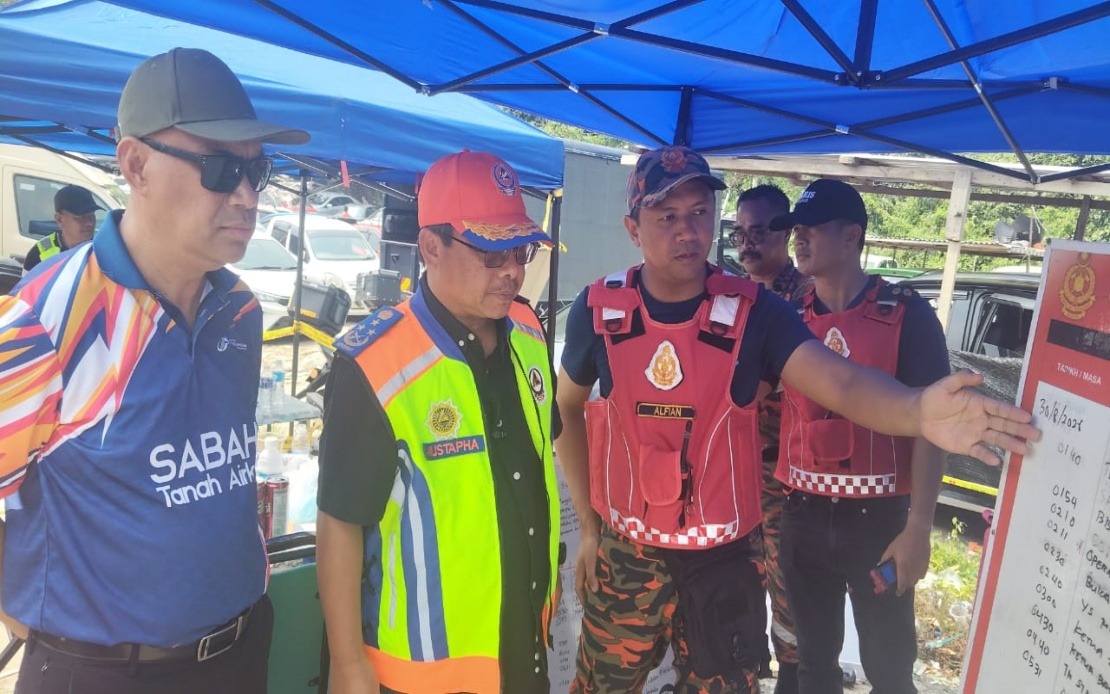
A fire that swept through Kampung Lok Buta in Kota Kinabalu early today has claimed the lives of three children and left more than 200 families without homes, prompting rapid mobilisation of relief operations across Sabah's capital. The incident, which occurred at 1.40 am, destroyed hundreds of residential structures in the tightly-packed village, forcing authorities to immediately designate the area as a disaster zone and establish two emergency centres to coordinate the humanitarian response.
The three young victims—four-year-old Nana Abdullah, her six-year-old brother Mohd Asrul Abdullah, and their eight-year-old cousin Nurfarahdilah Mohd Tajihah—perished in the flames that spread rapidly through the wooden structures characteristic of the settlement. The tragedy underscores the vulnerability of informal kampung communities, where densely-built homes constructed from timber and other flammable materials offer little resistance to fire spread, a recurring pattern in Malaysian urban settlements that continues to challenge disaster prevention efforts.
Authorities wasted no time in establishing two temporary relief centres at Dewan Kampung Likas and Dewan Damai to provide immediate shelter and support for the displaced residents. According to Datuk Mustapha Sakmud, Minister in the Prime Minister's Department for Sabah and Sarawak, these facilities serve as central coordination hubs where victims can register, receive assistance documentation, and access donated provisions. The decision to create dedicated relief infrastructure reflects lessons learned from previous kampung fires across Malaysia, where centralised registration systems have proven essential for tracking the most vulnerable populations and preventing assistance gaps.
Beyond immediate shelter provision, Mustapha emphasised the importance of identifying students among the affected population to minimise educational disruption. Many residents of informal settlements like Kampung Lok Buta are young families with school-age children, and prolonged displacement can derail academic progress at a critical stage. Mustapha committed to liaising with the Ministry of Education to ensure students from primary and secondary schools, as well as those enrolled in higher education and TVET institutions, receive targeted support to maintain their educational momentum during the recovery period.
The designation of Kampung Lok Buta as a disaster zone by Kota Kinabalu City Hall signals the scale of the emergency and potentially opens access to broader state and federal disaster relief mechanisms. This formal classification enables affected residents to qualify for various assistance programmes and expedites bureaucratic processes that would otherwise delay recovery efforts. City Hall, represented by Mayor Datuk Seri Dr Sabin Samitah, who chairs the District Disaster Management Committee, has assumed a coordinating role in liaising between local authorities, state agencies, and federal representatives.
Mustapha indicated that initial financial assistance would be extended to the families of the three deceased children, addressing the most acute humanitarian need. However, the challenge of supporting over 200 displaced households extends far beyond immediate bereavement support. Residents require assistance with housing reconstruction or temporary relocation, replacement of destroyed personal possessions, income support during the recovery phase, and trauma counselling—needs that typically exceed the capacity of ad-hoc relief mechanisms and demand sustained coordination.
The minister signalled that the disaster would be elevated to high-level political discussions, with plans to brief Prime Minister Datuk Seri Anwar Ibrahim and Sabah Chief Minister Datuk Seri Hajiji Noor through the Malaysia Agreement 1963 Implementation Action Council. This political engagement reflects recognition that informal settlement fires are not merely local incidents but symptoms of underlying urban planning and housing challenges that require strategic policy responses. The involvement of federal leadership potentially opens avenues for larger-scale intervention than state or municipal resources alone could provide.
Kampung fires in Malaysian cities, though often under-reported in national media, represent a recurring crisis affecting some of the most economically vulnerable populations. Sabah, with its rapidly expanding urban centres and substantial informal settlements, has experienced multiple such disasters. These incidents reveal infrastructural gaps—inadequate fire safety regulations in informal areas, limited water access for firefighting, narrow lanes that impede emergency vehicle access—that plague many kampungs across the country. The Kampung Lok Buta tragedy thus serves as a reminder of persistent housing and safety deficits despite Malaysia's status as an upper-middle-income nation.
The response coordination underway in Kota Kinabalu will be closely watched for lessons applicable elsewhere. How effectively authorities bridge the gap between emergency relief and longer-term recovery will influence the resilience of kampung communities facing similar risks. The involvement of multiple stakeholders—federal ministers, state officials, city authorities, education ministries, and NGOs distributing donations—creates both opportunities for comprehensive assistance and risks of fragmented efforts if coordination falters.
The tragedy also highlights the need for preventive measures beyond reactive relief. Fire safety education, improved building standards for informal settlements, community-based early warning systems, and improved firefighting infrastructure in densely-populated areas represent areas where sustained investment could reduce the frequency and severity of future incidents. Without addressing these structural vulnerabilities, Kampung Lok Buta will likely be followed by similar disasters in other Malaysian settlements.

