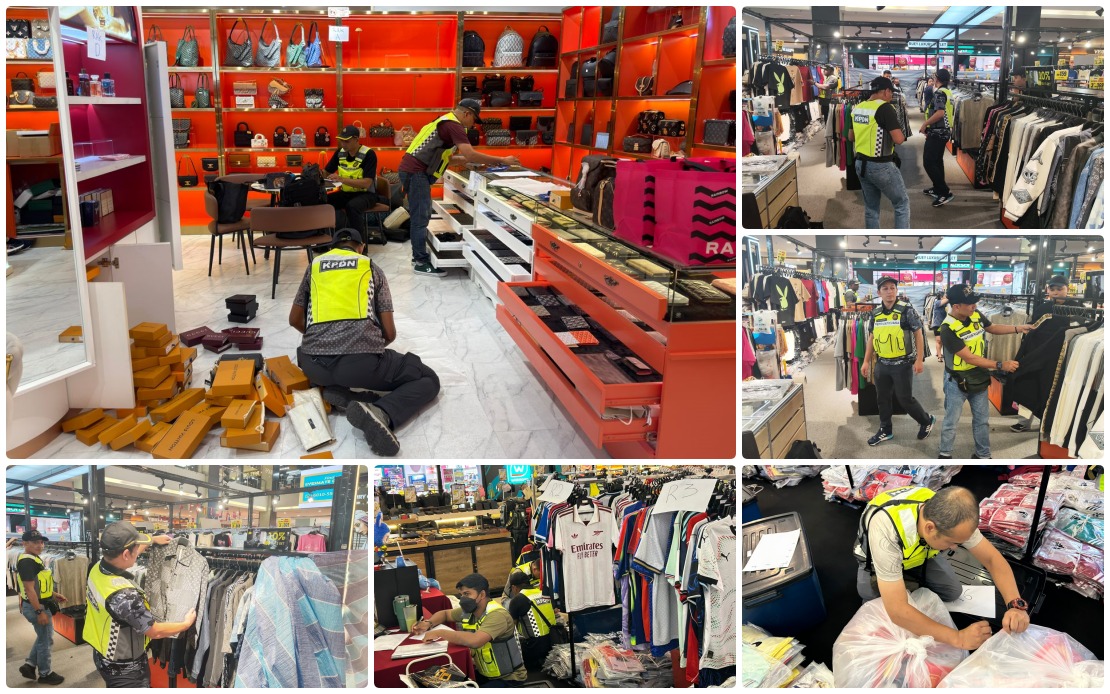
The Ministry of Domestic Trade and Cost of Living (KPDN) has executed a significant crackdown on the illicit counterfeit merchandise trade, seizing goods valued at RM600,000 across three separate premises in Johor Bahru during an enforcement operation conducted on Monday, June 15. The raid, coordinated through the Putrajaya Enforcement Division, represents a culmination of month-long investigative work targeting a sophisticated distribution network suspected of operating across multiple retail channels in the state.
According to enforcement director-general Datuk Azman Adam, the operation uncovered premises that were openly selling luxury branded goods bearing counterfeit trademarks belonging to several prominent international companies without authorization from legitimate trademark holders. The seized inventory encompassed a wide range of consumer items, including counterfeit clothing, handbags, wallets, belts, and fragrances, alongside business documentation that investigators believe will establish the extent and longevity of the unlawful operation. The comprehensive nature of the haul suggests the network had established itself as a material supplier rather than merely a street-level vendor.
The intelligence phase preceding the raids indicated that the operators had successfully penetrated major supermarket chains throughout Johor Bahru, a market penetration strategy that amplifies consumer harm by lending perceived legitimacy to counterfeit products. Furthermore, preliminary investigations suggest the detained individuals were functioning as regional distributors, supplying smaller retailers across multiple locations. This layered distribution model typically generates substantially greater profit margins for organized counterfeit operations while fragmenting enforcement responsibility across numerous downstream retailers.
Investigators determined that reasonable grounds existed to pursue charges under Section 102(1)(c) of the Trademark Act 2019, which specifically criminalizes possession of merchandise bearing wrongfully applied trademarks with intent to trade. The legal threshold for establishing such cases requires demonstrating both the deliberate nature of the trademark infringement and the commercial intent to distribute. The involvement of the trademark owners' representatives in physical verification procedures strengthens evidentiary foundations during prosecution phases, a procedural safeguard that reduces successful legal challenges by defendants.
Four individuals were taken into custody to assist investigators, including the identified owner and caretaker of the raided premises. The detention of operational management figures typically enables law enforcement to establish hierarchical command structures and trace funding sources within the broader criminal network. Such intelligence frequently reveals upstream connections to international counterfeit manufacturing operations, which remains a persistent challenge for enforcement agencies across Southeast Asia.
The penalties prescribed under Malaysian trademark legislation reflect the gravity with which authorities treat intellectual property crimes. Individual offenders convicted on first-offense charges face maximum financial penalties of RM10,000 per counterfeit item coupled with imprisonment for up to three years, penalties that escalate substantially for repeat offenders. Subsequent convictions carry fines reaching RM20,000 per item and imprisonment extending to five years, creating meaningful deterrent effects for organized operations dependent on repeat offenses. Corporate entities face substantially higher financial exposure, with first-time penalties capped at RM15,000 per item and repeat-offense penalties doubling to RM30,000 per item, structured to render large-scale distribution economically unviable.
The Johor operation exemplifies KPDN's intensified commitment to dismantling intellectual property crimes that simultaneously defraud consumers and legitimate trademark proprietors. The month-long investigation period reflects sophisticated law enforcement methodology that identifies network vulnerabilities before deploying enforcement resources. This intelligence-led approach contrasts sharply with reactive enforcement models and typically generates significantly higher prosecution success rates.
Counterfeit goods trafficking represents a persistent challenge throughout Malaysia and the broader Southeast Asian region, with illicit merchandise estimated to constitute 3-5 percent of regional trade flows. The infiltration of major retail channels, as evidenced in the Johor case, represents an escalating threat to consumer protection frameworks. Malaysian consumers increasingly encounter counterfeit luxury products at mainstream retail locations, effectively subsidizing organized crime networks while creating unknowing participants in intellectual property violations.
The implications for Malaysian commerce extend beyond trademark protection considerations. Counterfeit supply chains frequently operate without regulatory oversight regarding manufacturing standards, quality control, and safety certification, creating potential health and safety vulnerabilities. Fragrances and cosmetics, categories represented in the seized inventory, carry particular risk profiles when produced under unregulated conditions without compliance with established chemical composition standards or contamination safeguards.
For legitimate businesses operating within Malaysia's formal retail sector, uncontrolled counterfeit competition systematically erodes market share and pricing power. The RM600,000 seizure represents only a fraction of the broader counterfeit ecosystem, yet even this single operation would have generated substantial downstream retail sales had distribution continued uninterrupted. The loss of legitimate sales translates into reduced corporate tax revenues and employment impacts across authentic supply chains.
KPDN's public commitment to intensified enforcement operations signals a sustained policy focus on intellectual property protection. The statement issued by Datuk Azman Adam explicitly warns that the ministry will not tolerate ongoing counterfeit operations, establishing clear expectations for both traders and consumers. Such public messaging functions as secondary deterrent mechanisms by signaling to potential operators that trademark violations face escalating enforcement costs.