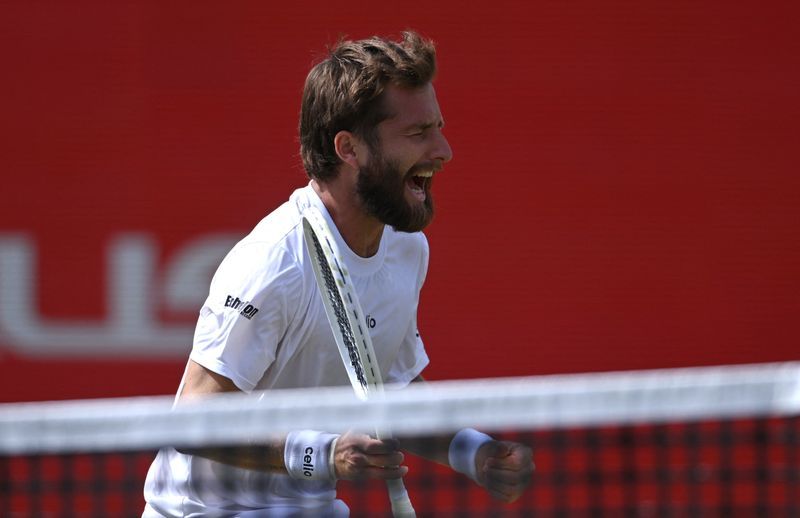
French tennis player Corentin Moutet has been stripped of nearly all his prize money from the Queen's Club tournament following a disciplinary fine for swearing extensively during a broadcast interview, an incident that underscores the sport's ongoing struggle with player conduct and media decorum. The 27-year-old world number 36 was fined $40,000 by the ATP for unsportsmanlike conduct stemming from his expletive-laden remarks during an on-court interview with the BBC immediately after his opening-round victory over fellow Frenchman Giovanni Mpetshi Perricard. The financial penalty is particularly severe because Moutet earned only $43,000 for advancing to the second round, meaning the fine effectively erases his winnings from the tournament and leaves him substantially out of pocket.
The incident occurred when Moutet was being interviewed courtside by BBC journalists following his first-match success. During the discussion, he made repeated references to being aced on match point by a 142 miles-per-hour second serve, using profanity to express his frustration with the outcome. After the interviewer politely requested that he refrain from repeating the specific expletive, Moutet continued swearing, doing so three additional times before the broadcaster terminated the interview prematurely. The production team subsequently issued public apologies to both the live crowd attending the event and television viewers who had witnessed the outburst.
Following the controversy, Moutet attempted to minimise the incident by posting on Instagram that he had simply been joking, a characterisation that fell short of satisfying ATP officials tasked with maintaining standards of player conduct. The ATP's formal statement attributed the fine to unsportsmanlike conduct, establishing the regulatory framework under which professional tennis players are expected to conduct themselves in media settings and public appearances. This classification reflects the sport's broader commitment to protecting its brand and ensuring that broadcasts remain suitable for audiences of all ages, particularly given that the BBC is a public service broadcaster with significant viewership across multiple demographics.
Moutet has exercised his right to appeal the decision, suggesting he intends to contest the ruling rather than accept the financial consequences without argument. The appeal process will likely extend the timeline for resolution, leaving the matter unresolved as the professional tennis calendar continues. For Malaysian and Southeast Asian tennis fans, this case illustrates the stringent standards applied to international competitors and the financial ramifications that can accompany behavioural lapses, even for relatively minor infractions compared to more serious misconduct.
This is not the first occasion on which Moutet's professional behaviour has attracted disciplinary attention. In 2022, he was defaulted from the Adelaide International tournament after directing profane language at the umpire during a match against Serbia's Laslo Djere, an incident that resulted in his complete removal from competition. That same year, the French Tennis Federation chose to suspend Moutet's access to federation support and resources due to persistent concerns regarding his on-court and off-court conduct. These cumulative instances paint a picture of a talented player struggling with emotional regulation and the expectations placed upon elite athletes operating in high-pressure environments.
The Queen's Club tournament, officially known as the Aegon Championships and held at the Queen's Club in London, is one of the ATP's most prestigious grass-court events and serves as crucial preparation for Wimbledon, which follows just days later. Moutet's early exit from the competition—he lost his subsequent match to Spain's Alejandro Davidovich Fokina in the second round—meant he gained minimal financial benefit from his participation. The combination of early elimination and substantial disciplinary fine renders his Queen's Club campaign financially disastrous, a cautionary tale about the importance of maintaining professional standards even in moments of frustration.
The incident raises broader questions about the intersection of athlete authenticity and broadcast standards. Modern tennis audiences on social media and streaming platforms have grown accustomed to unfiltered player commentary, creating tension between expectations on digital platforms and traditional broadcast television, where regulatory standards remain stricter. Moutet's apparent belief that his remarks constituted harmless joking suggests a generational disconnect regarding what constitutes acceptable public behaviour, particularly when children may be watching.
For players of Moutet's ranking and prize money trajectory, a $40,000 fine represents a meaningful financial consequence rather than merely a negligible penalty absorbed by wealthy athletes. Such substantial fines serve as deterrents and underscore the ATP's commitment to enforcing standards consistently. The fact that a single fine can entirely eliminate a tournament's winnings demonstrates how fragile prize money structures can be for mid-ranked professionals who depend heavily on consistent tournament performance to maintain their careers and fund their operations.
Moutet's case will likely feature prominently in discussions among tournament organisers, broadcasters, and the ATP regarding broadcast interview protocols. The incident occurred during what should have been a celebratory moment for the player, yet his inability to exercise restraint transformed a positive achievement into a regulatory embarrassment. Going forward, broadcasters may implement additional safeguards or protocols when interviewing players immediately after emotionally intense matches, recognising that heightened emotions can lead to lapses in judgment.
The financial and reputational damage sustained by Moutet extends beyond the immediate fine and serves as a reminder to younger players pursuing professional tennis careers that their conduct in media settings carries tangible consequences. In an era where tennis is increasingly accessible through multiple broadcast platforms and where social media amplifies every statement, athletes must navigate heightened scrutiny regarding their public behaviour. For Moutet, redemption will require demonstrating sustained improvement in professional conduct and emotional management, skills as important to long-term success as technical ability on the court.

%22%2F%3E%3C%2Fpattern%3E%3C%2Fdefs%3E%3Crect%20width%3D%22100%25%22%20height%3D%22100%25%22%20fill%3D%22url(%23ph3xy1tg)%22%2F%3E%3Crect%20width%3D%22100%25%22%20height%3D%22100%25%22%20fill%3D%22url(%23ph3xy1tp)%22%2F%3E%3Ctext%20x%3D%2250%25%22%20y%3D%2250%25%22%20text-anchor%3D%22middle%22%20dominant-baseline%3D%22central%22%20fill%3D%22rgba(255%2C255%2C255%2C0.95)%22%20font-family%3D%22Georgia%2C%20'Times%20New%20Roman'%2C%20serif%22%20font-weight%3D%22700%22%20font-size%3D%22272%22%20letter-spacing%3D%22-0.02em%22%3EFahmi%3C%2Ftext%3E%3C%2Fsvg%3E)