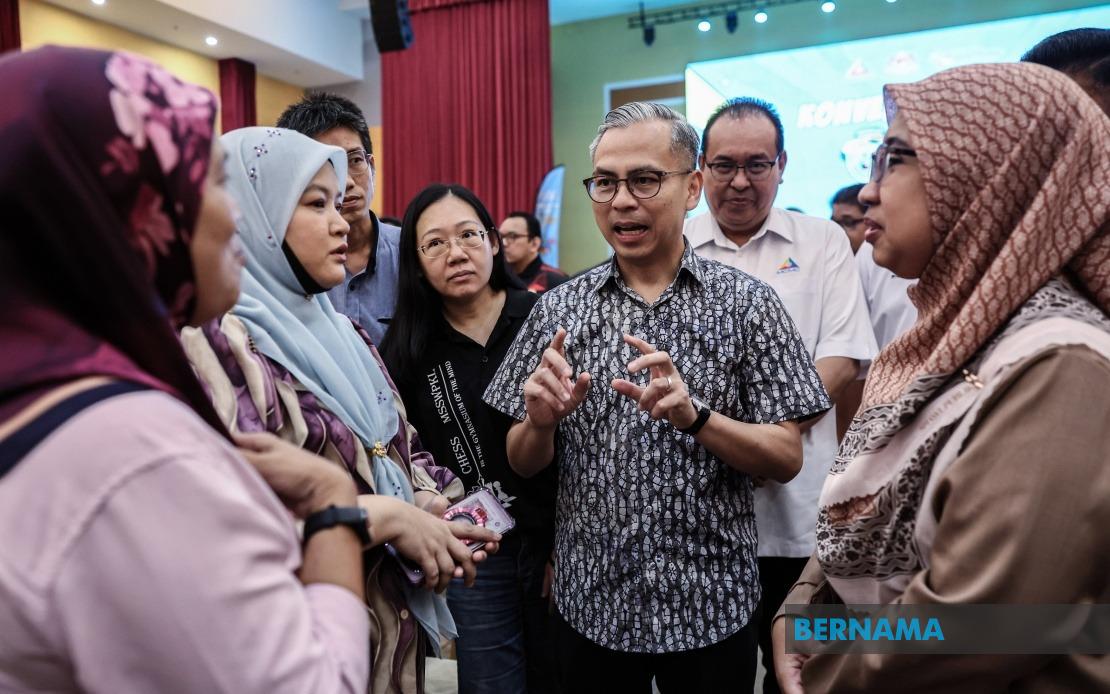
The government has moved to clarify the purpose and administration of MyKhas, emphasising that the fund represents resources allocated for public welfare rather than personal benefit to elected representatives. Communications Minister Datuk Seri Fahmi Fadzil made the distinction explicit, positioning MyKhas as a mechanism designed to channel assistance directly to residents and voters within parliamentary constituencies under the direct supervision of the Prime Minister's office.
Fahmi's clarification comes as the government continues to outline the operational framework for its special allocation system. He stressed that the scheme functions as a public resource governed by formal structures documented in both the Malaysia Plan and annual budget documents. This administrative positioning ensures that decisions regarding disbursement remain centralised rather than delegated to individual MPs, a structural choice that reflects broader government policy on resource distribution and accountability.
The Communications Minister underscored Prime Minister Datuk Seri Anwar Ibrahim's position that government funding channeled to parliamentary constituencies serves the broader objective of improving living standards and infrastructure in those areas. The fund can support diverse needs spanning educational facilities, Islamic schools, places of worship, and essential infrastructure like drainage systems. This broad scope indicates the government's intention to use MyKhas as a mechanism for targeted development rather than narrow political advantage.
In distinguishing between allocated resources and personal entitlements, Fahmi emphasised that even ministers holding office cannot utilise MyKhas for personal purposes. This explicit boundary underscores the government's commitment to treating public funds as instruments of service delivery rather than perks of political office. The restriction applies uniformly across all political representatives, establishing a principle of equal restraint regardless of position or portfolio.
The clarification regarding opposition-held constituencies represents a significant dimension of this framework. Rather than restricting MyKhas distribution solely to government-aligned areas, the administration has established a formal application process through the Implementation Coordination Unit under the Prime Minister's Department. This approach suggests an effort to separate partisan politics from resource allocation, allowing constituencies regardless of political colour to access available funds through established channels.
The timing of Fahmi's remarks reflects ongoing public discourse about government spending and the boundaries between political representation and resource management. As constituencies across Malaysia navigate their development priorities, clarity on how funds are accessed and controlled becomes increasingly important for local stakeholders and community leaders seeking to advance specific projects.
The MyKhas framework operates within the broader context of the government's commitment to transparency in public spending. By anchoring the system within Prime Minister oversight rather than individual MP discretion, the administration appears to be addressing historical concerns about the politicisation of development funds. This structure creates a centralised decision-making point that theoretically enables consistent application of criteria across constituencies.
For opposition-held areas, the availability of the formal application process provides a potential avenue for accessing resources despite the constituency being represented by non-government MPs. This mechanism, while requiring additional administrative steps, establishes a principle that development assistance should not be withheld based on political affiliation alone. However, the effectiveness of this approach depends on practical implementation and consistency in approving applications across different political contexts.
The government's emphasis on constituent welfare over MP entitlement aligns with broader regional trends in government reform. Several Southeast Asian democracies have undertaken similar initiatives to professionalise bureaucratic functions and separate party politics from state resource allocation. For Malaysian readers, this represents part of a wider effort to strengthen institutional frameworks and reduce discretionary spending that historically characterised earlier administrations.
Fahmi's role as both PKR's Information Chief and Communications Minister means his statements carry particular weight in signaling government policy direction. His repetition of the Prime Minister's position on resource allocation suggests consistency across the leadership structure, reducing the possibility that MyKhas administration varies significantly based on individual ministerial interpretation.
Moving forward, the practical test of this framework will emerge through actual disbursement patterns across Malaysia's constituencies. Observers will likely monitor whether opposition areas receive comparable levels of support and whether applications processed through the Implementation Coordination Unit face delays or heightened scrutiny. The government's commitment to this principle will ultimately depend on execution at the administrative level.
For constituencies throughout Malaysia, the MyKhas system potentially represents a more institutionalised approach to development funding compared to historical models where resource allocation remained more discretionary. Local leaders and community organisations seeking support for constituency projects should familiarise themselves with the formal application processes and documentation requirements established through the Prime Minister's Department, ensuring they can effectively access available resources within this structured framework.

