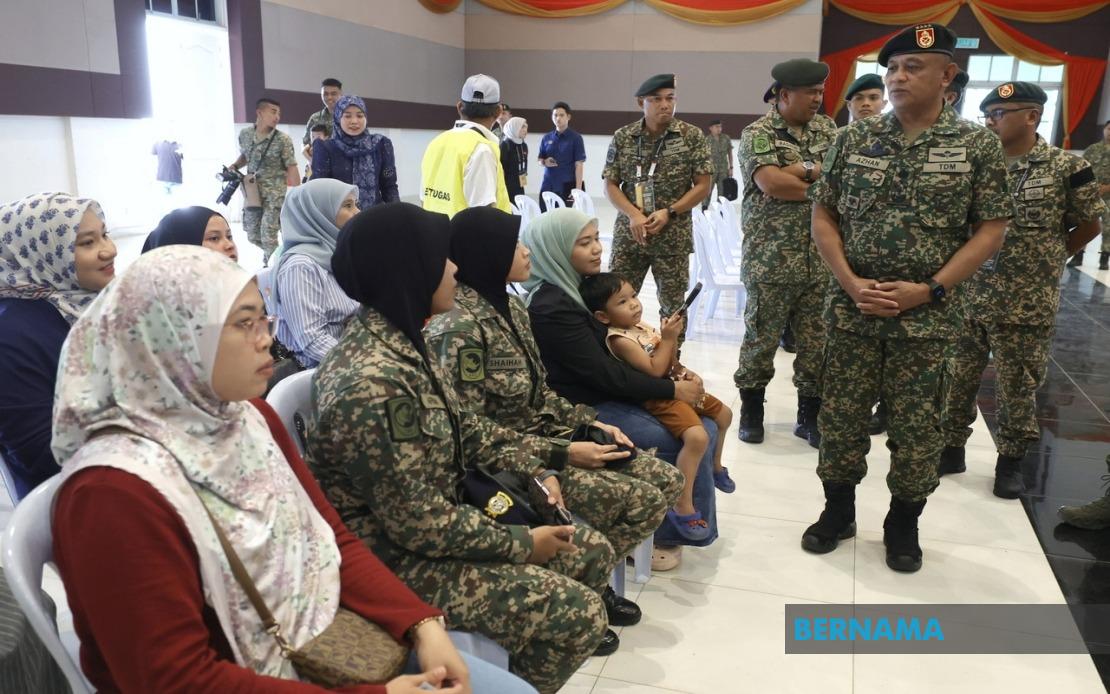
The early voting process for Negeri Sembilan's 16th state election is moving at a steady pace among military and police personnel, with General Tan Sri Azhan Md Othman, the Army chief, expressing satisfaction with how proceedings have unfolded at key polling venues across the state. Speaking on July 28 after visiting the Rasah Camp in Seremban and the Army Basic Training Centre in Port Dickson, Azhan reported that voter participation has already topped 60 per cent by midday, indicating robust engagement from security force members tasked with early balloting.
The logistics of conducting early voting for uniformed personnel represent a distinct challenge within Malaysia's electoral framework, necessitating coordinated efforts between the military, police, and Election Commission to ensure service members can exercise their franchise despite operational commitments. Azhan's inspection of multiple voting sites suggests a deliberate effort by military leadership to monitor the process and reinforce its importance to personnel, underscoring the institution's commitment to democratic participation despite the demanding nature of armed service.
Approximately 16,884 military personnel and their spouses were eligible to vote early in the Negeri Sembilan contest, with 63 per cent having already fulfilled their ballot requirement by noon. The remaining portion of registered early voters chose postal ballot options instead, a provision that acknowledges the geographical dispersal of military installations and the unpredictable nature of service commitments. This dual-voting mechanism—physical early voting and postal ballots—provides flexibility for service members while maintaining electoral integrity.
In total, 22,339 individuals participated in the early voting arrangement across both military and police cohorts. By midday, 16,467 voters had cast ballots in person, comprising 11,293 military personnel and spouses alongside 5,174 police officers and their families. The postal voting component accounted for the remainder, demonstrating the practical application of Malaysia's electoral provisions designed to accommodate citizens in special circumstances or occupational categories.
General Azhan projected that overall participation among military and police early voters would ultimately exceed 90 per cent once the polls closed at 5 pm that day, a target that aligned with Election Commission expectations. Such elevated turnout figures among security force contingents reflect both institutional encouragement and the patriotic obligation many service members feel toward participating in democratic processes. The 90 per cent benchmark suggests that even accounting for leave, deployments, or unforeseen absences, the overwhelming majority of eligible military and police voters were anticipated to cast their ballots.
The 16th Negeri Sembilan state election itself represented a significant political moment for the state, with 103 candidates contesting 36 state assembly seats. The election's broader electoral universe comprised 867,151 registered voters who were scheduled to cast ballots on the following Saturday, the official polling day for general voters. The early voting window for armed forces and police members thus served as an advance indicator of engagement patterns and enthusiasm levels that might characterise the wider state contest.
The Election Commission's orchestration of early voting for security personnel reflects recognition that uniformed services operate under different operational constraints than the civilian population. Police and military personnel may face deployment rotations, emergency call-outs, or operational schedules that conflict with standard election day hours, making early voting provision both a practical accommodation and a symbolic affirmation that their democratic participation matters despite their professional obligations.
Negeri Sembilan's approach to early voting demonstrates how Malaysian electoral mechanisms have evolved to accommodate diverse citizen circumstances while maintaining the fundamental principle of universal adult suffrage. The state election provided a microcosm of broader Malaysian democratic practice, where institutional frameworks attempt to balance accessibility with security and transparency. The smooth execution reported by military leadership on the day suggested these mechanisms are functioning as intended, though successful implementation ultimately requires coordination across multiple agencies and disciplined engagement from voters themselves.
For Malaysian and Southeast Asian observers, the proceedings underscore how regional democracies manage the intersection of military institutional participation and civilian electoral processes. Unlike some neighbouring nations where military personnel operate outside regular electoral frameworks, Malaysia's inclusion of armed forces and police in standard voting procedures—albeit with modified scheduling—reflects a constitutional commitment to broad-based political participation. This approach carries implications for civil-military relations, suggesting that subordination to civilian electoral authority remains a defining principle of Malaysian military governance.

