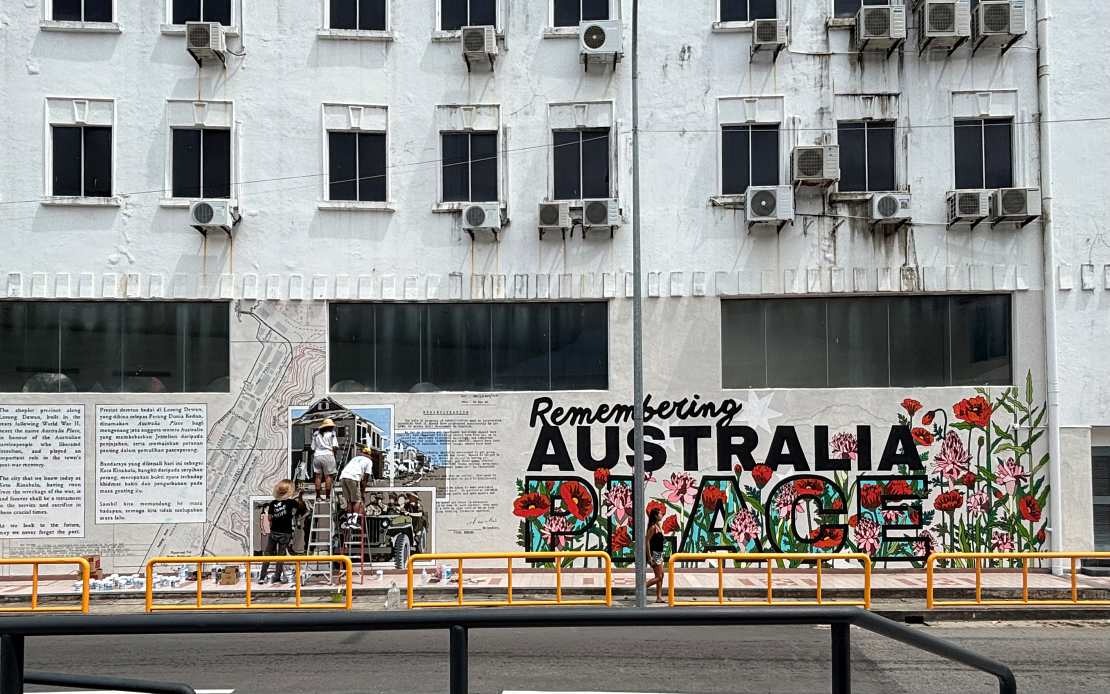
A freshly unveiled mural in Kota Kinabalu has become a visual testament to the multifaceted relationship binding Sabah and Australia together, transforming a locality long recognised colloquially as 'Australia Place' into a space of public commemoration. The artwork, commissioned at the Wisma Intiutama building within this historically significant precinct, was unveiled on Friday evening, strategically timed to coincide with the eve of Sandakan Day, an occasion that holds profound meaning for both nations.
The mural, formally titled 'Remembering Australia Place', represents far more than decorative street art. It encapsulates narratives of connection spanning multiple generations, from the upheaval of wartime to the present day. The timing of its unveiling deliberately positions it within Malaysia's calendar of remembrance, acknowledging the complex historical relationship that has bound these two distant nations through shared sacrifice and subsequent reconciliation. Sandakan Day itself marks one of the darkest chapters in the region's wartime experience, when 2,434 prisoners of war perished during the brutal death marches that devastated both the combatants and the local communities forced to witness their suffering.
Danielle Heinecke, who represents Australia's diplomatic interests in Malaysia as High Commissioner, underscored the mural's significance during the launch ceremony. She articulated how the artwork transcends its visual form to embody the philosophical underpinnings of modern Australia-Malaysia relations—a partnership grounded not merely in governmental protocols but in authentic human connections. The Commissioner emphasised that the mural tells stories of individuals whose lives have intertwined the destinies of both nations, creating bonds that persist and strengthen across time. Her remarks reflected the Australian government's commitment to deepening cultural and community ties within Southeast Asia, positioning such initiatives as integral to regional cohesion.
The ceremony attracted diverse stakeholders reflecting the breadth of bilateral engagement. Kota Kinabalu Mayor Datuk Seri Sabin Samitah participated in the official launch, alongside parliamentarians who could appreciate the mural's political and historical dimensions. University alumni from Australian institutions were conspicuously present, representing a constituency that has long benefited from educational exchanges between the two countries. This gathering underscored how the bilateral relationship extends across governmental, educational, and community spheres, creating multiple avenues through which Sabahans and Australians interact and build understanding.
The creative vision behind the mural originated from Pillars of Sabah, a locally rooted community arts organisation that translated diplomatic intentions into tangible visual expression. The organisation employed creative storytelling techniques to encode into the artwork the values that the Australia-Malaysia partnership purports to embody—resilience, cooperation, mutual respect, and the enduring power of cross-cultural friendship. By employing local artists and community input, Pillars of Sabah ensured that the mural remained authentically grounded in Sabahan cultural identity rather than imposing external narratives.
Jared Abdul Rahman, co-founder of Pillars of Sabah, brought a uniquely personal dimension to the project's significance. Born to a Sabahan father and Tasmanian mother who met while the former pursued tertiary education in Australia under the Colombo Plan, Jared embodies the human interconnections that the mural seeks to celebrate. His mixed heritage positioned him not as an external observer but as a living embodiment of the bilateral relationship, lending credibility and emotional authenticity to the artistic endeavour. The artist noted that the project provided an opportunity to unite successive generations of Kota Kinabalu residents in reflecting upon and honouring the partnership with Australia, acknowledging that such historical bonds require contemporary stewardship to remain meaningful.
The Colombo Plan, which facilitated Abdul Rahman's father's educational journey to Tasmania, represented a transformative chapter in post-colonial Asia-Pacific relations. Established in 1951, this initiative enabled students from developing nations across the Commonwealth and Asia to pursue higher education in more economically advanced countries, fostering networks of alumni who would become influential figures in their respective societies. For Sabah and Malaysia more broadly, the Colombo Plan created conduits through which younger generations gained exposure to Western institutions and perspectives, subsequently returning to apply their learning within regional contexts. The presence of Australian university alumni at the mural launch speaks to the enduring legacy of such educational exchanges in sustaining bilateral goodwill.
Sandakan Day itself carries immense symbolic weight within Sabah's collective memory. The death marches of 1945, in which Allied prisoners were forcibly relocated across Sabahan terrain, claimed countless lives and represented one of the Pacific War's lesser-known atrocities. Crucially, local Sabahans demonstrated extraordinary courage in assisting prisoners, providing sustenance and intelligence despite grave personal risk. The mural's unveiling on the eve of this commemorative day honours not only the wartime sacrifice but also the moral choices ordinary Sabahans made during extraordinary circumstances. This layered remembrance—encompassing both the suffering of prisoners and the heroism of local resistors—reflects a mature approach to historical reckoning that moves beyond simplistic narratives of victors and vanquished.
For contemporary Malaysia, the mural's significance extends beyond historical nostalgia into present-day strategic considerations. Australia remains a significant trading partner, security cooperator, and educational destination for Malaysians, particularly those seeking advanced technical and professional qualifications. The bilateral relationship encompasses defence cooperation, maritime security coordination, educational scholarships, and cultural exchanges that touch the lives of thousands of Malaysians annually. In this context, public artworks that reinforce mutual respect and shared values serve important functions in maintaining social buy-in for these relationships, preventing them from becoming abstract diplomatic abstractions.
The participation of students and teachers from Sekolah Menengah Kebangsaan Sanzac in the mural project held particular pedagogical significance. By involving younger Sabahans in the creation and interpretation of this public artwork, the project ensured that historical understanding would not remain confined to academic curricula but would permeate lived community experience. For these students, contributing to the mural transformed them from passive recipients of historical knowledge into active participants in constructing collective memory. Such intergenerational engagement proves essential for sustaining bilateral relationships that might otherwise fade from public consciousness as direct wartime experience passes from living memory.
The location of the mural within 'Australia Place' itself carries symbolic resonance. This informal designation reflects how Kota Kinabalu's urban geography has been shaped by Australian presence and influence across decades. Rather than erasing or obscuring this historical imprint, the mural celebrates it openly, suggesting a confident approach to multicultural urban identity. For Malaysian policymakers and community leaders, such public acknowledgement of foreign influence and presence—when grounded in genuine historical connection and mutual respect—can enhance rather than diminish local pride and sense of place. The mural demonstrates how inherited history can be reclaimed and reinterpreted through contemporary artistic practice.
Looking forward, initiatives like the 'Remembering Australia Place' mural establish benchmarks for how bilateral relationships might be sustained through cultural means beyond formal diplomacy. As both Australia and Malaysia navigate evolving regional geopolitics, including challenges from rising powers and shifting strategic alignments, the human and cultural dimensions of bilateral partnership assume heightened importance. Public artworks, educational exchanges, and community engagement programmes serve as ballast, grounding state-to-state relations in deep reservoirs of mutual understanding and shared historical experience. The mural's presence in central Kota Kinabalu ensures that passers-by—whether Sabahans or visiting Australians—encounter tangible reminders of connection that transcend policy papers and government statements.

