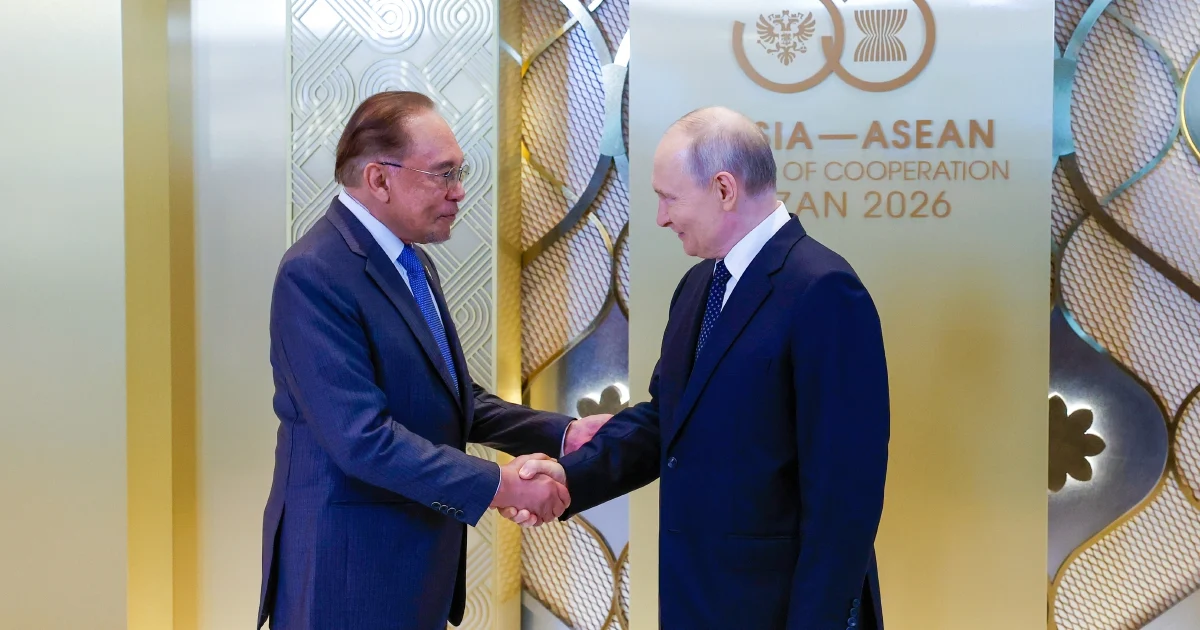
Prime Minister Datuk Seri Anwar Ibrahim revealed that Malaysia has secured assurances from Russian President Vladimir Putin regarding consistent, long-term energy deliveries to the nation, marking a significant step in diversifying the country's energy sourcing strategy. The announcement, made in Bintulu, underscores Malaysia's deliberate approach to establishing resilient relationships with major global energy producers to safeguard national energy security amid shifting international market dynamics.
The pledge from Putin represents a deepening of bilateral energy cooperation between Kuala Lumpur and Moscow, occurring at a time when Southeast Asian nations face mounting pressure to ensure stable power supplies for rapid economic growth and industrial expansion. For Malaysia specifically, which relies on domestic natural gas reserves from its offshore fields whilst simultaneously importing energy resources, the assurance of Russian supply represents a valuable diversification strategy that reduces dependence on any single source or region. This geographical and political diversification of energy suppliers is particularly crucial given Malaysia's positioning as an industrial hub within the ASEAN bloc.
Anwar's articulation of Malaysia's energy strategy reveals a pragmatic engagement with multiple global powers, a necessity given the nation's substantial energy consumption demands from both manufacturing sectors and household consumers. The commitment from Russia extends beyond mere commercial transactions; it reflects a broader geopolitical realignment where Southeast Asian nations leverage their strategic positions to negotiate favourable terms with diverse energy suppliers. For Malaysian policymakers, cultivating relationships with both traditional and emerging energy suppliers provides negotiating leverage and insulates the domestic economy from supply shocks originating in particular regions.
The timing of these discussions in Bintulu, one of Malaysia's major oil and gas production centres, carries particular significance. The location selection amplifies the message that energy infrastructure remains central to national development priorities, whilst simultaneously signalling Malaysia's capacity to engage with Russia on technical and commercial energy matters. Bintulu's Petronas facilities, which include liquefied natural gas processing plants, represent the technological sophistication Malaysia brings to regional energy markets, positioning the nation not merely as a consumer but as a significant energy hub.
From a Southeast Asian perspective, Malaysia's bilateral energy arrangements with Russia have broader implications for regional energy independence. As ASEAN nations collectively seek to transition toward sustainable energy systems whilst managing immediate power demands, partnerships with diverse suppliers create optionality and reduce vulnerability to supply chain disruptions or geopolitical coercion. Malaysia's moves establish a template that other regional economies, particularly energy-intensive nations like Thailand, Indonesia, and Vietnam, might examine when formulating their own supply diversification strategies.
The Russian commitment also occurs within the context of evolving global energy markets where liquefied natural gas (LNG) has become increasingly important. Malaysia possesses established LNG export infrastructure and deep expertise in hydrocarbon processing, making it a logical partner for energy producers seeking reliable, technically capable buyers. Simultaneously, Malaysian demand for energy imports continues rising due to industrial growth and urbanisation, creating mutual commercial interests that sustain long-term partnership viability.
Anwar's framing of energy security through diversified partnerships reflects a sophisticated understanding of contemporary geopolitical realities where smaller nations protect their interests through strategic flexibility rather than rigid alignment. By publicly confirming commitments from major powers whilst maintaining relationships across geopolitical divides, Malaysia positions itself as an economically important nation whose energy needs warrant serious attention from global players. This approach contrasts with approaches that might lock economies into single-source dependencies or ideological alignment camps.
The implications for Malaysian consumers and industry require careful monitoring. Stable energy supplies underpin competitiveness in export-oriented manufacturing sectors, influence electricity tariffs affecting household budgets, and support the petrochemical industries crucial to employment in states like Sarawak and Sabah. Long-term energy security strengthens Malaysia's attractiveness to foreign investors considering regional manufacturing bases, potentially supporting job creation and tax revenues across multiple economic sectors.
Government assurances regarding energy supply, however, must navigate practical implementation challenges including price negotiations, logistics arrangements, and regulatory frameworks ensuring energy reaches consumers efficiently. International energy markets involve complex contractual relationships, currency fluctuations, and infrastructure requirements that require sustained technical engagement beyond diplomatic announcements. Malaysia's energy agencies must translate high-level political commitments into concrete purchasing agreements specifying volumes, pricing mechanisms, and delivery timelines.
The broader strategic context involves Malaysia's non-aligned orientation within regional and global systems, a posture enabling the nation to develop partnerships with energy producers regardless of their geopolitical alignment. This flexibility distinguishes Malaysia from nations constrained by formal military alliances or economic bloc memberships, allowing Kuala Lumpur to pursue energy security objectives without subordinating them to broader geopolitical commitments. Such autonomy proves increasingly valuable as global energy systems experience structural transformation due to decarbonisation pressures and shifting consumption patterns.
Energy security remains fundamentally linked to economic stability and national development prospects. Malaysia's efforts to secure diverse, reliable supply sources through partnerships with major producers like Russia contribute to foundational conditions supporting economic growth, industrial productivity, and social stability. As regional competition for energy resources intensifies and global energy transition accelerates, nations demonstrating foresight in diversifying supplies and cultivating multiple strategic partnerships position themselves advantageously for coming decades.
%22%2F%3E%3C%2Fpattern%3E%3C%2Fdefs%3E%3Crect%20width%3D%22100%25%22%20height%3D%22100%25%22%20fill%3D%22url(%23ph5pwjeg)%22%2F%3E%3Crect%20width%3D%22100%25%22%20height%3D%22100%25%22%20fill%3D%22url(%23ph5pwjep)%22%2F%3E%3Ctext%20x%3D%2250%25%22%20y%3D%2250%25%22%20text-anchor%3D%22middle%22%20dominant-baseline%3D%22central%22%20fill%3D%22rgba(255%2C255%2C255%2C0.95)%22%20font-family%3D%22Georgia%2C%20'Times%20New%20Roman'%2C%20serif%22%20font-weight%3D%22700%22%20font-size%3D%22226%22%20letter-spacing%3D%22-0.02em%22%3ELegacy%3C%2Ftext%3E%3C%2Fsvg%3E)