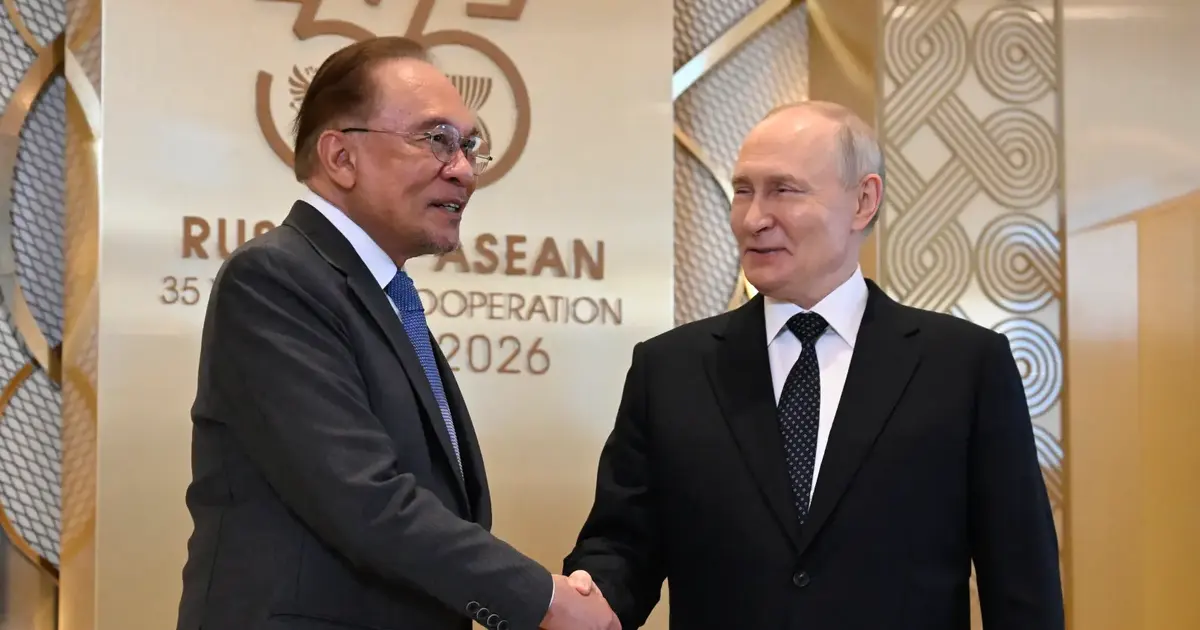
Prime Minister Anwar Ibrahim has secured assurances from Russian President Putin regarding the continuity of Malaysia's energy imports, with commitments extending across the next two decades. The guarantee addresses Malaysia's long-term energy security needs at a time when the nation faces sustained demand for hydrocarbons across its industrial, transportation, and power generation sectors. This arrangement represents a significant pillar in Malaysia's diversified energy procurement strategy, ensuring that domestic reliance on a single source does not compromise economic stability.
The commitment carries particular weight given global energy market volatility and geopolitical tensions that have disrupted supply chains in recent years. Malaysia's energy-intensive industries, including oil and gas refining, petrochemicals, and power generation, depend on reliable hydrocarbon access to maintain competitive advantage in regional and global markets. By securing two decades of guaranteed supply from Russia, Malaysia creates predictability for long-term industrial planning and investment decisions, allowing major energy consumers and manufacturers to forecast operational costs with greater confidence.
Russia has historically played a growing role in Asian energy markets as European import channels have faced political and economic constraints. Malaysia's position as a major Southeast Asian economy with significant petrochemical infrastructure makes it an attractive market for Russian energy exports. The scale and duration of this supply commitment reflect mutual strategic interests: Russia gains a stable, substantial buyer while Malaysia obtains diversified sourcing that reduces vulnerability to supply disruptions from any single region.
Concurrently with energy negotiations, Anwar Ibrahim has identified opportunities to expand Malaysian export markets through engagement with Central Asian partners, particularly Turkmenistan. Malaysia's vision encompasses leveraging these diplomatic channels to penetrate major East Asian markets including China, Japan, and South Korea, which collectively represent enormous consumer bases and industrial demand. Turkmenistan itself holds substantial hydrocarbon reserves and maintains strategic positioning along trade corridors connecting Asia, making it a valuable commercial partner and potential gateway to broader regional networks.
The diversification of Malaysian export destinations addresses structural challenges facing the nation's manufacturing and services sectors. China remains Malaysia's largest trading partner, but Japanese and South Korean markets offer premium pricing for high-value goods and sophisticated services where Malaysian firms can compete effectively. Direct diplomatic engagement with Central Asian authorities can facilitate regulatory alignment, reduce non-tariff barriers, and establish preferential trade frameworks that benefit Malaysian exporters competing against regional rivals.
Anwar Ibrahim's multi-pronged approach reflects modern economic diplomacy that intertwines energy security with broader commercial expansion. Energy stability underpins industrial competitiveness, while export growth generates foreign exchange earnings and employment opportunities. By securing Russian hydrocarbon supplies while simultaneously strengthening Asian market access, Malaysia positions itself as both a reliable consumer within global energy networks and an increasingly important supplier of manufactured goods and services to dynamic regional economies.
The timing of these initiatives coincides with Malaysia's economic recovery and renewed focus on infrastructure development and industrial modernisation. Stable energy costs and supply certainty create conditions favourable for attracting foreign direct investment in energy-intensive manufacturing. International investors increasingly prioritise supply chain predictability, and Malaysia's demonstrated ability to secure long-term energy commitments enhances its appeal as a regional manufacturing hub.
Turkmenistan's role in this broader strategy extends beyond simple trade conduit status. The Central Asian nation serves as a demonstration of Malaysia's diplomatic reach and willingness to engage partners beyond traditional Southeast Asian circles. Such initiatives signal to Malaysian business communities that government actively works to create international market opportunities, potentially encouraging private sector expansion into less familiar markets where official bilateral relationships reduce commercial uncertainty.
The commitment from Russia also carries implications for Malaysia's geopolitical positioning in an era of great power competition. While maintaining ASEAN's traditional non-alignment stance, Malaysia demonstrates pragmatic engagement with major powers to serve concrete national interests. This balancing act—securing Russian energy commitments while pursuing Japanese and South Korean market access—reflects sophisticated diplomatic management that maximises opportunities without surrendering strategic independence.
For Malaysian consumers and businesses, these developments promise sustained energy availability at predictable pricing levels, supporting inflation control and macroeconomic stability. The export expansion agenda addresses productivity and income growth across manufacturing employment, potentially strengthening the middle class and supporting government revenue through corporate taxation. Together, these initiatives represent strategic planning oriented toward long-term economic resilience and competitive positioning within rapidly evolving Asian markets where energy security and export dynamism determine national prosperity.

%22%2F%3E%3C%2Fpattern%3E%3C%2Fdefs%3E%3Crect%20width%3D%22100%25%22%20height%3D%22100%25%22%20fill%3D%22url(%23ph38hg2g)%22%2F%3E%3Crect%20width%3D%22100%25%22%20height%3D%22100%25%22%20fill%3D%22url(%23ph38hg2p)%22%2F%3E%3Ctext%20x%3D%2250%25%22%20y%3D%2250%25%22%20text-anchor%3D%22middle%22%20dominant-baseline%3D%22central%22%20fill%3D%22rgba(255%2C255%2C255%2C0.95)%22%20font-family%3D%22Georgia%2C%20'Times%20New%20Roman'%2C%20serif%22%20font-weight%3D%22700%22%20font-size%3D%22320%22%20letter-spacing%3D%22-0.02em%22%3ERM9%3C%2Ftext%3E%3C%2Fsvg%3E)