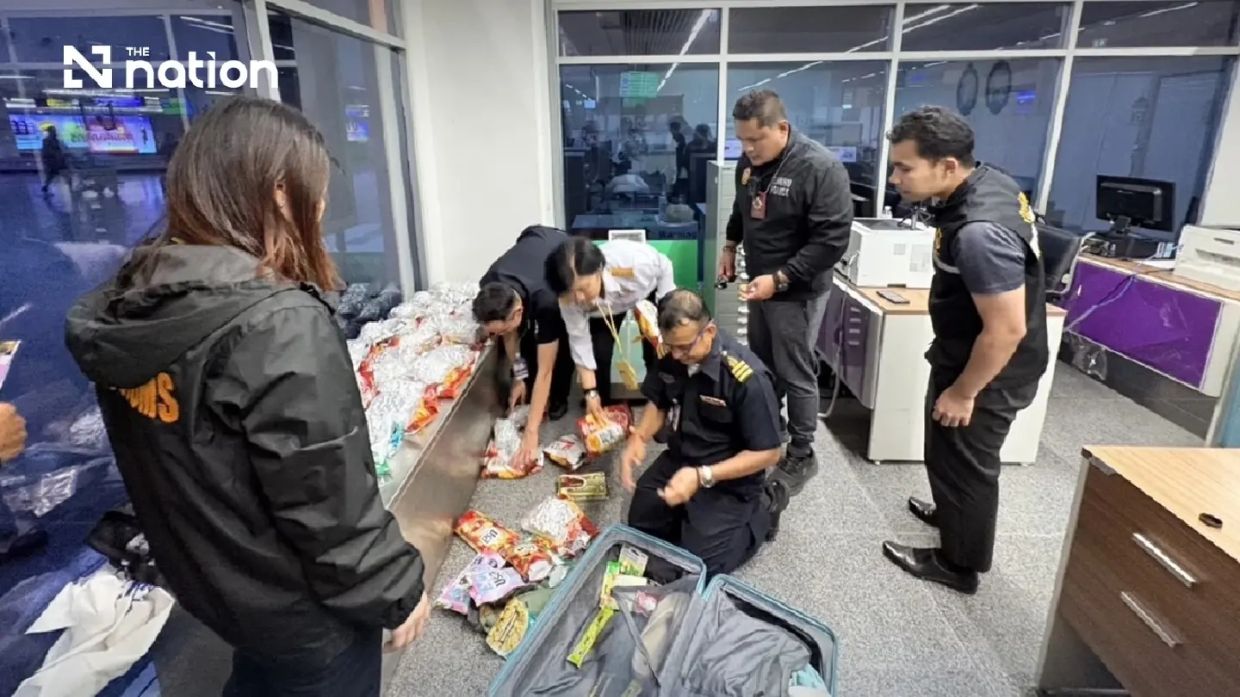
A Russian national was apprehended at Phuket International Airport on Wednesday as he attempted to depart Thailand with a substantial quantity of cannabis concealed in his checked luggage, marking another significant drugs seizure at one of Southeast Asia's busiest travel hubs. The arrest of Sergei Chalabari, aged 30, occurred within the international departure terminal and involved the collaborative efforts of Thai customs and police authorities working to stem the flow of illicit narcotics through the country's transportation networks.
Customs officer Rawin Kanokakorn led an inspection team that scrutinised two blue BP WORLD wheeled suitcases at the Mai Khao subdistrict checkpoint in Thalang district. The combined weight of the luggage was recorded at eight kilogrammes before the search began, though this figure would significantly increase once contraband was discovered. Upon detailed examination of the baggage, authorities uncovered an organised cache of cannabis products carefully packaged for transport, suggesting a level of preparation intended to evade detection by standard screening procedures.
The seizure itself revealed the scale of the smuggling attempt. Officers found 35 individually vacuum-sealed packages of cannabis flowers weighing 11.4 kilogrammes in total, accompanied by 12 separate packages of cannabis resin totalling 6.2 kilogrammes. This combined haul of 17.6 kilogrammes represents a substantial quantity under Thai narcotics legislation, where even possession of lesser amounts carries severe penalties. The methodical packing and sealing of individual portions suggests either commercial intent or connection to a larger distribution network.
During preliminary questioning at the airport, Chalabari acknowledged ownership of both the suitcases and their contents, a confession that considerably simplified the evidentiary burden for investigators. This admission eliminated potential complications regarding culpability and left little room for alternative explanations about how the drugs came to be in his possession. The suspect was subsequently informed that he faced charges of attempting to export controlled substances without proper customs authorisation, a criminal designation that carries mandatory legal proceedings.
The operational coordination between multiple government agencies underscored Thailand's institutional approach to airport security. Pol Col Salan Sankhisasanakun, superintendent of Sakhu Police Station, and his deputy Pol Lt Col Rattanawut Nukaew oversaw the police dimension of the operation, while the customs investigation was managed by Nucha Jeeradit, chief of the Phuket Airport Customs House, along with colleagues Thanomjit Burirak and Charoenporn Jaengwansuk. This multi-departmental structure reflects the Thai government's recognition that effective border control requires seamless integration between revenue and law enforcement agencies.
Chalabari was transferred to Sakhu Police Station for formal processing and handover to investigators, with Pol Capt Chaphinya Surithamkul designated as the deputy investigation inspector overseeing the case progression. The seized cannabis and suitcases were retained as evidence, preserving the chain of custody necessary for prosecution. This procedural adherence suggests confidence in the strength of the case, particularly given the suspect's initial cooperation.
For Malaysian observers, this incident reflects broader regional concerns about drug trafficking through major aviation hubs. Thailand's location on traditional trafficking routes, combined with Phuket's status as a major international destination, makes the airport a natural flashpoint for interdiction efforts. The sophistication of the concealment method—vacuum-sealed packaging designed to evade detection—indicates that international smuggling networks continue to evolve their techniques in response to enforcement improvements.
The arrest carries implications for how Southeast Asian governments coordinate narcotics enforcement. While Thailand has intensified airport security measures in recent years, the continued interception of large quantities suggests that smugglers persistently attempt transshipment through Thailand, often targeting Western destinations. The fact that a Russian national was carrying cannabis suggests potential connections to European markets, where demand for Thai-sourced cannabis remains significant despite its illegality.
From a regional security perspective, the case exemplifies why countries like Malaysia maintain strict aviation screening protocols. The scale of contraband that can transit international airports—particularly when multiple agents coordinate poorly—necessitates the kind of rigorous baggage inspection that characterised this operation. Malaysian authorities monitoring such cases gain valuable intelligence about smuggling methodologies and the risk profiles of certain passenger categories, informing risk-based screening approaches at KLIA and other domestic airports.
The broader context of cannabis smuggling in Southeast Asia has shifted notably with changing global drug policy landscapes. While some jurisdictions decriminalise cannabis, Thailand and Malaysia maintain zero-tolerance approaches, creating arbitrage opportunities for traffickers. The methodical packing and substantial quantity suggests this may have represented a commercial operation rather than personal use, though Thai law enforcement has not publicly characterised the defendant's alleged role in any larger network.
As Chalabari proceeds through Thailand's legal system, the case will likely generate prosecutorial outcomes that reflect the kingdom's firm stance on narcotics trafficking. Thai courts have consistently imposed substantial sentences for drug smuggling, particularly when the quantities involved exceed thresholds that activate trafficking rather than possession statutes. The circumstances of this arrest—caught at the point of departure with admission of ownership—provide prosecutors with a straightforward case trajectory.

