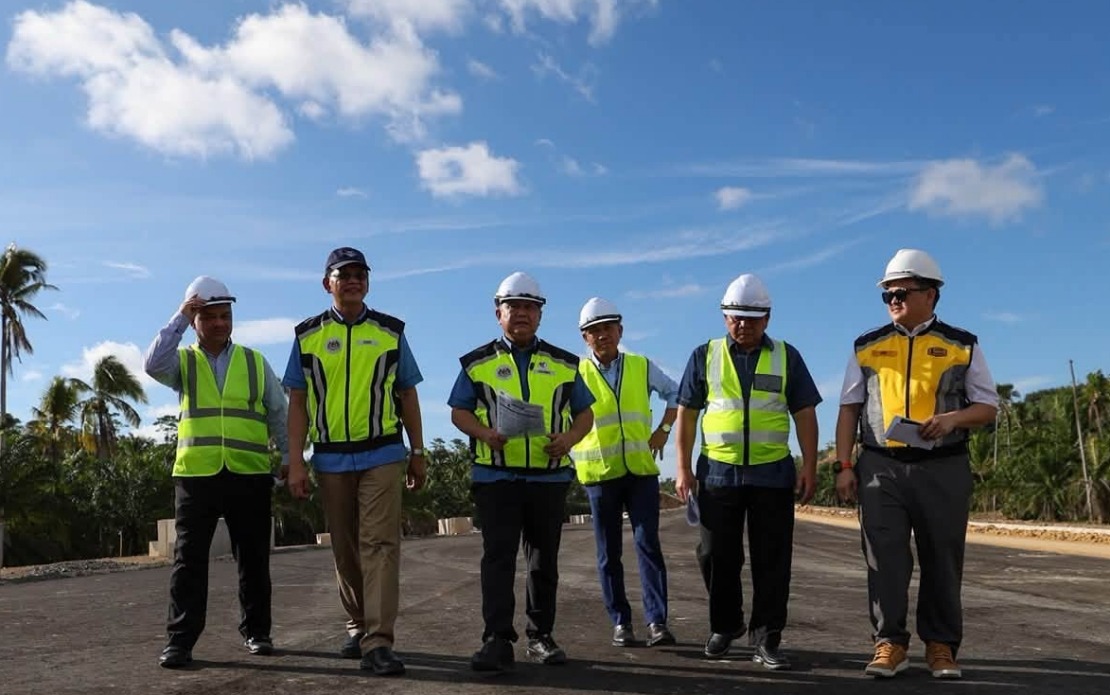
The contractor responsible for Sabah's Pan Borneo Highway Work Package 11 has formally submitted a recovery plan to address accumulating delays on the RM167.48 million infrastructure project, according to Works Minister Datuk Seri Alexander Nanta Linggi. The 7.3-kilometre Rampayan Laut-Sarang alignment section had achieved approximately 62 per cent completion as of late June, but the project remains behind its original construction schedule by nearly 4.35 per cent, equivalent to a 32-day shortfall. The contractor and government bodies are targeting the contractually mandated completion date of September 29, 2026, which means recovery efforts must accelerate in the coming months to deliver the route on time.
The work package forms part of the broader Pan Borneo Highway initiative, a transformational infrastructure project designed to enhance connectivity across Sabah and improve transport networks throughout the eastern Malaysian state. This particular section represents a critical link in the overall highway system, and delays here carry implications for related construction phases and the wider economic benefits the highway promises to unlock. The recovery plan signals that stakeholders acknowledge the deviation and are committing resources to bring the project back within acceptable tolerances, though the compressed timeline suggests considerable effort will be required in the remaining months.
Nanta revealed that the Works Ministry, alongside the Sabah Public Works Department (JKR Sabah), project consultants, and the contractor itself, intends to institute rigorous monitoring mechanisms to implement the recovery plan. A key objective is to whittle down the accumulated delay to just 14 days by August 2026, demonstrating a structured approach to closure rather than accepting the current shortfall. This intermediate target suggests the team recognises the risk profile and is implementing staged reviews to ensure corrective measures remain effective and achievable, rather than relying on a single aggressive push near the deadline.
The delays encountered thus far stem from multiple sources, reflecting the complexity of managing large-scale infrastructure work in an environment with competing utility and service demands. Nanta specifically highlighted challenges in relocating utilities, including work involving Sabah Electricity Sdn Bhd (SESB), the Sabah State Water Department (JANS), and Celcom Timur Sabah Sdn Bhd (CTSB). These utility companies must move electricity lines, water pipes, and telecommunications infrastructure out of the highway corridor, a process that requires careful coordination and technical expertise. Additionally, land acquisition matters have complicated progress, underscoring the administrative and legal dimensions that accompany major public works beyond mere construction execution.
The minister stressed that resolving these structural obstacles demands improved coordination among all participating agencies and a more proactive, integrated approach to problem-solving. Rather than treating utility relocation and land issues as separate challenges, Nanta suggested the need for a unified strategy where government departments, utility providers, and the contractor work in tandem to expedite each phase. This emphasis on institutional collaboration reflects a growing recognition within Malaysia's public works sector that siloed operations frequently create bottlenecks that delay completion and inflate costs.
Beyond the immediate scheduling concern, Nanta articulated the strategic rationale underpinning the Rampayan Laut-Sarang alignment. The new route will offer motorists a significantly shortened journey to Simpang Mengayau and Kudat, trimming up to 30 kilometres from existing travel distances and saving between 30 and 60 minutes in transit time depending on starting and ending points. For a region where distance and time represent material economic constraints, this improvement carries substantial practical value for residents and businesses operating across northern Sabah.
The highway segment also serves a broader developmental agenda centred on tourism expansion and economic stimulation across northern Sabah's coastal regions. By improving access to what the minister termed the Tourism Belt and the Northern Sabah Coastal Tourism Master Plan, the completed highway will facilitate visitor flows to attractions and hospitality enterprises that have historically faced infrastructure constraints. Enhanced transportation connectivity typically catalyses economic activity in tourism-dependent areas, potentially generating employment and investment opportunities for local communities who have experienced limited previous growth momentum.
Nanta emphasised that the government's commitment extends beyond merely meeting the contractual deadline; quality, safety, and integrity in project delivery constitute equally important objectives. This statement reflects a matured approach to infrastructure development, acknowledging that rushed completion divorced from quality assurance creates long-term liabilities for maintenance, safety incidents, and public confidence. The ministerial assertion signals that accelerating the schedule must not come at the expense of construction standards or safety protocols.
For Malaysian observers and stakeholders across Southeast Asia, the Sabah Pan Borneo Highway represents a bellwether for Malaysia's capacity to execute large-scale infrastructure projects on schedule and within budget—a critical metric as the country competes for international investment and seeks to position itself as a reliable infrastructure partner in regional development initiatives. The current delays, while not extraordinary for projects of this complexity, underscore persistent challenges in utility coordination and land administration that have plagued Malaysian public works programmes across multiple decades and jurisdictions. Successfully implementing the recovery plan will demonstrate whether recent institutional reforms and heightened ministerial oversight have genuinely enhanced project management discipline and stakeholder accountability.
The September 2026 deadline now represents a concrete benchmark against which to measure whether Malaysia's infrastructure bureaucracy can sustain focus on delivery amid competing pressures. As other Southeast Asian nations pursue comparable highway and transportation projects—from Indonesia's toll roads to Thailand's high-speed rail initiatives—the experiences on the Pan Borneo Highway carry instructive value for understanding the administrative and technical prerequisites for success in the regional context.

