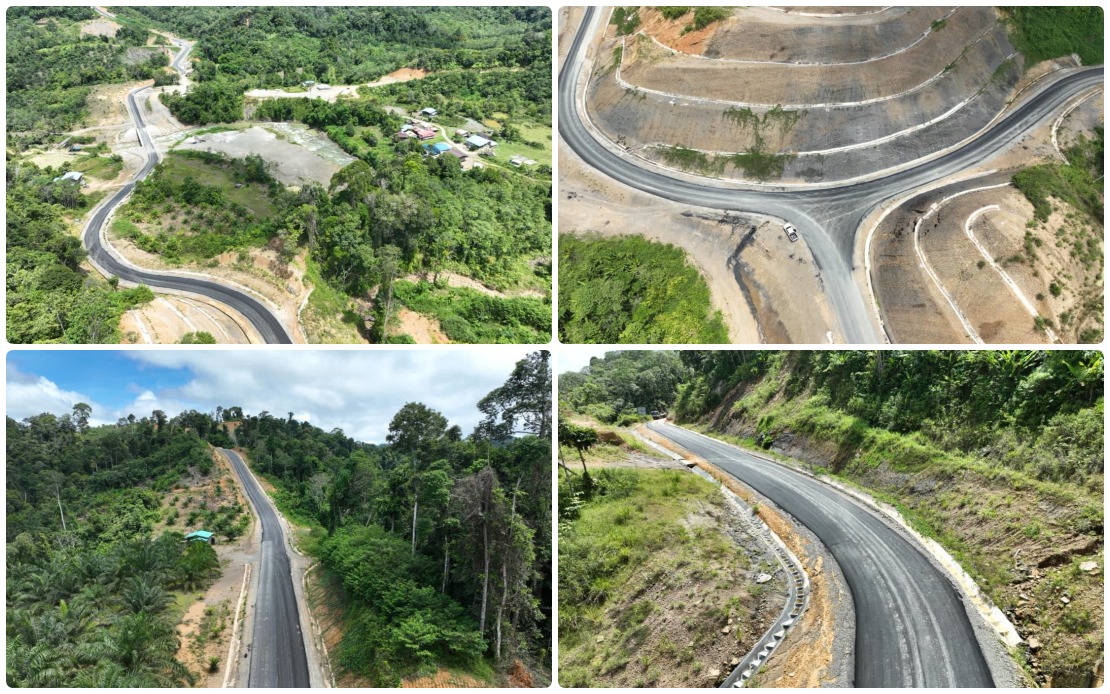
The completion of the Sapulut-Salong-Pagalungan-Pensiangan highway to Pensiangan town marks a significant breakthrough for Sabah's interior communities, transforming what was once a grueling and weather-dependent journey into a manageable three-hour drive from Keningau. Datuk Seri Arthur Joseph Kurup, the Natural Resources and Environmental Sustainability Minister and Member of Parliament for Pensiangan, announced the achievement following a recent site inspection, describing the project as fulfilling a key manifesto commitment to upgrade road infrastructure in the parliamentary constituency.
The transformation is already visible in the daily rhythms of Pensiangan town. Where boats once dominated the transport landscape, cars now line the streets and parking areas, a tangible indicator of improved accessibility. This shift reflects not merely the completion of asphalt and concrete, but the opening of practical pathways for essential services and professional movement. Teachers, medical personnel, and nurses can now reach the district with considerably less risk of becoming stranded during adverse weather, a critical consideration in Sabah's climate where tropical downpours can rapidly render unpaved routes impassable.
The dramatic reduction in travel time—from more than six hours to just three—represents more than statistical improvement. It addresses a historical barrier that has constrained economic participation, professional recruitment, and social mobility for interior residents. The old journey, which could extend even further during monsoon conditions, effectively isolated Pensiangan from the broader regional economy and discouraged qualified professionals from taking positions in the district. By contrast, the new road conditions enable daily or frequent commuting patterns that simply were not feasible before, fundamentally altering the calculus of livelihood decisions for both established and prospective residents.
Crucially, the road completion is already catalyzing demographic and economic reversals in areas that have experienced youth outmigration for decades. Arthur noted that younger people are beginning to return to their home villages to develop agricultural holdings and participate in local economic activity, a pattern typically associated with improved infrastructure and reduced isolation. This return migration, if sustained, could help stabilize populations and preserve traditional knowledge systems that are often lost when younger generations permanently relocate to urban centers.
The road project sits within a broader master development strategy that extends beyond Pensiangan itself. Phase Four of the initiative will push the highway network to the Kalimantan border, positioning the district as a potential economic gateway and tourism corridor between Malaysia and Indonesia. This transnational dimension could unlock trade opportunities and cross-border commerce that currently remain dormant, particularly in agriculture and resource extraction sectors where Sabah's interior holds competitive advantages.
Supporting this highway investment is a constellation of complementary infrastructure projects designed to create an integrated development ecosystem. The Jalan Sinaron-Linayukan connection in Tongod has already been completed, while the Jalan Rancangan Belia Tiulon-Simbuan remains under active construction. These road networks form the skeletal framework enabling goods movement and service delivery across the broader region. Simultaneously, the Sapulut coffee processing facility—currently under construction—represents value-addition capacity that could transform raw agricultural output into higher-margin finished products, strengthening local incomes and employment.
Port and logistics infrastructure receives parallel attention through the upgrading of jetty and boat facilities at Pangkalan Salong, now nearing completion. While road access has improved dramatically, water transport retains strategic importance for certain cargo types and seasonal conditions, making multipmodal connectivity essential. The agricultural collection centre at Pagalungan and the Salong Agrobazaar serve as aggregation points where smallholder farmers can consolidate produce for more efficient marketing and quality management, addressing traditional bottlenecks that undercut farm profitability.
Digital connectivity forms another pillar of the development strategy, with telephone and internet infrastructure upgrades extending throughout the district. In contemporary economic contexts, connectivity deficits can be as limiting as physical isolation, preventing residents from accessing online markets, banking services, and information resources that determine competitiveness. By coupling road access with telecommunications modernization, the development plan addresses both physical and informational barriers simultaneously.
Border infrastructure planning reflects the strategic importance Arthur places on cross-boundary economic integration. An immigration and customs complex at the Kalimantan frontier—currently in approval processes—would formalize and streamline trade flows while reducing transaction costs for legitimate commerce. Such facilities typically signal government commitment to orderly transnational economic activity and can attract investment from traders seeking predictable regulatory environments. The planned complex could transform Pensiangan from a peripheral outpost into a recognized commercial gateway, though success depends on complementary investments in Indonesian border facilities and bilateral trade protocols.
Educational investment, notably the newly constructed Sixth Form Centre at Sekolah Menengah Kebangsaan Nabawan for Nabawan district, expands secondary and tertiary education pathways for interior residents. Previously, young people seeking Form Six or pre-university qualifications would require expensive relocation to urban centers, effectively pricing out many talented but economically disadvantaged students. Local provision reduces these barriers and helps retain human capital within the region. The combination of improved transportation, education access, and economic opportunity creates reinforcing conditions for longer-term development, though sustainability depends on maintaining workforce competitiveness and generating sufficient local employment to absorb graduates.
The cumulative effect of these interconnected projects reflects a sophisticated understanding that infrastructure development requires more than single-sector interventions. Roads alone do not guarantee prosperity if agricultural production lacks processing capacity or if farmers cannot access markets. Processing facilities mean little without reliable transportation networks. Educational institutions produce limited regional benefit if graduates must permanently migrate to find employment. Arthur's master plan attempts to construct an integrated ecosystem where each element reinforces others, multiplying development impact beyond what isolated projects could achieve. Whether this vision translates into sustained economic transformation will depend on implementation quality, local capacity development, and continued political commitment as administrations change.

