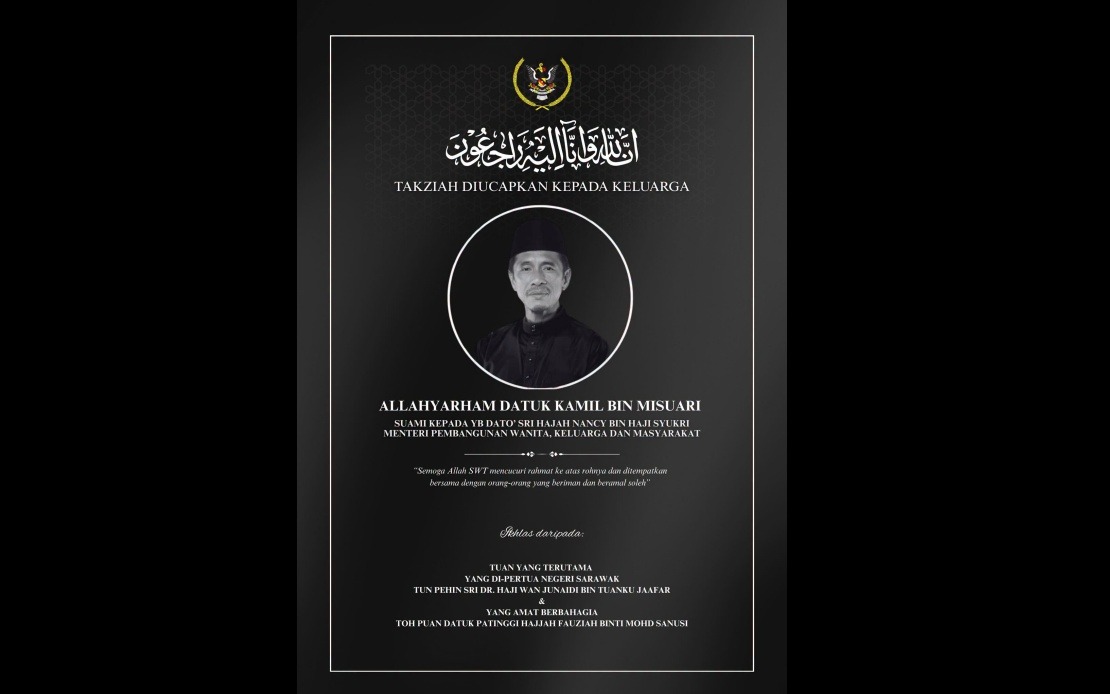
The Yang Dipertua Negeri Sarawak, Tun Dr Wan Junaidi Tuanku Jaafar, has expressed his sympathies to Women, Family and Community Development Minister Datuk Seri Nancy Shukri following the passing of her spouse, Datuk Kamil Misuari. The 65-year-old died at a hospital in Kuala Lumpur on June 18, according to an announcement from the minister's office.
Through a formal statement released by Astana Sarawak, the state governor and his wife, Toh Puan Fauziah Mohd Sanusi, have offered prayers for the deceased. The couple sought divine blessings upon Kamil's soul, asking that his virtuous deeds be acknowledged and that he be counted among the righteous in the afterlife, in keeping with Islamic tradition and prayer practices observed by senior government figures in Malaysia.
The statement further indicated that Tun Wan Junaidi and Toh Puan extended their hopes that the bereaved minister and her extended family would find the emotional resilience and inner strength required to navigate the difficult period ahead. Such formal expressions of sympathies from high-ranking state officials underscore the significance placed on supporting government colleagues during times of personal loss and grief.
Kamil's mortal remains are scheduled to be transported to Kuching on June 19, where funeral preparations will commence. The late businessman will be laid to rest at the Samariang Muslim Cemetery in accordance with Islamic funeral rites and customs observed in the state. The arrangement reflects the family's connection to Sarawak, where both Kamil and Nancy maintain strong ties.
The couple's marriage, which began in 1985, spanned nearly four decades and produced three children together. Throughout their union, Kamil supported his wife's rise through the political ranks, though he maintained a largely private profile away from the public eye. Their family structure represents a common pattern among Malaysia's political families, where spouses often play supportive roles behind the scenes while children pursue various professional paths.
Nancy Shukri's appointment as Women, Family and Community Development Minister places her among a select group of female cabinet members in Malaysia's federal government. Her portfolio touches on critical social policy areas affecting Malaysian families across all demographics, from childcare provisions to domestic welfare programmes and community development initiatives. The loss of a long-time spouse inevitably impacts both her personal circumstances and her capacity to discharge ministerial duties during the immediate aftermath.
The passing represents a significant moment within Malaysia's political establishment, where senior ministers' personal milestones frequently attract formal recognition from state and federal leaders. Such condolences serve both as genuine expressions of sympathy and as ceremonial acknowledgments of a colleague's standing within government circles. The involvement of Sarawak's top state official, despite the death occurring in Kuala Lumpur, reflects the interconnected nature of Malaysia's political networks across different states and levels of government.
For Nancy Shukri, the immediate period will require balancing personal grief with her continued responsibilities toward her ministry and the public. Malaysian government practice typically allows senior ministers space to attend to family matters without formal leave announcements, though the minister's office may subsequently issue statements regarding her schedule or any adjustments to official engagements. The government machinery generally accommodates such circumstances with discretion and respect.
Kamil's death also highlights the broader reality facing Malaysia's aging generation of political spouses and business figures who came of age during the country's rapid development decades. Many such individuals witnessed transformative periods in Malaysian society and contributed to the nation's economic and social progress, though often without seeking public recognition or media attention. Their contributions to their spouses' political careers and to Malaysian society at large frequently remain understated in public discourse.
The formal recognition of Kamil's passing through official state statements demonstrates how Malaysian government protocols extend compassion and respect to the families of prominent officials. These ceremonial aspects of governance, while sometimes perceived as mere formalities, serve to reinforce social cohesion and acknowledge the human dimension underlying political structures. They also provide families with public recognition of their loss during vulnerable periods.
%22%2F%3E%3C%2Fpattern%3E%3C%2Fdefs%3E%3Crect%20width%3D%22100%25%22%20height%3D%22100%25%22%20fill%3D%22url(%23ph5xfrkg)%22%2F%3E%3Crect%20width%3D%22100%25%22%20height%3D%22100%25%22%20fill%3D%22url(%23ph5xfrkp)%22%2F%3E%3Ctext%20x%3D%2250%25%22%20y%3D%2250%25%22%20text-anchor%3D%22middle%22%20dominant-baseline%3D%22central%22%20fill%3D%22rgba(255%2C255%2C255%2C0.95)%22%20font-family%3D%22Georgia%2C%20'Times%20New%20Roman'%2C%20serif%22%20font-weight%3D%22700%22%20font-size%3D%22320%22%20letter-spacing%3D%22-0.02em%22%3EPM%3C%2Ftext%3E%3C%2Fsvg%3E)
%22%2F%3E%3C%2Fpattern%3E%3C%2Fdefs%3E%3Crect%20width%3D%22100%25%22%20height%3D%22100%25%22%20fill%3D%22url(%23ph2flptg)%22%2F%3E%3Crect%20width%3D%22100%25%22%20height%3D%22100%25%22%20fill%3D%22url(%23ph2flptp)%22%2F%3E%3Ctext%20x%3D%2250%25%22%20y%3D%2250%25%22%20text-anchor%3D%22middle%22%20dominant-baseline%3D%22central%22%20fill%3D%22rgba(255%2C255%2C255%2C0.95)%22%20font-family%3D%22Georgia%2C%20'Times%20New%20Roman'%2C%20serif%22%20font-weight%3D%22700%22%20font-size%3D%22320%22%20letter-spacing%3D%22-0.02em%22%3EPAS%3C%2Ftext%3E%3C%2Fsvg%3E)