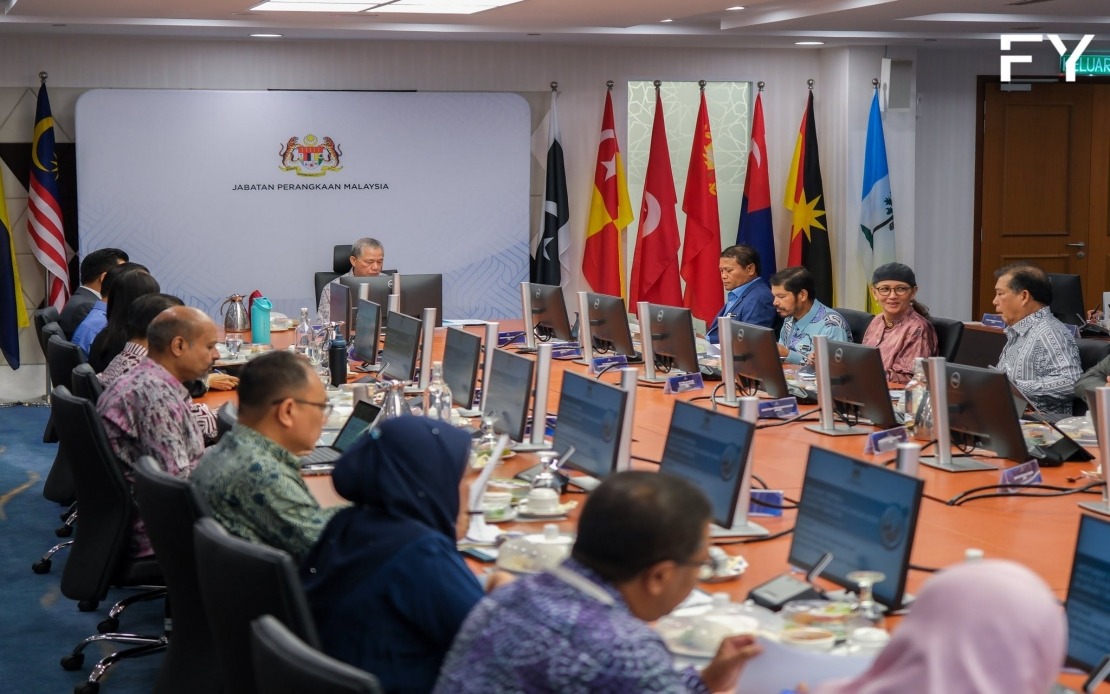
Deputy Prime Minister Datuk Seri Fadillah Yusof has underscored the government's commitment to fortifying the National Statistical System and substantially broadening the application of data analytics and artificial intelligence as foundational elements underpinning strategic decision-making, with the aim of driving the successful execution of the 13th Malaysia Plan spanning 2026 to 2030.
Addressing the National Statistics and Data Council in a high-level meeting that convened senior cabinet figures including Works Minister Datuk Seri Alexander Nanta Linggi, Deputy Health Minister Datuk Hanifah Hajar Taib, and Chief Statistician Datuk Seri Dr Mohd Uzir Mahidin, Fadillah articulated how evidence-based governance has become indispensable in navigating an increasingly complex global landscape. The pressures confronting Malaysia span economic volatility stemming from international trade uncertainties, shifting geopolitical alignments, accelerating digital disruption, environmental degradation and the transformative impact of emerging technologies. In this context, data infrastructure and official statistics have transcended their traditional informational role to become strategic assets capable of bolstering public service efficiency whilst enhancing national economic resilience.
The Deputy Prime Minister highlighted Malaysia's resilient macroeconomic trajectory, citing first-quarter 2026 gross domestic product expansion of 5.4 per cent as validation that development strategies grounded in rigorous data analysis deliver tangible results. This performance, he suggested, reflects the value of policies formulated through careful evaluation of statistical evidence rather than ad-hoc approaches. The 13th Malaysia Plan's successful delivery hinges upon maintaining access to comprehensive, accurate and current data and statistics that can meaningfully inform each stage of policy design, operationalisation, assessment and impact evaluation.
Fadillah, who additionally holds the portfolio of Minister of Energy Transition and Water Transformation, identified the imperative to develop an integrated national database architecture, strengthen big data analytical capabilities, and harness artificial intelligence systems to drive productivity improvements, foster innovation and amplify competitive advantage. These technical investments assume particular urgency given Malaysia's strategic priorities in energy transition, climate mitigation, water security transformation and broader sustainable development commitments. Effective delivery of policies and capital allocations within these domains demands granular, multifaceted data infrastructure capable of tracking progress against established benchmarks and enabling real-time course correction.
The Strengthening of the National Statistical System initiative requires sustained enhancement predicated upon coordinated engagement spanning multiple institutional layers. Fadillah emphasised the necessity for collaborative frameworks encompassing federal ministries, statutory agencies, state administrations, commercial enterprises, universities and research institutions. This whole-of-ecosystem approach acknowledges that contemporary governance challenges transcend departmental silos, requiring seamless information flows and analytical synthesis across traditionally fragmented data repositories.
In an era marked by pervasive digitalisation, the capacity to aggregate information from heterogeneous sources whilst maintaining security protocols, ethical standards and operational integrity has become mission-critical. Fadillah stressed that such integrated data mobilisation enables government entities to construct more holistic diagnostic assessments of emerging societal challenges and expedite response mechanisms. The fusion of administrative records, operational metrics and real-time datasets creates intelligence foundations that compress decision cycles and enhance policy targeting.
The council reviewed multiple concurrent initiatives aimed at consolidating national data infrastructure. These encompass standardising the country's official statistical methodologies, reinforcing data governance frameworks, synthesising administrative information systems, constructing a comprehensive science, technology and innovation talent registry, mobilising demographic and employment data to inform youth development programs, and implementing systematic asset management protocols for national road networks. Collectively, these workstreams constitute the building blocks of a more cohesive, authentically integrated and development-focused national data ecosystem.
For Malaysian policymakers and stakeholders, this strategic pivot towards data-centric governance carries significant implications. Regions and sectors that successfully leverage advanced analytics and AI capabilities will likely outpace competitors in navigating emerging economic transitions. The emphasis upon integrated databases and big data analytics suggests government agencies may increasingly allocate resources toward technology infrastructure and data science talent acquisition, reshaping public sector employment patterns and creating demand for specialized analytical expertise throughout the civil service.
The broader Southeast Asian context further underscores the urgency of Fadillah's advocacy. As regional economies compete for foreign direct investment and technological capability development, those demonstrating sophisticated data governance and AI-enabled policy frameworks gain competitive credibility with multinational enterprises and development finance institutions. Malaysia's explicit commitment to these dimensions positions the nation to attract investments in high-value sectors dependent upon robust analytical infrastructure and evidence-based regulatory environments.
Moreover, the Deputy Prime Minister's framing of data and statistics as strategic national assets rather than administrative byproducts reflects evolving international norms around data sovereignty and strategic autonomy. By consolidating control over comprehensive national datasets and developing indigenous AI capacity, Malaysia reduces dependence upon foreign technology providers for critical governance intelligence, whilst establishing proprietary analytical advantages for competitive advantage in knowledge-intensive industries.
The integration of administrative data systems, talent registries and sectoral datasets referenced in the council meeting also signals intent to enhance policy coherence and resource allocation efficiency. Fragmented information systems historically impede whole-of-government approaches to cross-cutting challenges such as climate resilience, inclusive growth and demographic transitions. Unified data architecture enables simultaneous tracking of interdependencies across health, education, economic participation and environmental outcomes, facilitating more sophisticated policy design.
Implementing these aspirations will undoubtedly encounter technical, organisational and cultural obstacles. Legacy systems within government agencies, varying data quality standards across jurisdictions, privacy protection requirements and institutional resistance to analytical transparency present formidable challenges. Nevertheless, Fadillah's sustained advocacy and ministerial-level council engagement suggest Malaysia's government recognises that technological upgrading of governance infrastructure represents a prerequisite for navigating the 13th Malaysia Plan's ambitious development objectives and sustaining regional competitiveness throughout the 2026-2030 period.