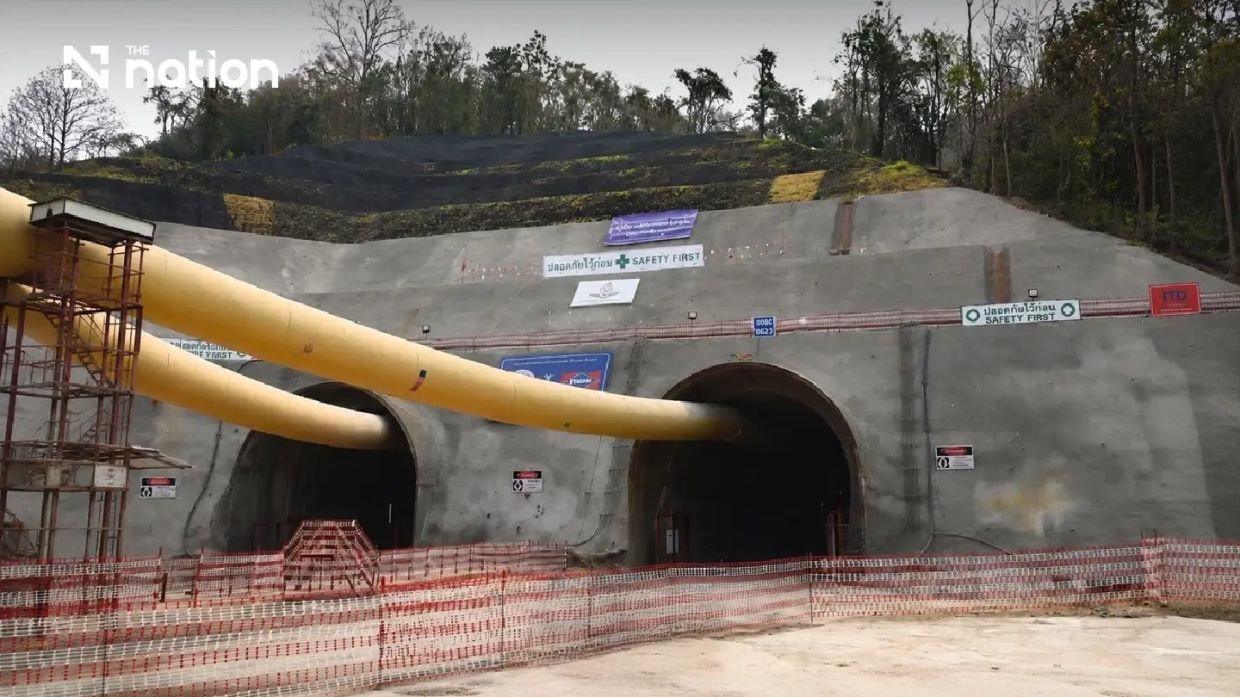
A fatal accident at a major railway construction site in northern Thailand has claimed two lives and left seven workers hospitalised. The incident occurred on Saturday evening at the Doi Luang tunnel in Chiang Saen district, Chiang Rai, where teams were engaged in interior finishing work on the State Railway of Thailand's ambitious Den Chai-Chiang Rai-Chiang Khong railway line. The accident underscores ongoing safety challenges in large-scale infrastructure projects across Southeast Asia, where rapid development timelines sometimes conflict with rigorous safety protocols.
Based on preliminary investigations, authorities believe rocks dislodged from the tunnel wall triggered the collapse while workers were applying waterproofing measures to the interior surfaces. Deputy Transport Minister Siripong Angkasakulkiat received the initial distress call at 8.35pm on Saturday and confirmed the incident involved structural failure rather than operational error alone. Earlier accounts had suggested the collapse occurred in the shotcrete—sprayed concrete—work area, though officials noted they were still examining the exact sequence of events and contributing factors that led to the disaster.
The injured workers sustained varying degrees of harm, with three classified as seriously hurt and four with minor injuries. All victims were promptly transported to medical facilities for treatment. The rapid response by emergency services and the project's safety protocols helped prevent further casualties, though the loss of life has prompted immediate scrutiny of construction practices at the site. The accident area has since been sealed and cordoned off to prevent unauthorised access while investigations continue.
The Doi Luang tunnel itself represents a significant engineering achievement in the broader railway expansion programme. The tunnel, located in Chiang Saen district, stretches 3.4 kilometres and has already been successfully bored through its mountain passage. However, the interior finishing phase—which includes waterproofing, ventilation systems, and safety installations—remains technically demanding and carries inherent risks for workers operating in confined spaces at height or depth.
This fatality occurred within Contract 3 of the larger Chiang Rai-Chiang Khong railway section, a THB19.385 billion component of the overall project. Contract 3 encompasses an extensive scope of work across approximately 87 kilometres, including at-grade and elevated railway tracks, three passenger stations, three railway halts, signalling and telecommunications infrastructure, and associated facilities. The scale and complexity of such contracts means numerous subcontractors and workers are typically involved simultaneously across multiple work fronts.
The CKST-DC3 Joint Venture—a consortium of CH. Karnchang Public Company Limited, Sino-Thai Engineering & Construction Public Company Limited, and Chiangmai Construction Co., Ltd.—holds responsibility for executing Contract 3. As the principal contractor, the joint venture oversees safety management, worker training, and site supervision. The accident will likely trigger comprehensive safety audits of the contractor's procedures and may result in construction delays while remedial measures are implemented.
Deputy Minister Siripong confirmed that the project's dedicated safety unit had assumed direct control of the incident site and was implementing additional monitoring protocols. The State Railway of Thailand's Special Projects and Construction Department mobilised rapidly to inspect conditions and gather evidence. Such coordinated responses are standard in major accident investigations, though they often reveal systemic issues that extend beyond the immediate incident.
For Malaysia and other Southeast Asian nations pursuing similar large-scale railway and infrastructure projects, the Doi Luang collapse offers cautionary lessons about the pressures inherent in ambitious construction schedules. The Den Chai-Chiang Rai-Chiang Khong railway line itself reflects broader regional connectivity ambitions, particularly linking Thailand's interior regions with border areas. Yet such ambitious timelines can inadvertently incentivise cutting corners on safety, a risk that requires vigilant oversight from both contractors and government regulators.
The incident also highlights the vulnerability of workers in the construction sector across the region, many of whom come from economically disadvantaged backgrounds and may lack adequate safety training or the authority to refuse unsafe work conditions. Both Thailand and its neighbours in Southeast Asia have struggled to enforce robust labour protections in sprawling construction projects where subcontracting chains obscure accountability. This accident may prompt renewed calls for stricter enforcement of safety standards and worker protections throughout the region's infrastructure boom.
Authorities indicated that further details regarding the investigation would be released as the examination of the scene and evidence progressed. The transport ministry committed to transparent reporting, though the investigation itself could take several weeks to complete comprehensively. Determining whether the collapse resulted from design deficiencies, material failures, inadequate worker training, or supervisory lapses will be essential for preventing similar tragedies.
The broader Den Chai-Chiang Rai-Chiang Khong railway project remains strategically important for Thailand's infrastructure modernisation and regional economic integration. However, the Doi Luang tunnel accident demonstrates that advancing development goals must never come at the cost of worker safety. The investigation findings may influence how future major contracts are structured, bid, and supervised throughout Thailand and potentially influence practices across Southeast Asia's competitive construction industry.
%22%2F%3E%3C%2Fpattern%3E%3C%2Fdefs%3E%3Crect%20width%3D%22100%25%22%20height%3D%22100%25%22%20fill%3D%22url(%23ph3duqbg)%22%2F%3E%3Crect%20width%3D%22100%25%22%20height%3D%22100%25%22%20fill%3D%22url(%23ph3duqbp)%22%2F%3E%3Ctext%20x%3D%2250%25%22%20y%3D%2250%25%22%20text-anchor%3D%22middle%22%20dominant-baseline%3D%22central%22%20fill%3D%22rgba(255%2C255%2C255%2C0.95)%22%20font-family%3D%22Georgia%2C%20'Times%20New%20Roman'%2C%20serif%22%20font-weight%3D%22700%22%20font-size%3D%22320%22%20letter-spacing%3D%22-0.02em%22%3E300%3C%2Ftext%3E%3C%2Fsvg%3E)