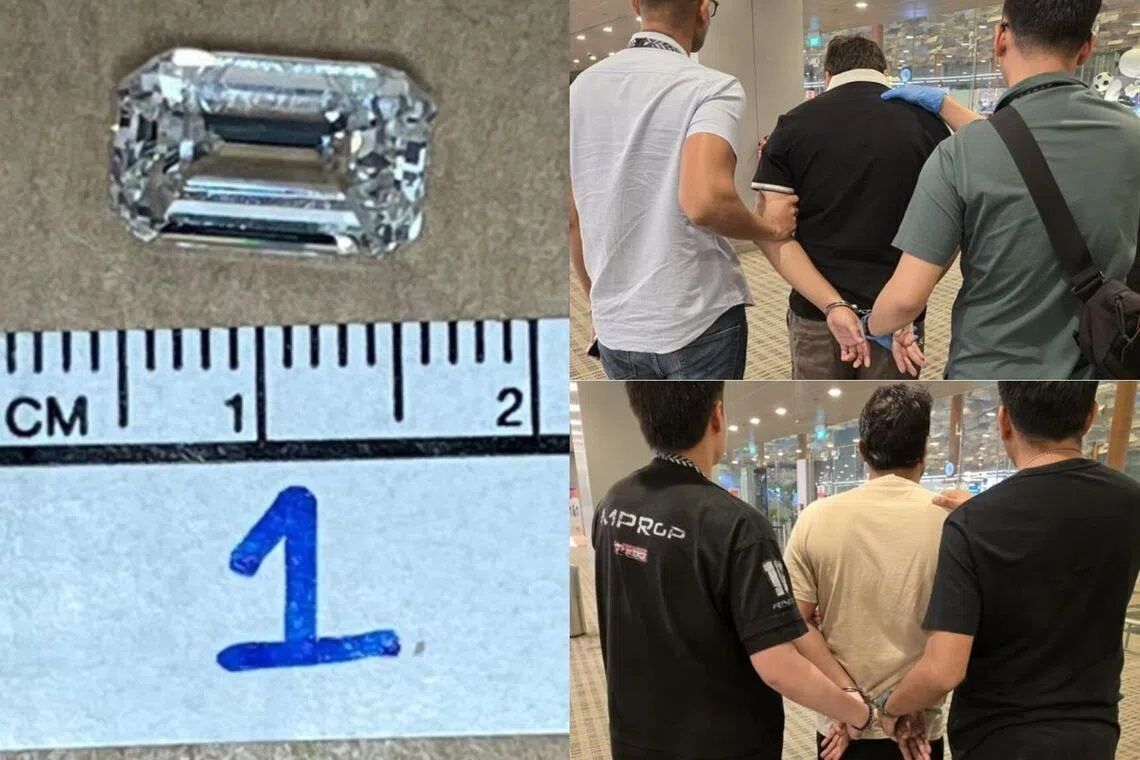
Singapore authorities have apprehended two men suspected of executing a high-value jewellery theft in Chinatown, with the brazen heist unfolding in plain sight at a retail store on Kreta Ayer Road. The 30-year-old and 42-year-old suspects were taken into custody at Changi Airport Terminal 3 on Friday, June 19, hours after the diamond valued at over S$235,000 vanished from the premises. Police responded to a distress call at 3.40pm that afternoon, triggering an investigation that would culminate in their swift apprehension and recovery of the stolen stone.
The theft itself employed a technique as old as the jewellery trade itself: sleight of hand masquerading as legitimate customer interest. The pair entered the shop and expressed genuine-seeming curiosity about purchasing the diamond, requesting to examine it closely while handling what appeared to be serious intent. As the jeweller's attention remained focused on the transaction, the suspects deftly exchanged the genuine gemstone for a counterfeit replica, replacing authenticity with artifice in a moment requiring considerable coordination and nerve. When they departed without completing a purchase, their sudden loss of interest triggered immediate suspicion among shop staff, who conducted a verification check that revealed the substitution.
Central Police Division officers and the Police Operations Command Centre coordinated the investigation that led to the suspects' identification and capture. Detectives leveraged closed-circuit television footage from the jewellery store alongside police surveillance cameras positioned throughout Chinatown's commercial district, methodically tracing the suspects' movements before and after the alleged crime. Ground-level enquiries and systematic follow-up investigations narrowed the field of suspects until the two men emerged as the primary persons of interest. Their capture at the airport terminal suggests they were attempting to flee Singapore, possibly fearing imminent arrest once the theft became evident.
Police successfully recovered the stolen diamond and have secured it as evidence for the forthcoming prosecution. The recovery represents a significant success for law enforcement, preventing the gemstone from disappearing into underground markets or being smuggled overseas through the jurisdiction's primary air gateway. The swift resolution also demonstrates the effectiveness of coordinated multi-divisional police work and the capacity of modern surveillance infrastructure to reconstruct criminal sequences with considerable precision.
The two suspects now face charges under Singapore's theft laws, specifically theft in a dwelling committed with common intention—a charge recognising their coordinated participation in the crime. The legal framework under which they will be prosecuted carries substantial consequences: conviction on this charge exposes each man to imprisonment of up to seven years alongside financial penalties. The severity of the potential sentences reflects Singapore's determination to combat organised property crime targeting high-value commercial establishments, particularly luxury retailers vulnerable to sophisticated theft techniques.
Police disclosed limited information regarding the suspects' nationalities, maintaining operational security while the investigation progresses toward formal charges scheduled for June 20. The withholding of certain biographical details is standard practice in Singapore's criminal justice system during preliminary investigation phases, particularly when international dimensions might complicate extradition or cross-border legal proceedings. This restraint in information release balances public interest against investigative requirements and privacy considerations.
The case illuminates a persistent vulnerability within the luxury jewellery retail sector: the execution of sleight-of-hand substitutions by perpetrators who combine theatrical confidence with precise manual dexterity. Such techniques require neither sophisticated technology nor complex logistical planning, yet consistently succeed against experienced retail staff operating in high-pressure sales environments. The simplicity of the method—genuine interest masking criminal intention, immediate departure before discovery, coordination between accomplices—makes such thefts difficult to prevent through conventional security measures alone.
In response, Singapore's police force has issued formal guidance to jewellery retailers and luxury goods merchants throughout the island-state, urging heightened vigilance against precisely this modus operandi. Shop owners are advised to implement procedural safeguards when handling high-value items, including witness verification protocols, momentary removal of items from customer handling during transactions, and systematic authentication checks after customer contact. The alert recognises that security requires not merely technological investment but also procedural discipline and staff training adapted to the specific vulnerabilities that organised retail theft exploits.
For Malaysian readers and regional observers, the case underscores the transnational dimensions of organised retail crime within Southeast Asia. Luxury goods theft frequently involves suspects who operate across multiple jurisdictions, exploiting regulatory differences and police cooperation gaps. The swift recovery and arrest in Singapore contrast with cases elsewhere where stolen jewellery crosses borders undetected, suggesting the importance of coordinated regional law enforcement frameworks and mutual legal assistance protocols. The incident also reflects broader trends in transnational organised crime where high-value portable goods—jewellery, electronics, watches—attract criminal specialisation targeting the region's affluent consumer markets.
%22%2F%3E%3C%2Fpattern%3E%3C%2Fdefs%3E%3Crect%20width%3D%22100%25%22%20height%3D%22100%25%22%20fill%3D%22url(%23ph4adttg)%22%2F%3E%3Crect%20width%3D%22100%25%22%20height%3D%22100%25%22%20fill%3D%22url(%23ph4adttp)%22%2F%3E%3Ctext%20x%3D%2250%25%22%20y%3D%2250%25%22%20text-anchor%3D%22middle%22%20dominant-baseline%3D%22central%22%20fill%3D%22rgba(255%2C255%2C255%2C0.95)%22%20font-family%3D%22Georgia%2C%20'Times%20New%20Roman'%2C%20serif%22%20font-weight%3D%22700%22%20font-size%3D%22151%22%20letter-spacing%3D%22-0.02em%22%3ESingapore%3C%2Ftext%3E%3C%2Fsvg%3E)