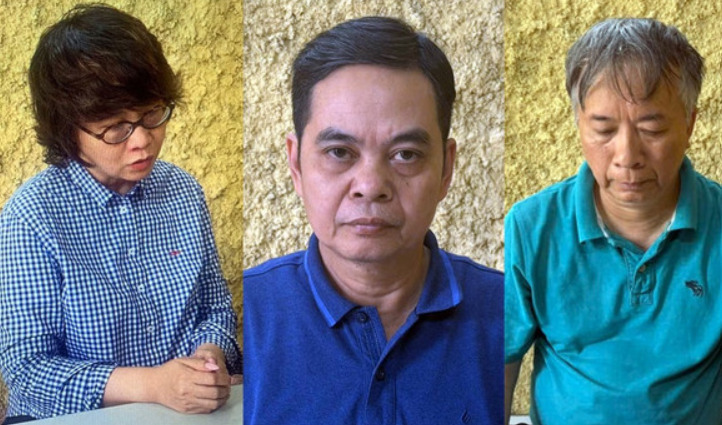
Vietnamese police have intensified their control over public narratives surrounding the nation's founding leadership, moving Wednesday to arrest three executives from the Vietnam Writers' Association Publishing House in connection with a book about Ho Chi Minh, the revered founder of the Communist Party. The action marks an escalating enforcement campaign that has swept up the book's author, a former telecommunications industry executive named Nguyen Thanh Nam, along with social media personalities who promoted the controversial volume and now extends to the editorial team responsible for its publication and distribution.
The book in question, titled "Stories with Thanh -- A New Account of Light", was first released in May and subsequently withdrawn from circulation following pressure exerted by government authorities. Rather than presenting a straightforward historical account, the volume focuses on Ho Chi Minh's formative period spent abroad, chronicling his efforts to identify and develop strategies that would eventually contribute to Vietnam's independence struggle. This particular framing appears to have triggered official displeasure, suggesting that state officials hold specific sensitivities regarding how the nation's founding father and the revolutionary movement are interpreted and communicated to the Vietnamese public.
According to a statement released by Hanoi police, the three individuals in custody—identified as the director, editor-in-chief, and head of the editorial board at the publishing house—are accused of "producing, possessing, distributing or disseminating information, documents or items aimed at opposing the Socialist Republic of Vietnam". This sweeping charge reflects the broad legal frameworks Vietnam employs to restrict content deemed contrary to state interests. Police characterised the trio's involvement as encompassing the entire editorial pipeline, from initial revision work through to the book's promotion, asserting that their actions constituted an organised effort to challenge official historical narratives.
Government prosecutors have specifically alleged that the book distorts understanding of the country's revolutionary history whilst undermining the policies and ideological positions of Vietnam's Communist Party leadership. This framing reveals the state's view that historical interpretation itself represents a political matter requiring strict official supervision. For readers across Southeast Asia accustomed to broader academic freedom, Vietnam's approach underscores the region's varied approaches to press liberty and intellectual autonomy, with implications for how multinational publishers and authors operate within the country.
The crackdown has extended well beyond the publishing house itself. Vietnam's culture ministry announced Wednesday that it had imposed administrative sanctions against 23 news organisations whose journalists had published articles offering positive commentary about the biography. These media outlets collectively paid nearly US$2,500 in financial penalties, whilst more than a dozen employees directly responsible for the coverage faced workplace consequences including reassignment, suspension, or termination. The ministry's statement claimed that the sanctioned outlets "acknowledged their errors and gained a profound understanding of the lessons of source verification", language suggesting that publishing favourable reviews constitutes a verification failure rather than an editorial choice.
The author himself, Nguyen Thanh Nam, came under arrest during early July on similar anti-state charges. Before his detention, he was made to deliver a nationally televised apology acknowledging that his book contained "factual errors and false assertions that run counter to the guidelines and policies of the party and state". In his statement, Nam expressed regret that the publication had "tarnished the image of President Ho Chi Minh" and caused public confusion. This orchestrated confession represents a standard feature of Vietnam's political control mechanisms, wherein individuals accused of ideological transgression publicly recant their positions before state media audiences.
An influencer who leveraged social media platforms to promote the book also faced arrest charges alongside Nam, demonstrating the government's recognition that digital channels now represent critical vectors for idea dissemination. As Vietnam's internet penetration and social media adoption have accelerated, state authorities have correspondingly invested in monitoring and restricting online content that strays from approved narratives. This dimension of the enforcement campaign highlights the modernisation of Vietnam's censorship architecture to address contemporary communication technologies.
The enforcement action reflects broader patterns in Vietnam's governance regarding acceptable historical discourse. The nation's communist leadership maintains strict control over how the revolutionary period, Ho Chi Minh's legacy, and the party's ideological positions are publicly discussed and transmitted. Unlike many regional democracies, Vietnam does not tolerate competing interpretations of foundational historical events, instead insisting upon an officially sanctioned narrative that all media organisations and publishers must faithfully reproduce. For international organisations considering business operations in Vietnam, these incidents underscore the risks associated with content production within a tightly controlled information environment.
International human rights organisations document a broader suppression of dissent across Vietnamese society. Human Rights Watch reports that more than 160 individuals are currently imprisoned for activities deemed critical of the state, a figure that has remained stubbornly resistant to change despite periodic international criticism. The Ho Chi Minh book case exemplifies how state enforcement operates across multiple sectors simultaneously—targeting authors, publishers, journalists, and digital influencers through coordinated legal and administrative mechanisms designed to reinforce ideological conformity. The simultaneous arrests and sanctioning suggest coordinated planning by security and cultural authorities rather than isolated enforcement actions.
From a regional perspective, Vietnam's crackdown on the Ho Chi Minh biography and related content illustrates how governance approaches diverge markedly across Southeast Asia. Whilst some nations in the region maintain robust protections for intellectual freedom and historical scholarship, Vietnam's model prioritises state-directed narrative control over pluralistic debate. This approach has consequences for academic publishing, journalism, and the broader intellectual ecosystem. For Malaysian readers and observers, the case underscores the importance of monitoring governance trends in neighbouring Southeast Asian states and understanding how information control mechanisms operate in the broader region. The enforcement campaign also signals to international publishers that operating successfully in Vietnam requires accepting significant constraints on editorial independence and historical interpretation.

