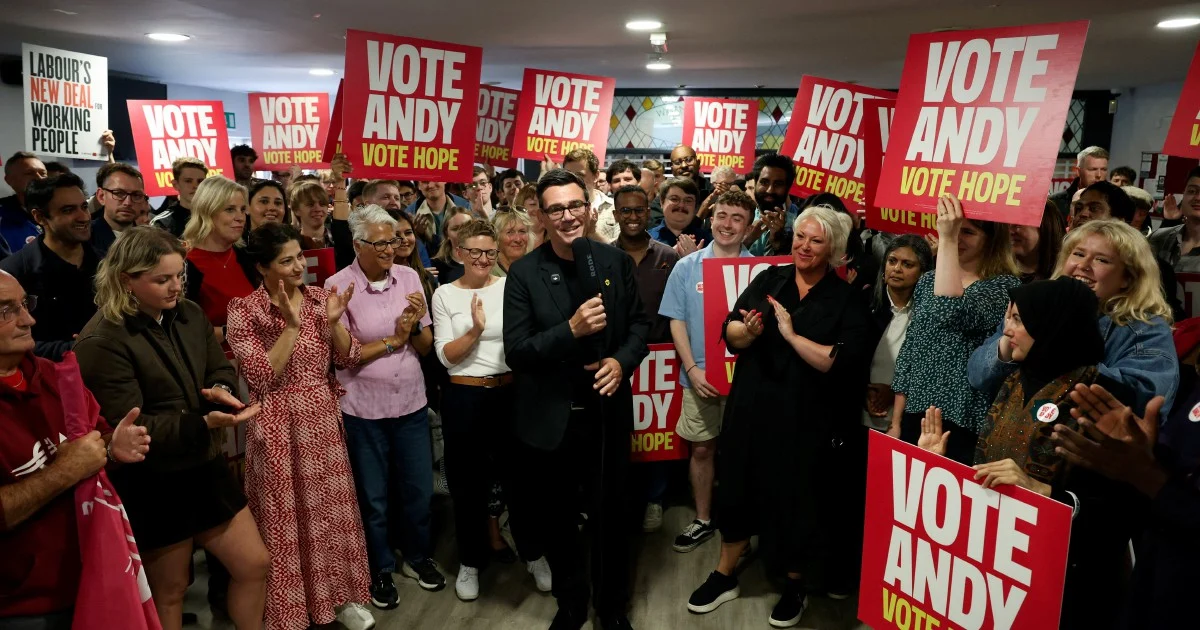
Labour politician Andy Burnham's effort to secure the Makerfield seat and position himself as a future prime minister could be significantly bolstered by an internal struggle between two competing right-wing factions that is fragmenting their electoral base. The Thursday election result in this northwest England constituency may prove pivotal not because of Burnham's individual political strengths, but rather because the Conservative Party and Reform UK are each attempting to capture populist voters, with neither side commanding sufficient consolidation to mount an effective challenge against Labour's candidate.
The splintering of right-wing votes represents a critical strategic advantage in British electoral politics, particularly under the first-past-the-post system where plurality rather than majority support determines the winner. When opposing camps fail to coordinate or unify around a single candidate, they effectively cede territory to a well-organised alternative. For Burnham, who has aspirations extending beyond his current parliamentary role to the highest office in the land, this dynamic offers an unexpected opportunity to secure a comfortable victory margin that will strengthen his credibility within Labour ranks.
Burnham's leadership credentials within the Labour Party have been developing over several years, marked by his work as mayor of Greater Manchester and his previous experience in national government. The Makerfield contest represents a crucial test of his electoral viability at the national stage, demonstrating his capacity to win and retain a seat in a traditionally working-class area. A decisive victory in this constituency, particularly one achieved through opposition fragmentation, would provide him with a concrete achievement to present to party members if he were to mount a formal challenge against Starmer or position himself as an alternative should circumstances change.
The broader context of British politics reveals the ongoing tension between traditional conservatism and the newer populist insurgency represented by Reform UK. This party, led by Nigel Farage's faction, has attracted voters dissatisfied with the Conservative Party's perceived failures on immigration, taxation, and establishment politics. The competition between these two right-wing entities for the same pool of voters creates a zero-sum dynamic where votes cast for one inevitably cannot support the other, allowing centre-left candidates like Burnham to prosper without necessarily expanding their own voter coalition.
For Malaysian and Southeast Asian observers, this British political dynamic offers instructive parallels regarding how electoral fragmentation can reshape political outcomes. In multiparty democracies across the region, similar vote-splitting phenomena occur when multiple candidates compete for overlapping voter preferences, occasionally allowing minority candidates to secure plurality victories. The Malaysian political landscape, with its more complex multi-ethnic and multi-party structure, creates different mathematical outcomes, but the principle of fragmented opposition benefiting an alternative candidate remains strategically relevant.
Keir Starmer's position as Prime Minister, meanwhile, faces scrutiny from within his own party regarding his ideological direction and capacity to deliver Labour's electoral promises. Burnham represents a more populist strain within Labour, with demonstrated appeal to traditional working-class constituencies that form the backbone of the party's electoral base. Should Burnham accumulate successive electoral victories and policy successes, he could construct a plausible narrative of being the candidate best positioned to extend Labour's appeal beyond urban, progressive metropolitan centres.
The Conservative Party's electoral difficulties extend beyond simple factional competition. Twelve years of governance before losing power to Labour in recent elections has eroded much of the party's popular support, and internal divisions over direction and identity have further weakened its cohesion. The emergence of Reform UK, rather than reuniting the right-wing vote under a single banner, has instead intensified competition and fragmented resources that might otherwise have been concentrated against Labour.
Thursday's Makerfield result will carry significance for Burnham's personal trajectory and for understanding broader trends within British centre-left politics. The result will signal whether his appeal extends beyond his existing powerbase in Manchester, and whether he can build momentum toward higher office. However, the apparent ease with which he might achieve victory due to right-wing fragmentation rather than personal magnetism raises questions about the strength and durability of any mandate he might secure.
The timing of this election in the context of Starmer's premiership is also strategically important. Should Burnham decisively win Makerfield while simultaneously building a reputation as an effective regional administrator and Labour strategist, he would position himself as an obvious successor should Starmer's position weaken or if Burnham decides to mount a formal challenge for the party leadership. In such scenarios, the Makerfield victory would serve as concrete evidence of electoral prowess and voter confidence.
Looking forward, the structural advantage that Burnham enjoys from right-wing fragmentation may not persist indefinitely. Political parties and voters sometimes consolidate around fewer options as elections approach, potentially reducing the vote-splitting effect that currently works in his favour. Alternatively, Reform UK's continued growth could force the Conservative Party into existential crisis that reshapes British right-wing politics entirely. Either development could significantly alter the political calculations that currently favour Burnham and Labour candidates across the northwest.
For observers across Asia interested in how electoral systems interact with party competition and political ambition, the Burnham case exemplifies how accidents of vote distribution, rather than purely personal appeal or policy persuasiveness, can determine electoral outcomes and shape the trajectory of individual political careers. The interplay between institutional design, party strategy, and voter behaviour creates opportunities that ambitious politicians must recognise and exploit when circumstance provides them.