%22%2F%3E%3C%2Fpattern%3E%3C%2Fdefs%3E%3Crect%20width%3D%22100%25%22%20height%3D%22100%25%22%20fill%3D%22url(%23ph54jg6g)%22%2F%3E%3Crect%20width%3D%22100%25%22%20height%3D%22100%25%22%20fill%3D%22url(%23ph54jg6p)%22%2F%3E%3Ctext%20x%3D%2250%25%22%20y%3D%2250%25%22%20text-anchor%3D%22middle%22%20dominant-baseline%3D%22central%22%20fill%3D%22rgba(255%2C255%2C255%2C0.95)%22%20font-family%3D%22Georgia%2C%20'Times%20New%20Roman'%2C%20serif%22%20font-weight%3D%22700%22%20font-size%3D%22272%22%20letter-spacing%3D%22-0.02em%22%3EAnwar%3C%2Ftext%3E%3C%2Fsvg%3E)
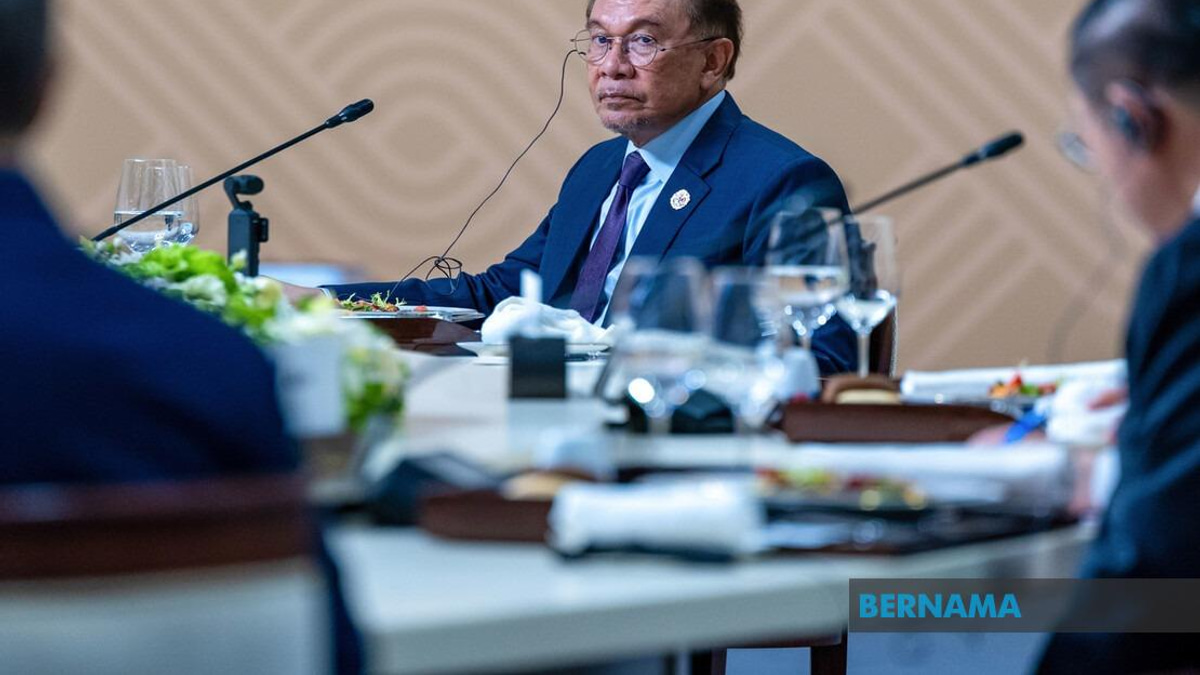
Malaysian Prime Minister Datuk Seri Anwar Ibrahim has lauded Russian President Vladimir Putin and Chinese President Xi Jinping for their advocacy of peace and their denunciations of violence inflicted on civilians across Gaza, Iran and Lebanon. Speaking during an exclusive interview with Russia's RT network while attending the Commemorative Summit in Kazan marking 35 years of ASEAN-Russia diplomatic relations, Anwar articulated Malaysia's independent foreign policy stance on the escalating regional tensions that have defined recent geopolitical developments in West Asia.
Anwar underscored Malaysia's consistent opposition to military actions undertaken by what he termed the Zionist regime, emphasizing that the nation has maintained this principled position irrespective of pressure from major powers or ideological blocs. He pointed to Parliament's bipartisan decision as evidence of Malaysia's commitment to opposing what he characterized as aggression, while simultaneously noting the country's ongoing diplomatic engagement aimed at facilitating a just resolution to the protracted conflict and its regional ramifications.
The Prime Minister revealed an extensive diplomatic outreach spanning multiple regions and stakeholders, including engagement with leaders from Gulf states, Pakistan, Türkiye, and Iran. This multilateral approach reflects Malaysia's effort to position itself as a bridge-builder and peace advocate rather than a passive observer. Anwar expressed cautious optimism that these diplomatic channels could contribute toward achieving an equitable outcome, though he acknowledged the considerable complexity inherent in navigating such contentious international disputes.
Central to Anwar's articulation of Malaysia's foreign policy framework is the concept of centrality rather than neutrality—a distinction that carries significant implications for how ASEAN nations approach geopolitical tensions. By explicitly rejecting the notion of neutrality, Anwar signaled that Malaysia refuses to remain silent or impartial when confronted with what it perceives as violations of human rights, atrocities against civilian populations, or attacks on sovereign nations. This philosophical positioning allows Malaysia to advocate for oppressed populations and condemn specific actions while simultaneously avoiding formal alliance with any particular superpower or ideological faction.
Anwar elaborated on how this principle of centrality operates in practice, explaining that it does not bind Malaysia to ideological conformity or dependency on major powers, yet it permits the nation to adopt clear positions when gross human rights violations or attacks on minorities occur. The distinction enables Malaysia to maintain strategic autonomy while fulfilling what its government views as a moral obligation to speak against injustice. This approach has become increasingly important for Southeast Asian nations seeking to preserve influence and credibility amid intensifying great power competition in the region.
The Prime Minister launched a pointed critique of what he characterized as Western hypocrisy, particularly concerning the apparent contradiction between declared international principles regarding sovereignty and the apparent acceptance of Israeli military actions backed by United States support. Anwar questioned how the international community could condemn aggression in some contexts while simultaneously condoning similar actions in others, framing this inconsistency as a fundamental betrayal of the principles underpinning modern international law and civilized discourse. His criticism extended beyond mere policy disagreement to encompass a broader challenge to the moral coherence of Western-dominated international order.
Anwar acknowledged that while Iran's military response to Israeli strikes has drawn criticism from various quarters, he contended that this scrutiny should not overshadow the broader aggression directed against Iran. He highlighted what he viewed as a disturbing asymmetry in international attention and condemnation, where Israeli and American actions receive diplomatic cover while Iranian actions face isolation and censure. This double standard, in Anwar's assessment, represents a form of systematic hypocrisy that undermines the legitimacy of international institutions and norms.
The Prime Minister's statements reflect Malaysia's broader positioning within Southeast Asia and the Global South as a nation unwilling to accept what many view as a rules-based international order selectively applied according to geopolitical interests. Malaysia's public commendation of Russia and China's stances on West Asian conflicts signals alignment with nations that challenge Western predominance in shaping international narratives and policies. For Malaysia, this positioning serves multiple strategic interests, including maintaining relationships with major powers while appealing to domestic constituencies and regional publics increasingly skeptical of Western motives.
Anwar's remarks also carry implications for ASEAN's collective approach to regional disputes and broader geopolitical tensions. By articulating a clear framework of centrality and condemning specific actions while maintaining diplomatic engagement, Anwar is essentially proposing a model that other Southeast Asian nations might adopt—one that permits principled opposition to perceived injustices without requiring formal alliance commitments or ideological subordination. This approach appears designed to preserve Southeast Asia's strategic autonomy at a time when major powers increasingly demand alignment on contentious international issues.
The emphasis on independent decision-making and bipartisan parliamentary support for Malaysia's positions underscores the domestic political dimensions of the nation's foreign policy. Anwar's framing suggests that Malaysia's stance on West Asian conflicts enjoys broad domestic consensus, strengthening the government's ability to maintain these positions despite potential pressure from Washington or its allies. The invocation of parliamentary processes and bipartisan cooperation lends legitimacy to Malaysia's diplomatic choices and suggests that this approach reflects genuine popular sentiment rather than mere elite preference.
Anwar's extensive engagement with leaders across the Islamic world, from Iran to Pakistan to the Gulf states, indicates Malaysia's aspirations to play a meaningful diplomatic role in efforts to de-escalate regional tensions. The Prime Minister positioned Malaysia as a trusted interlocutor capable of communicating across sectarian and political divides, potentially offering valuable perspectives to various stakeholders invested in preventing further escalation. This diplomatic activism aligns with Malaysia's historical role as a bridge-builder between the Muslim world and the broader international community.
Ultimately, Anwar's statements represent a deliberate articulation of Malaysia's determination to maintain strategic autonomy and moral clarity in an increasingly polarized international environment. By publicly commending Russia and China while criticizing Western policies and actions, Malaysia signals that it will not automatically align with Western preferences merely because of historical ties or economic interdependence. This positioning reflects broader shifts within Southeast Asia, where nations increasingly resist pressure to choose between competing blocs and instead seek to craft independent foreign policies grounded in national interests and principled positions on global issues.