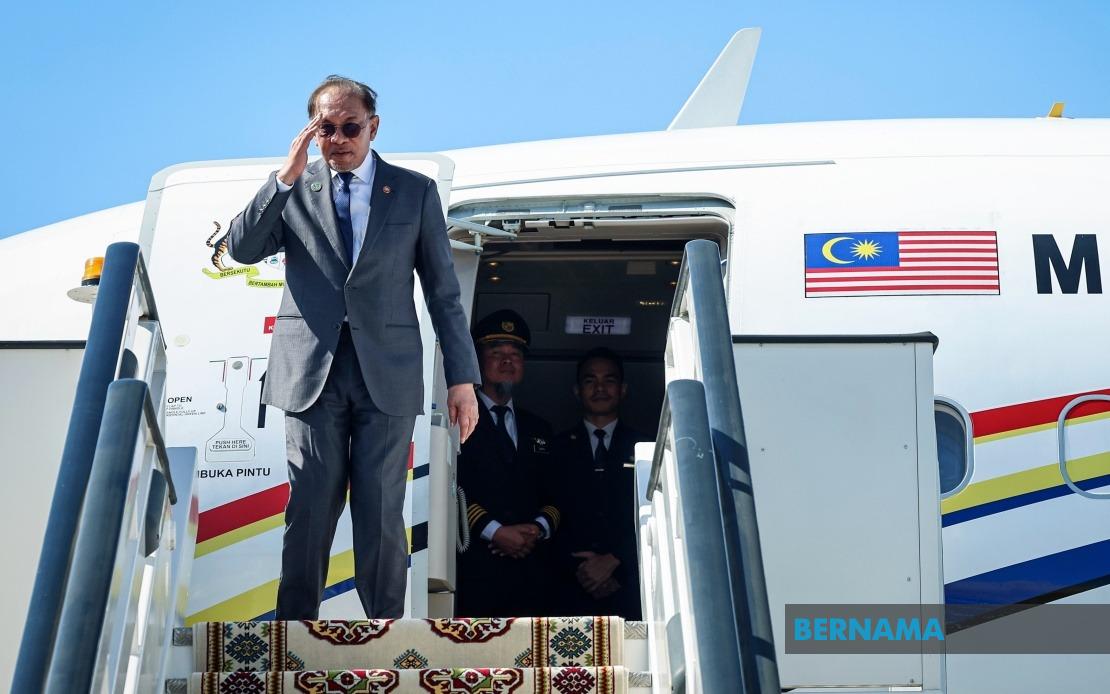
Prime Minister Datuk Seri Anwar Ibrahim transitioned seamlessly from his inaugural diplomatic mission to Turkmenistan into an action-packed working visit to Penang on June 20, demonstrating the government's parallel focus on international relations and domestic economic development. The back-to-back engagements underscore the tempo of Malaysia's engagement across multiple fronts—strengthening ties with Central Asian partners while simultaneously advancing infrastructure projects and institutional recognition at home. His departure from Ashgabat International Airport at 4.45 pm local time marked the conclusion of a two-day state visit that had begun on June 18, hosted by President Serdar Berdimuhamedov, representing Anwar's first visit to the Central Asian nation since becoming Malaysia's 10th Prime Minister in November 2022.
The Turkmenistan leg of Anwar's regional tour followed his participation in the 35th ASEAN-Russia Commemorative Summit in Kazan, Russia, underscoring Malaysia's commitment to strengthening multilateral partnerships across Asia and beyond. The Economic Minister Akmal Nasrullah Mohd Nasir and Investment, Trade and Industry Minister Datuk Seri Johari Abdul Ghani accompanied him to Russia, reflecting the coordinated approach to advancing Malaysia's trade and investment interests. This diplomatic sequence positions Malaysia as an active player in emerging geopolitical alignments, particularly as regional powers navigate shifting global dynamics and competition for influence across Asia.
Upon landing in Penang, Anwar transitioned into his domestic agenda with the opening of MKS Instruments Malaysia Sdn Bhd at Bandar Cassia Technology Park in Batu Kawan at 11 am. The facility opening represents Malaysia's continued attractiveness as a destination for advanced manufacturing and precision instrumentation companies, sectors critical to the nation's pivot toward high-value economic activities. MKS Instruments' expansion into Penang signals confidence in the state's industrial ecosystem and workforce capabilities, contributing to the Northern Corridor's broader economic diversification beyond traditional manufacturing.
The midday event transitioned into the groundbreaking ceremony for Setia Fontaines Industrial Park at 1 pm, held at the Setia Experience Centre in Bandar Setia Fontaines, Kepala Batas. This development project represents a substantial private-sector commitment to Penang's economic infrastructure, reflecting continued confidence in the state as an investment destination despite the challenging global environment. Alongside the industrial park launch, Setia unveiled two additional strategic collaborations within the Setia Fontaines township, signalling a comprehensive development approach that integrates industrial, commercial, and residential components. For Malaysian investors and policymakers, such integrated township developments increasingly represent the template for modern industrial zones, combining productivity with livability to attract both businesses and talent.
The afternoon's centrepiece event was the HAWANA 2026 Grand Finale at PICCA Convention Centre @ Butterworth Arena, a gathering anticipated to draw approximately 1,000 media practitioners from Malaysia and overseas. The National Journalists' Day celebration, organized by the Communications Ministry with Bernama as the implementing agency, provides a platform for recognizing excellence and professionalism within Malaysia's diverse media landscape. Anwar's personal attendance and active participation in presenting awards underscores the government's commitment to media recognition and the broader ecosystem that shapes public discourse and democratic participation.
During the HAWANA ceremony, the Prime Minister presented both the HAWANA Award and Special HAWANA Award to individuals whose careers have demonstrably advanced journalism standards and contributed to informed public understanding of critical issues. Beyond awards recognition, Anwar distributed contributions from Tabung Kasih@HAWANA to media professionals facing financial hardship, reflecting a social support mechanism acknowledging the economic pressures facing journalists in an increasingly fragmented media environment. This dual recognition and assistance approach addresses both the aspirational and practical dimensions of professional media work, reinforcing institutional support for the fourth estate at a time when newsrooms globally face unprecedented disruption.
HAWANA itself functions as Malaysia's premier recognition mechanism for media sector contributions, celebrating the dedication and professionalism that underpin reporting on issues ranging from governance to business, from social affairs to international relations. The ceremony's scale and ministerial attention reflect acknowledgment that a robust, professional media ecosystem remains foundational to national discourse and democratic functioning. For regional observers, Malaysia's formal institutionalization of media awards and support mechanisms contrasts with environments where journalism faces greater institutional constraints, positioning the country as relatively open to professional media practice within Southeast Asia's diverse media landscapes.
Anwar's compressed schedule reflected the demanding logistics of senior political leadership, where international commitments and domestic responsibilities often intertwine within single business trips. The progression from Turkmenistan to Penang, then onward to a Himpunan Pertubuhan Lima Generasi (PLG) Malaysia dinner in Negeri Sembilan the same evening, illustrated the intensity of prime ministerial engagement. Such condensed itineraries require substantial advance coordination across government agencies, private sector partners, and security establishments, yet they also allow leaders to address multiple constituencies and priorities without extended absences from capital-based governance responsibilities.
The Penang visit demonstrated how state-level economic development initiatives receive high-level national attention, particularly when involving significant private investment and industrial expansion. Penang's continued prominence in national economic planning reflects its historical role as a manufacturing and investment hub, though increasingly diversified toward technology, services, and higher-value production. The events Anwar attended positioned the state as central to Malaysia's industrial modernization efforts, with projects like Setia Fontaines Industrial Park representing the next generation of development approaches that integrate multiple economic functions and contemporary sustainability considerations.
For Malaysian business observers and investors, the visible alignment between industrial development announcements, government participation, and media recognition reflected integrated governance messaging around economic confidence and progress. The back-to-back facility openings and groundbreakings conveyed momentum in private-sector expansion despite challenging economic conditions, while the HAWANA event reinforced institutional commitment to professional standards and recognition across the media sector. Such coordination between different government portfolios—finance, investment, communications—under prime ministerial leadership suggests deliberate efforts to present coherent economic narratives and development strategies.
The international context underlying these domestic events merits consideration for regional audiences. Anwar's Turkmenistan visit, his first to the Central Asian nation as Prime Minister, potentially signals Malaysia's intention to strengthen engagement with economies outside traditional Southeast Asian and East Asian circles. Central Asia represents an emerging strategic focus for multiple Asian powers, with energy, trade, and connectivity dimensions that align with Malaysia's broader economic interests. The sequence of diplomatic engagement—ASEAN-Russia summit, then Turkmenistan—positioned Malaysia as an active participant in Asia-Pacific regionalism while simultaneously exploring relationships with nations on Asia's continental frontiers.
The concluding PLG Malaysia dinner in Negeri Sembilan that evening represented a return to domestic political engagement, suggesting maintenance of grassroots connections even during intensive international travel schedules. The Five Generations organization (PLG) gatherings reflect Malaysia's political culture of maintaining constituencies and support networks through systematic engagement. This rhythm of international diplomacy punctuated by domestic political participation characterizes contemporary Malaysian political leadership, balancing global engagement with domestic political constituencies and regional responsibilities within federal governance structures.