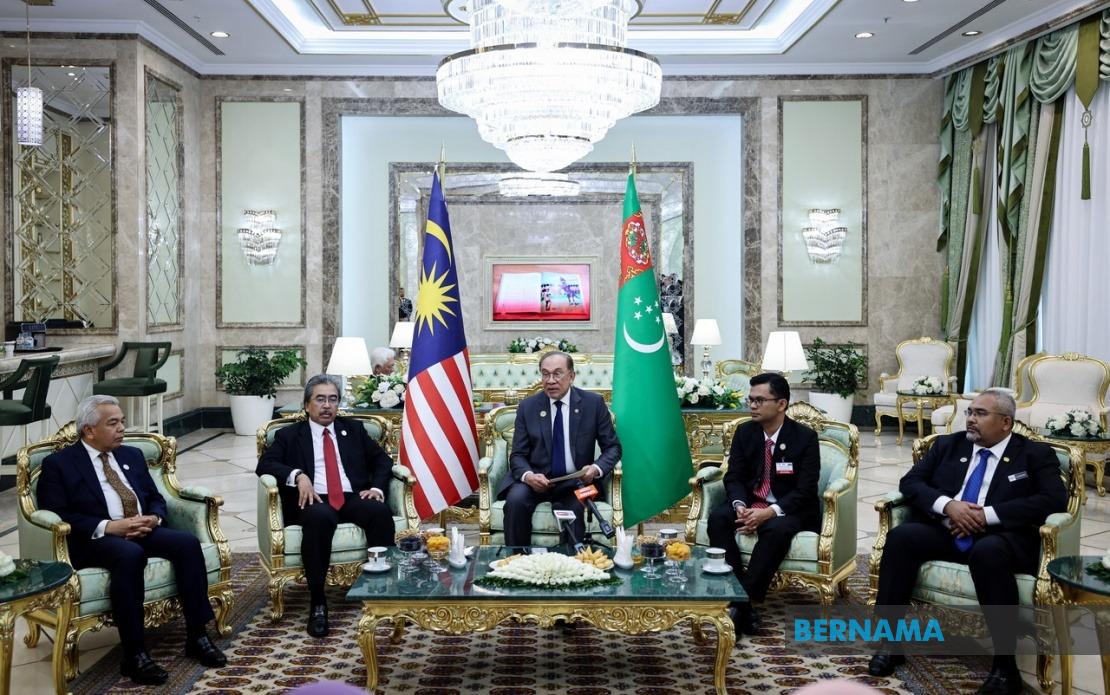
Prime Minister Datuk Seri Anwar Ibrahim has characterized his official working visit to Turkmenistan as a successful diplomatic mission that has fortified strategic cooperation between Malaysia and the Central Asian nation while opening new avenues for mutual economic advancement. Speaking on June 19 following the conclusion of his two-day engagement that began on June 18, Anwar underscored how the visit had accomplished its core diplomatic objectives and reinforced the foundation of bilateral friendship essential for sustained regional collaboration.
The visit represented Anwar's first official journey to Turkmenistan in his capacity as Malaysia's 10th Prime Minister, a position he has held since November 2022. The trip was undertaken at the formal invitation of President Serdar Berdimuhamedov, signaling the importance both nations place on direct high-level engagement and the strategic significance of their relationship within the broader context of Asian geopolitics and energy security.
Central to the discussions during Anwar's stay was the exploration of cooperative opportunities in the energy sector, an area of considerable strategic importance given Malaysia's ongoing need for diverse energy sources and Turkmenistan's substantial hydrocarbon reserves. The deliberations appear designed to position Malaysia as a strategic partner capable of tapping into Central Asian energy resources at a time when global energy markets remain volatile and diversification of supply chains represents a critical policy objective for most Asian economies.
Anwar's delegation comprised senior government officials reflecting the multidimensional nature of the bilateral engagement. Minister of Investment, Trade and Industry Datuk Seri Johari Abdul Ghani and Minister of Economy Akmal Nasrullah Mohd Nasir accompanied the Prime Minister, alongside representatives from the Prime Minister's Office and the Foreign Ministry. The composition of the delegation underscored how Malaysia approached the visit not merely as a diplomatic courtesy but as an opportunity for substantive economic and commercial advancement.
The presence of PETRONAS among the delegations participants carries particular significance, suggesting that discussions extended beyond governmental frameworks to encompass technical and commercial dimensions of potential energy collaborations. As Malaysia's national petroleum corporation and a major player in Southeast Asian energy markets, PETRONAS brings both expertise and financial capability essential for materializing any substantial energy infrastructure projects or resource development initiatives that may emerge from enhanced bilateral relations.
In his public remarks distributed through social media, Anwar extended formal appreciation to President Berdimuhamedov and the Turkmenistan government for the reception accorded to the Malaysian delegation. He also publicly recognized the contributions of various institutions and individuals instrumental in ensuring the visit's successful execution, including the Malaysian Embassy in Ashgabat, ministry personnel, security contingents, and accompanying media representatives. Such acknowledgment reflects diplomatic protocol while also recognizing the coordinated effort required for managing high-level state visits.
The characterization of the visit as opening a new chapter in bilateral cooperation suggests that previous engagements between the two nations may have been intermittent or limited in scope. For Malaysia, this pivot toward deeper engagement with Turkmenistan reflects a broader foreign policy orientation emphasizing South-South cooperation and the cultivation of partnerships across Asia that extend beyond traditional Southeast Asian frameworks. The emphasis on energy sector development aligns with Malaysia's strategic interest in securing reliable, long-term energy supplies to support industrial development and economic growth.
Turkmenistan's strategic location along historic trade routes and its significant natural gas reserves have long positioned the country as an important player in Central Asian geopolitics. For Malaysia, cultivating stronger ties with Turkmenistan potentially creates pathways for energy cooperation that could diversify Malaysia's resource dependencies while simultaneously strengthening Malaysia's diplomatic footprint in Central Asia. Such engagement also reflects recognition that economic prosperity in Southeast Asia depends increasingly on cross-continental partnerships and cooperation frameworks that transcend traditional regional boundaries.
The timing of Anwar's visit to Turkmenistan comes amid broader regional discussions about connectivity, infrastructure development, and economic integration across Asia. Malaysia's proactive diplomacy in Central Asia through this high-level engagement demonstrates the country's willingness to pursue strategic partnerships that serve national economic interests while contributing to regional stability and prosperity. The emphasis on energy sector cooperation particularly resonates given ongoing global energy transitions and the importance of maintaining stable, diversified energy supplies for Asian economies.
For Malaysian business and industry, the development of closer ties with Turkmenistan presents potential opportunities for commercial engagement, technical partnerships, and investment possibilities. The involvement of senior economic ministers in the delegation suggests that Malaysian policymakers view Turkmenistan not merely as a source of energy resources but as a potential partner for broader economic collaboration spanning trade, investment, and knowledge exchange.
The successful conclusion of this inaugural official visit under Anwar's premiership establishes a diplomatic foundation upon which deeper engagement can be constructed. Future high-level exchanges, technical working groups, and commercial missions are likely to flow from the relationship-building undertaken during this visit. For Southeast Asia more broadly, Malaysia's expanded engagement with Central Asian partners represents a regional contribution to fostering broader Asian connectivity and cooperation frameworks that strengthen the continent's collective economic resilience and geopolitical stability.