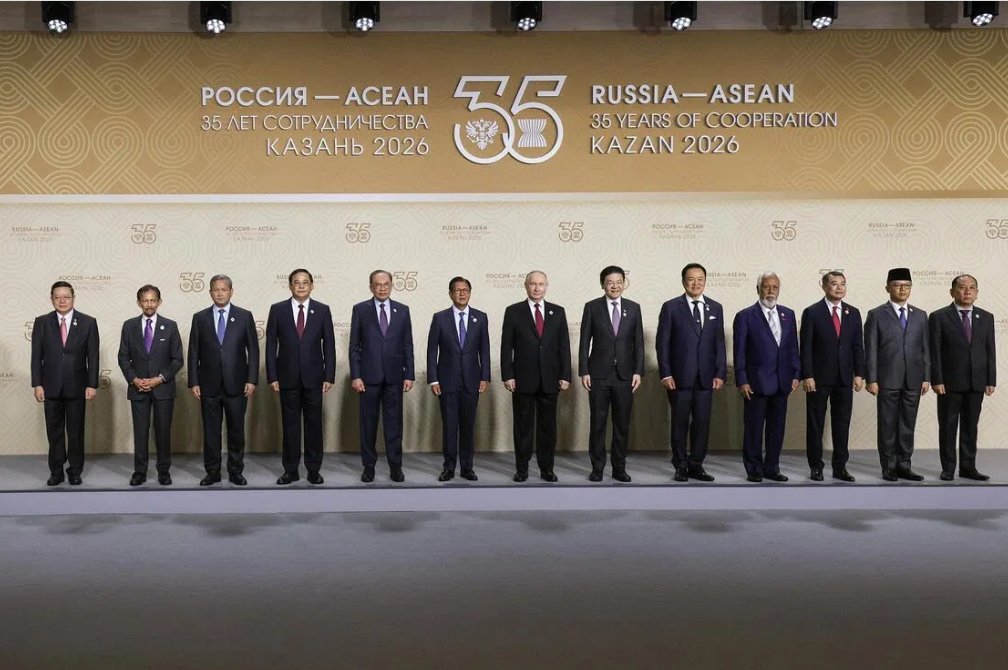
Asean and Russia have cemented their strategic partnership through a series of landmark agreements at a summit held in the Russian city of Kazan on June 17 and 18, signalling both sides' determination to expand cooperation despite broader geopolitical tensions. The Asean-Russia Commemorative Summit served a dual commemorative purpose, marking 35 years since the establishment of relations and 30 years of formal dialogue partnership, and produced three substantial outcome documents that will guide bilateral engagement through the remainder of this decade.
The centrepiece of the summit was the adoption of the Kazan Declaration, a comprehensive roadmap that reviews three-and-a-half decades of Asean-Russia relations while projecting the future direction of cooperation. The declaration embraces an expansive vision of partnership, identifying maritime security, trade and investment flows, energy collaboration, infrastructure connectivity, counter-terrorism efforts, educational advancement and cultural promotion as priority domains. Complementing this broad strategic statement, negotiators also finalised a Joint Statement on Cultural Cooperation aimed at deepening interpersonal connections between Russian and Asean citizens, along with the Asean-Russia Comprehensive Plan of Action spanning 2026 to 2030, which will translate political commitments into concrete operational initiatives.
Prime Minister Lawrence Wong, leading Singapore's delegation to the summit hosted by Russian President Vladimir Putin, positioned Asean's engagement with Moscow within the bloc's broader strategic framework of deepening internal integration while expanding external partnerships. In his address, Wong underscored that in an increasingly unpredictable geopolitical landscape, Asean and Russia should identify convergence points while collaborating on matters of mutual concern, particularly initiatives that promote dialogue, confidence-building and regional stability. He particularly welcomed Russia's endorsement of Asean Centrality, the principle that Southeast Asia should remain the driving force in regional architecture, and noted Russia's consistent participation in Asean-led mechanisms including the ASEAN Regional Forum and the East Asia Summit.
Wong seized the occasion to highlight Singapore's forthcoming leadership roles within Asean, noting that the city-state will chair the bloc in 2027 and host the ARF and EAS meetings the following year. The Prime Minister extended an invitation for Russia to participate in these forums when they convene in the Philippines later in 2024, framing Russian involvement as essential to maintaining inclusive dialogue and preventing regional polarisation. This positioning reflected a careful diplomatic balance, with Singapore keen to preserve channels with Moscow while maintaining its broader commitment to rules-based international order.
Beyond security and political frameworks, Wong identified practical areas where Asean and Russia could generate tangible benefits for their populations. Disaster management emerged as one such domain, with Southeast Asia's vulnerability to typhoons, flooding and other natural calamities intersecting with Russian expertise in emergency response and recovery. Similarly, both sides recognised the utility of cooperating on drug trafficking and substance abuse, transnational challenges that impose heavy social and economic costs across the region. The Prime Minister also highlighted educational and cultural exchanges as foundations for deeper people-to-people understanding, noting that Russian civil servants regularly participate in capacity-building programmes within Asean member states including Singapore.
Singapore's diplomatic messaging at the summit attempted to thread a delicate needle on contentious international issues. While avoiding direct condemnation of Russia's actions at the summit itself, Wong reiterated Singapore's longstanding principled positions on Ukraine and the Middle East. He emphasised that Singapore's approach to the Ukraine conflict stems not from alignment with any particular power but from consistent application of international law principles regarding sovereignty and territorial integrity. Similarly, he framed Singapore's welcoming of the United States-Iran peace agreement as reflecting hopes for de-escalation and restoration of freedom of navigation in vital sea lanes like the Strait of Hormuz, concerns directly relevant to Southeast Asia's maritime prosperity and security.
The underlying tension in Singapore's approach reflects the complex position many Southeast Asian nations inhabit in an era of great power competition. Singapore has previously imposed sanctions on Russia and condemned its invasion of Ukraine as violating international law, positions that remain formally unchanged. Yet the commitment to engaging Russia at senior levels, adopting five-year cooperation plans and maintaining dialogue demonstrates that Asean states view sustained communication with Moscow as preferable to isolation. This pragmatic compartmentalisation allows for cooperation in specific domains while maintaining principled stances on international law, a balancing act increasingly central to Southeast Asian statecraft.
Wong's bilateral meeting with Putin on the summit's margins provided an opportunity for direct engagement on both bilateral matters and wider regional and international developments. In public remarks shared via social media, Wong characterised their discussion as illustrative of dialogue's value even when nations hold divergent views on specific questions. He reaffirmed Singapore's valuation of long-standing relationships with Russia and the Russian people, and reiterated willingness to identify additional avenues for cooperation aligned with mutual interests. This messaging sought to position Singapore as committed to maintaining mature, pragmatic relations with Russia independent of broader geopolitical alignments, a posture increasingly important for Southeast Asian credibility in navigating between competing power blocs.
Beyond the bilateral Asean-Russia framework, Wong also met with Rustam Minnikhanov, the head of Russia's Tatarstan republic, reflecting the multilayered nature of contemporary interstate engagement. Singapore and Tatarstan maintain longstanding ties tracing back to a 2007 visit by then-Minister Mentor Lee Kuan Yew, and the June meeting enabled discussion of expanded cooperation in cultural exchanges, educational partnerships and people-to-people connections. Such subnational diplomatic channels increasingly matter in a world where cities and regions pursue distinct foreign policies and international engagement strategies, and Singapore has long positioned itself as an attractive partner for regional actors seeking diverse international relationships.
The summit outcomes carry significance for Malaysia and other Southeast Asian nations as they navigate intensifying strategic competition. The five-year cooperation plan signals that despite geopolitical headwinds and international sanctions, Russia remains committed to sustained engagement with Asean rather than turning inward or pivoting exclusively toward China and India. For Southeast Asian countries balancing relationships with major powers, this demonstrates that multiple partnership frameworks can coexist. The emphasis on maritime security, energy cooperation and connectivity reflects Russia's recognition that Southeast Asia represents an economically dynamic region with growing influence in global affairs, worthy of sustained high-level engagement even amid international isolation on specific issues.
More broadly, the Kazan summit illustrates Asean's capacity to maintain inclusive regional architecture and diplomatic flexibility despite external pressures toward alignment and polarisation. While Western nations have sought to isolate Russia following its Ukraine invasion, Asean's approach demonstrates that Southeast Asian states view their regional autonomy and capacity for independent foreign policy as fundamental interests that supersede pressure to choose sides in great power contests. The adoption of substantive cooperation frameworks suggests both Asean and Russia view this relationship as strategically valuable beyond symbolic gestures, with real potential for collaboration in areas ranging from energy security to educational development that can benefit both sides' populations regardless of broader geopolitical tensions.