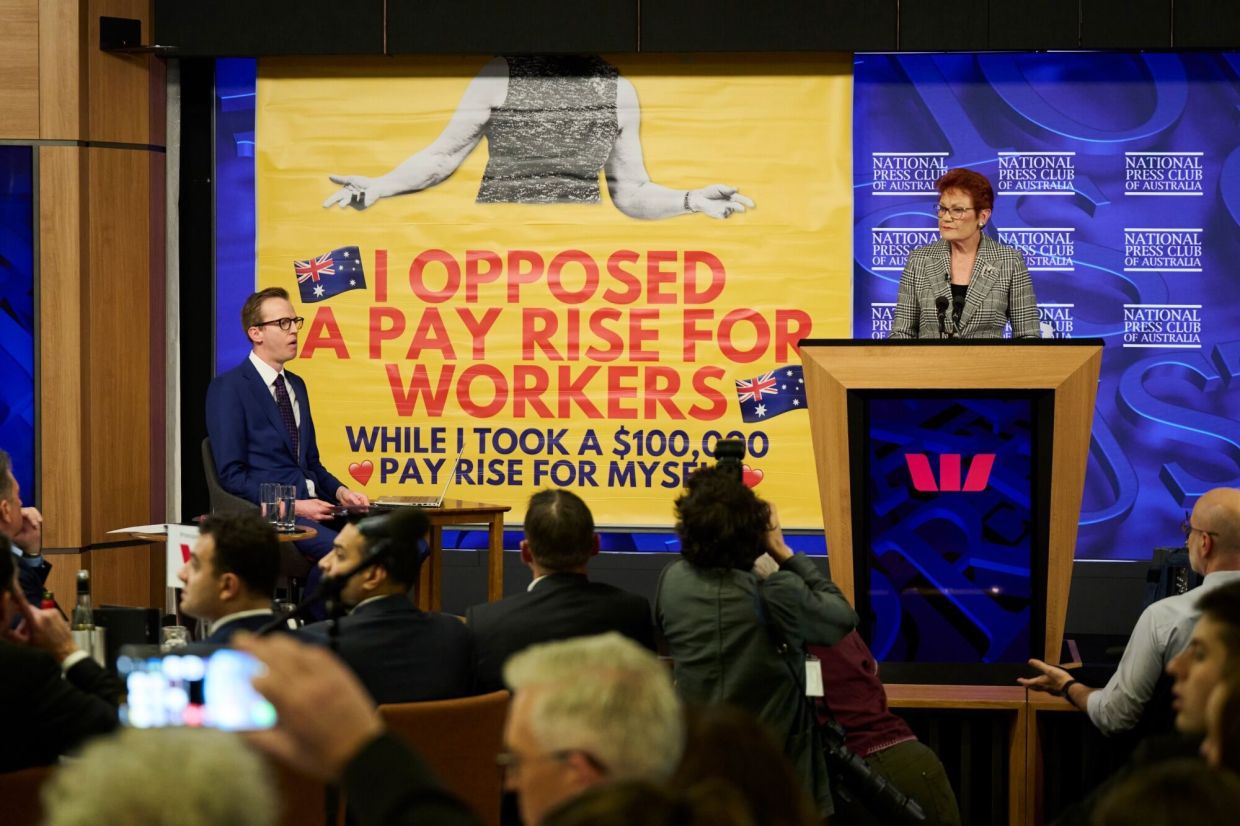
Pauline Hanson, leader of Australia's hard-right One Nation party, has made a forceful pitch for cultural uniformity in the country, declaring that while Australia can accommodate people of different races, it must operate under a single cultural framework. Speaking at the National Press Club in Canberra on Wednesday, Hanson articulated a vision fundamentally at odds with decades of Australian multicultural policy, characterising the approach as fundamentally flawed and unworkable for the nation's future. Her remarks represent a significant moment in her three-decade political career, marking her first appearance at the influential venue despite decades of political activity.
The One Nation leader framed her argument around Australia's deepening housing affordability crisis, positioning unchecked immigration as the primary culprit driving competition for limited housing stock and inflating property values beyond the reach of ordinary Australians. This framing has proven politically resonant, tapping into widespread community anxiety about housing costs that have become a defining economic challenge for younger generations and first-time buyers across the country. By linking immigration directly to tangible economic hardship, Hanson has moved the immigration debate beyond cultural concerns to focus on bread-and-butter economic pressures that affect household finances.
In her National Press Club speech, Hanson pledged to dramatically reduce migration numbers and implement more restrictive entry policies targeting specific groups. She specifically referenced people "from places immersed in extremism like radical Islam," signalling that her immigration platform encompasses both volumetric restrictions and ideological screening of prospective migrants. This dual approach combines numerically-driven limits with values-based admission criteria, a combination that appeals to voters concerned about both labour market competition and cultural integration.
One Nation's electoral fortunes have shifted markedly in recent months, with the party gaining substantial ground in opinion polling throughout the past year. This surge accelerated notably following May of the previous year, when the centre-right coalition government's political position collapsed, creating space in the political landscape for populist challengers. The timing has proven advantageous for Hanson, allowing One Nation to position itself as an alternative to both the governing Labor party and the traditional centre-right opposition.
The broader economic environment has substantially amplified One Nation's political prospects. Australians have endured a difficult period characterised by renewed inflation pressures, rising interest rates that have increased mortgage repayments for hundreds of thousands of homeowners, and elevated fuel costs partly attributable to geopolitical tensions involving Iran. These interconnected economic headwinds have created genuine hardship for many households, particularly those with mortgages, car-dependent lifestyles, and fixed incomes vulnerable to inflationary erosion. One Nation has capitalised on this discontent by presenting immigration and green energy policies as contributing factors to economic difficulty.
Hanson's narrative frames these economic challenges as consequences of policy failures rather than broader structural or global factors. She has identified multiculturalism, immigration levels, and environmental policy commitments as causes of contemporary economic distress, offering her party's proposed restrictions and policy reversals as solutions to inflation, interest rates, and fuel costs. This approach provides voters with identifiable targets for their economic frustration and proposed remedies, even where the causal connections may be contested or overstated.
Prime Minister Anthony Albanese's Labor government has attempted to address economic pressures through targeted fiscal interventions. The administration implemented a temporary reduction in fuel excise taxes to ease petrol pump pain for motorists, and has pursued broader tax reform initiatives aimed at improving housing affordability by increasing supply and reducing barriers to purchase. These measures reflect an orthodox economic policy response to cost-of-living pressures, focusing on supply-side solutions and temporary demand-side relief.
Albanese has characterised the rise of One Nation and similar movements as symptomatic of deeper discontent with economic performance and policy effectiveness. He has pointed to what he terms "simplistic grievance-based politics" as a predictable reaction when economies fail to deliver broadly shared prosperity and when significant segments of the population experience stagnant or declining living standards. From this perspective, Hanson's One Nation represents not an ideological movement with independent appeal, but rather a symptom of economic dysfunction and community anxiety about diminishing opportunity.
The tension between these interpretations—whether One Nation's rise reflects genuine policy failures around immigration and multiculturalism, or represents a political response to economic stress that may be misdirecting responsibility—shapes current Australian political debate. For Malaysian observers, the Australian experience offers instructive parallels and contrasts regarding immigration policy, multiculturalism, and political populism in diverse societies.
Malaysia's constitutional framework explicitly protects Malay-Muslim cultural and religious interests while simultaneously accommodating significant non-Muslim and non-Malay communities, a fundamentally different approach from both traditional Australian multiculturalism and Hanson's proposed monoculturalism. The Australian debate nonetheless resonates across Southeast Asia, where several nations grapple with similar tensions between immigration's economic benefits and cultural integration challenges, and where economic anxiety sometimes manifests in anti-immigration sentiment.
The Australian case also illuminates how economic hardship can rapidly shift political coalitions and amplify voices previously marginalised in mainstream political discourse. One Nation's polling surge coincides precisely with deteriorating economic conditions, suggesting that electoral volatility and receptiveness to populist messaging correlates strongly with economic performance. This dynamic extends beyond Australia, affecting democratic societies throughout the region and globally where cost-of-living pressures mount and governments struggle to deliver broad-based prosperity.