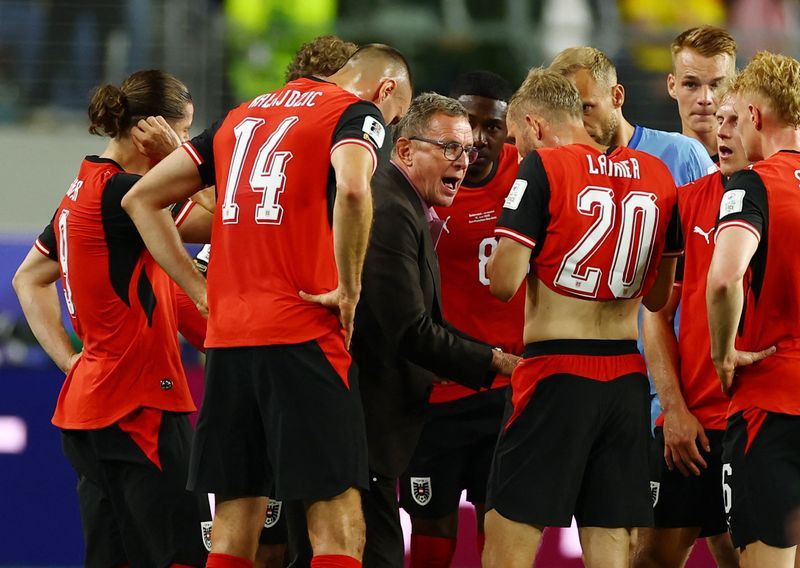
Austria's manager Ralf Rangnick used his team's hard-fought 3-1 victory over Jordan in Santa Clara on Tuesday to underscore an emerging reality of contemporary international football: the gap between established powerhouses and emerging nations has narrowed considerably. The Austrian outfit, riding high on the back of a strong Euro 2024 campaign, found themselves pushed to the brink by a Jordan side making their World Cup debut, ultimately requiring a second-half penalty from substitute Marko Arnautovic in the 12th minute of stoppage time to secure all three points.
The match revealed vulnerabilities in Austria's defensive setup that will concern the coaching staff ahead of their Group J encounter with Argentina, the group leaders who comprehensively defeated Algeria 3-0. Despite entering the contest as clear favourites against newcomers to the tournament, Austria struggled to assert the kind of dominance expected of a side competing at football's biggest stage. Jordan's tactical discipline and willingness to press forward with purpose created genuine difficulties for their opponents, suggesting that World Cup debutants no longer arrive as naive participants.
Rangnick was magnanimous in his post-match assessment, attributing his team's subdued performance largely to the opposition's quality rather than any Austrian shortcomings. When questioned about the reasons for his side's uninspired display, he deliberately shifted focus to Jordan's contribution. "I think it's due to the opponent," he explained, acknowledging that the Jordanian outfit had executed their game plan with conviction and intelligence. The coach elaborated that Jordan had performed far beyond what many observers might have anticipated from a World Cup newcomer, demonstrating tactical maturity and courage in their approach to the match.
The Austrian manager expressed particular satisfaction with the tournament's expansion to 48 teams, viewing the format change as fundamentally positive for global football development. This structural shift ensures that more nations gain exposure at the sport's premier competition, creating opportunities for countries to test themselves against elite opposition and accelerate their footballing evolution. Rangnick characterised this as "an enriching experience" for international football, suggesting that the competitive benefits extend beyond the participating nations to the tournament itself.
However, Rangnick was careful to push back against any suggestion that the expanded format had diluted competitive standards. He pointed instead to concrete evidence from the tournament that smaller nations were performing with genuine quality. Spain's unexpected draw with Cape Verde, Australia's impressive victory over Turkey, and Haiti's resilient showing against Scotland all served as examples supporting his contention that there are no longer truly inferior opponents in modern World Cup football. These results reflected not fortune or upsets in the traditional sense, but rather the genuine progress made by developing footballing nations.
The Austrian coach's observation touches on a broader technical reality in international football over the past 15 years. Smaller nations have invested heavily in youth development structures, coaching education, and access to statistical analysis and sports science. This democratisation of football knowledge has allowed countries with smaller populations and fewer resources to compete far more effectively than in previous decades. Rangnick's comments suggest that Austria's coaching staff recognised these developments intellectually before the match, though the reality of facing a determined Jordan side provided a stark practical reminder.
Rangnick's remarks also reflect a philosophical acceptance that tournament success in the modern era requires adapting expectations and respecting opposition. He stressed that "it's not that easy to win during this tournament," emphasising that with 48 teams competing, every match presents genuine obstacles. This represents a significant shift in mentality from the era when larger nations could expect relatively straightforward passage through group stages, with only the knockout rounds presenting serious challenges. The expanded format has essentially compressed the tournament competitively, ensuring that focused, well-organised teams can trouble the traditional heavyweights.
Austria's narrow escape against Jordan raises interesting questions about their capacity to compete with Argentina in their next fixture. While Rangnick can take satisfaction from securing victory despite an uneven performance, the manner of that win—relying on a late penalty—suggests that his team must improve their efficiency in open play and their defensive solidity. The fact that a World Cup debutant pushed an established side so close indicates that the tournament's competitive level has shifted, and teams can no longer rely on reputation or pedigree alone to secure victories.
The narrative of this match also resonates across Southeast Asian football, where nations like Malaysia and other regional competitors aspire to reach World Cup tournaments. Rangnick's acknowledgement that smaller nations have genuinely improved provides hope that with proper investment and strategic planning, emerging football nations can compete credibly at international level. Jordan's display offers a template for how disciplined tactics and collective effort can trouble better-resourced opponents, even in the absence of individual superstars or vast domestic leagues.
Moving forward, Austria must address the defensive frailties exposed by Jordan's attacking play before facing Argentina. Rangnick's diplomatic praise for the opposition masks the reality that his team underperformed and got lucky to escape with three points. The 48-team format has fundamentally altered World Cup dynamics, removing any assumption of easy matches and requiring every side to perform at their best consistently. For Austria, this means tightening their defensive shape and improving ball retention if they are to progress from a group containing the tournament's strongest sides.